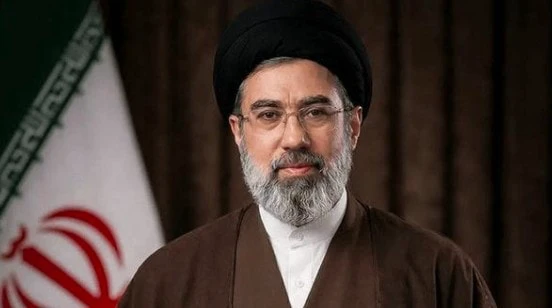
Iran’s new Supreme Leader, Mojtaba Khamenei, in his first statement since his appointment, said that the Strait of Hormuz must remain closed as leverage against the US and that the attacks on Middle East neighbours will continue.
Khamenei’s statement was read on state television on Thursday by a news anchor, and he did not appear on camera.
He warned that US military bases could be attacked if they remain operational in the region. “All US bases should be immediately closed in the region,” he said.
The Iranian leader vowed to avenge those killed in the war and claimed that Iran would “obtain compensation” from its enemy. He said that if it refuses to do so, Iran will “take from its assets” or destroy them to the same extent.
Iran’s Three Conditions To End War
On the same day, Iranian President Masoud Pezeshkian outlined three conditions for ending Iran’s ongoing conflict with the United States and Israel.
Laying out the terms, Iranian President Masoud Pezeshkian said any resolution must recognise Iran’s legitimate rights and guarantee that the country will not face future attacks.
In a post on social media platform X, Pezeshkian also demanded compensation for damages incurred during the war.
“Talking to leaders of Russia and Pakistan, I reaffirmed Iran’s commitment to peace in the region. The only way to end this war–ignited by the Zionist regime and US–is recognising Iran’s legitimate rights, payment of reparations, and firm international guarantees against future aggression,” he wrote.
Iran’s ‘Economic’ Revenge
Iran’s unrelenting attacks on shipping traffic and energy infrastructure in the Persian Gulf pushed oil back above $100 a barrel on Thursday, as American and Israeli strikes pounded the Islamic Republic with no sign of an end to the war in sight.
Iran is trying to inflict enough global economic pain to pressure the United States and Israel to halt their bombardment, which started the war on February 28. Iran’s president said its attacks would continue until Iran gets security guarantees against another assault, indicating that even a ceasefire or US declaration of victory might not halt the conflict.