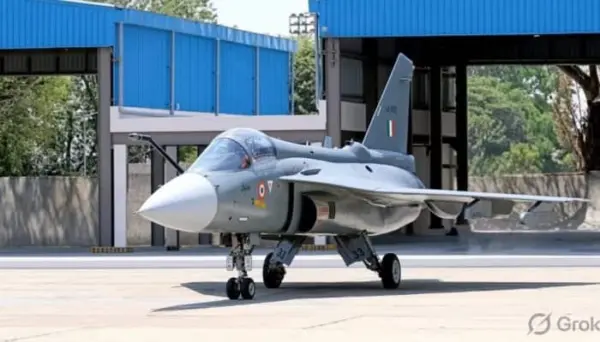
Air Marshal Nagesh Kapoor (Retd) has earned the right to speak his mind. He served the Indian Air Force with distinction and retired only recently as Vice Chief.
So when he told NDTV that the Tejas is being denied to the force on one pretext or another, and that the IAF is hamstrung because someone somewhere has not kept promises, his words carry the weight of a man who has lived through squadron shortages. Yet the picture he paints is incomplete, and in places unfair. It treats Hindustan Aeronautics Limited as a lone failure, when Indian defence procurement is far messier, far more constrained, and far more collective than that.
Look closely at the Tejas Mk1A story. The IAF ordered 83 aircraft in 2021 and later added 97 more, taking the total to 180. HAL has built airframes. Production lines in Bengaluru and Nashik have been expanded. Private partners now make fuselage and wing sections. What has held the programme back is not merely a lack of urgency inside HAL. The single biggest bottleneck has been the late arrival of GE F404-IN20 engines from the United States. Think of the engine as the heart of a fighter; the body may be ready, but without a heart it cannot fly. Those engines were contracted years ago, delivery slipped by more than two years, and even after some arrived, quality problems appeared. HAL has invoked penalties against GE.
There is more. Mission software for a modern fighter must be tested again and again before a pilot’s life depends on it. Certification cannot cut corners on safety. The Air Force itself keeps sharpening its requirements as technology and threats change, and that is its right, but every change adds months. The Ministry of Defence has warned HAL at times, yes, but it also writes the rules HAL must follow. So this is not a simple tale of one public sector company dragging its feet. It is a tale of dependence on a foreign supplier, of safety standards that refuse to bend, and of a customer that rightly wants a fully capable aircraft, not a half-ready one.
To blame HAL alone while ignoring these outside constraints is to misunderstand how defence procurement works here. Public sector units do not write their own rules. They work under government policy, under offset conditions, under Make in India directives that still leave critical items like engines outside our control, and under a service whose needs keep evolving. It is the classic case of tying a heavy stone to a runner’s leg and then shouting because he is losing the race. Kapoor knows this system from the inside. That is exactly why the narrow focus on HAL’s promises is so surprising.
None of this means HAL is blameless. It is not. The organisation carries an old working culture that can be bureaucratic, risk-averse and slow to own its timelines with the same intensity the user service feels. Accountability is often diffuse. Decisions take longer than they should. Communication with the customer has not always been crisp. These are real problems. The new Chairman and Managing Director, Ravi Kota, known inside the system as the LCA man for his deep involvement in Tejas has a clear job. He must tighten the organisation and make every division, every programme manager and every decision-maker answerable for the commitments they give.
Culture does not change with slogans. It changes when missed internal deadlines carry consequences, and when delivery pressure is felt as sharply on the shop floor as it is in Air Headquarters. Kota’s record on the Tejas contracts and on getting the earlier fleet operational gives him the standing to demand that change. He should use it without apology. But accountability and support are not opposites. The Air Force cannot keep treating HAL as the permanent villain and still expect indigenous capability to mature.
Strategic autonomy is not built by expressing disappointment and then looking abroad for the next stop-gap. China can field large numbers of J-20s because it poured decades of focused state power, industrial scale and technology acquisition into the effort. India’s path has been different, more democratic, more blocked by technology denial regimes, more dependent on licensed production and imported engines. That does not make Tejas a failure. It makes the delays painful but understandable. The Mk1A will still be a capable 4.5-generation fighter with modern sensors and weapons.
The Mk2 will fill the large middle of the force that no country of India’s size can cover with costly fifth and sixth-generation jets alone. Joining European projects like FCAS or GCAP deserves study, but it cannot replace finishing what we have begun at home. Walking away only makes us permanent buyers. The stone was not tied by HAL alone. Support with uncompromising accountability remains the harder, wiser road.