In the last 107 hours, the Indian women’s cricket team has lived at the eye of a storm. Some of it was self-inflicted, perhaps, having declined to receive the Women’s Asia Cup trophy from Mohsin Naqvi, the ACC’s sitting president but, more pointedly, Pakistan’s interior minister.
That controversy aside, India also reduced the final itself to a formality, dispatching Sri Lanka by 72 runs, before embarking on a near-8,000-kilometre odyssey – Dubai to Delhi first, and eventually on to Nagoya.
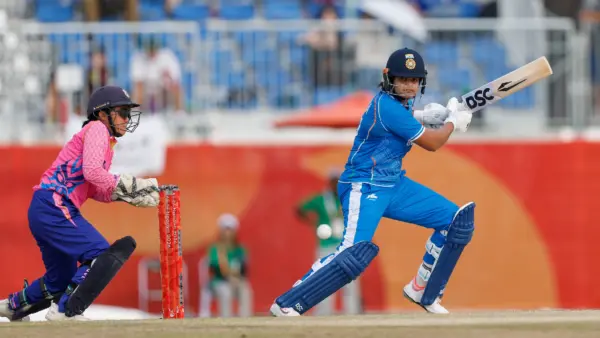
Against that backdrop, Harmanpreet Kaur’s team could dearly have done with a campaign opener that did not demand much out of the players. They got precisely that in the fourth quarter-final of the women’s cricket competition at the 2026 Asian Games. Bowling hosts Japan out for 57, India strolled to the target inside five overs, shedding only two wickets along the way.
For Japan, whose men’s team are themselves gearing up for a one-off T20I against India in Sano on September 22, an opportunity to play against the current 50-over world champions came as a rare platform to showcase their potential. The opening pair of Haruna Iwasaki and Ayaka Kato-Strafford made the most of that platform, scoring 24 in the powerplay, but crucially, without either’s departure.
But that was the full extent of the moral victory Japan could claim. The next 33 runs cost all ten remaining wickets, as Sree Charani – the world’s top-ranked T20I bowler – turned the contest into a massively lopsided duel. The left-arm spinner took four wickets for 10 runs, while Shafali Verma, who has recently made a strong case to be used more often with the ball by Harmanpreet, having scalped two wickets at the Asia Cup, chipped in with 2/13.
For Japan, Ayaka Kato-Strafford was the leading run-scorer with a 47-ball 25, albeit the first metric can be ignored when playing against a team placed 36 slots higher in the ICC women’s T20I team rankings. Born in Brisbane to an Australian father and a Japanese mother, Ayaka has also represented Australia U-19 – making her debut at merely 15 – while her brother, Kazuma Kato-Strafford, plays as an all-rounder for the Japan men’s team.
In the chase, nearly one-third of the target was scored in the first over itself, with Shafali accumulating 17 against Ahilya Chandel, whom she has previously faced in the nets of Delhi Capitals. The next over brought Japan a rare moment of unbridled joy, as Nonoha Yasumoto trapped G Kamalini for a golden duck.
In the next over, Ayaka proved her game extends well beyond the bat, as she dismissed Bharti Fulmali. While the wicket is of little significance in the context of the game, Fulmali not getting to cumulative triple-figure in international cricket despite having already played 13 T20Is will be a cause of concern for the Indian team.
The other concern could be their next opponents – Bangladesh. No side came remotely close to troubling India through the Asia Cup, but Bangladesh ran them closest, and might well have engineered an upset but for five dropped catches. Should Nigar Sultana Joty’s side prove less charitable this Sunday, India will need to be at their best.
Brief Scores: Japan 57 all out in 19.5 overs (Ayaka Kato-Stafford 25; Sree Charani 4/10) lost to India 59/2 in 5 overs (Shafali Verma 40 not out; Nonoha Yasumoto 1/8) by 8 wickets.