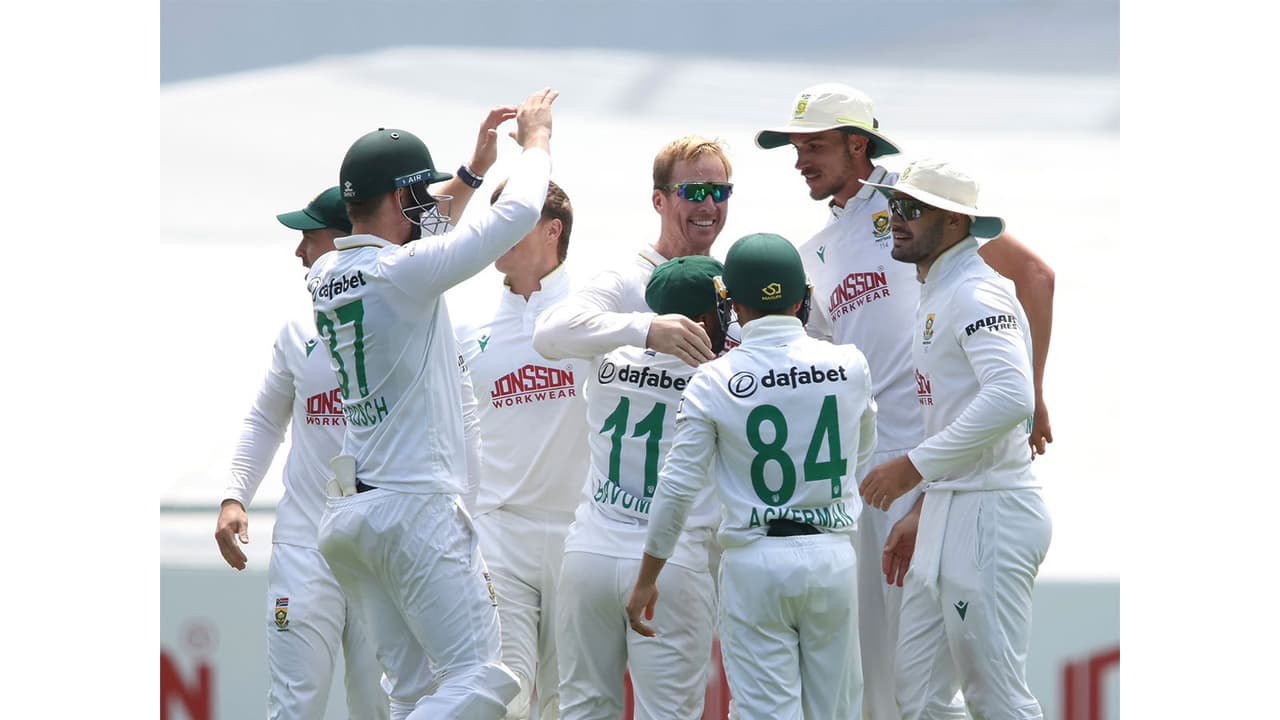
South Africa clinched a 2-1 Test series win over Australia at Newlands, with Simon Harmer’s 6/16 bowling performance securing the victory and moving South Africa to the top of the ICC Men’s Test rankings.
South Africa Clinches Test Series
South Africa defeated Australia by 176 runs in the third and final Test at Newlands on Saturday to clinch the three-match series 2-1, with Simon Harmer claiming six wickets for 16 runs to dismantle the visitors’ second innings on the final day. Chasing a target of 288, Australia were bowled out for 111 in their second innings, with off-spinner Harmer returning career-best figures of 6/16 and fast bowler Rabada claiming 3/39. Harmer also completed a 10-wicket haul in the match, while Rabada reached the landmark of 350 Test wickets. With this victory, the Temba Bavuma-led South Africa became the number one side in the ICC Men’s Test rankings.
The Final Day Collapse
Australia resumed their chase on the fifth day and suffered an immediate collapse. Rabada removed Matt Renshaw for a duck, Marnus Labuschagne for four and Travis Head for 14, leaving the visitors struggling at 22/3. Josh Inglis was run out for four to leave Australia at 40/4. Harmer then took control, dismissing Alex Carey for two and Cooper Connolly for a duck before removing Mitchell Starc, who also failed to score. Australia slipped to 60/7. Green, who made 27, was the next to fall, bowled by Harmer as Australia reached 62/8. Cummins offered resistance with an 11-run contribution from 90 balls before he was trapped leg-before by Harmer at 107/9. Josh Hazlewood was bowled for a duck to bring the innings to a close at 111, handing Harmer his sixth wicket of the innings.
The Second Innings Recovery
The victory followed a significant recovery by South Africa in their second innings. After conceding a 100-run first-innings lead, the hosts were bowled out for 387, setting Australia a target of 288. Ryan Rickelton and Wiaan Mulder were the architects of that recovery, scoring 101 and 115 respectively. Rickelton faced 219 deliveries and struck 12 boundaries, while Mulder’s 221-ball innings included 10 fours and four sixes. Their partnership helped South Africa turn a precarious position into a strong total. Marques Ackerman also contributed with 62, while Matthew Breetzke scored 43 and captain Temba Bavuma made 35. Mitchell Starc picked up three wickets for Australia, while Pat Cummins took two.
First Innings Context and Historical Significance
Australia had posted 429 in their first innings, securing a 100-run advantage after South Africa were dismissed for 329. Josh Inglis led the visitors with 102, while Matt Renshaw scored 74, Cameron Green made 65 and Alex Carey added 80. Simon Harmer took four wickets in that innings, while Marco Jansen claimed three. South Africa’s first innings included contributions from Ackerman, who scored 95, Aiden Markram (78), Marco Jansen (52) and David Bedingham (50). Starc was Australia’s most successful bowler, finishing with six wickets for 72 runs.
South Africa’s second-innings fightback, followed by Rabada’s early strikes and Harmer’s decisive spell on the final day, completed a turnaround in the series and secured a 2-1 victory for the hosts. Harmer became the third South African spinner to claim a 10-wicket haul in a Test against Australia, joining Charlie Llewellyn, who took 10/116 in Johannesburg in 1902, and Hugh Tayfield, who returned figures of 13/165 in Melbourne in 1952. Harmer finished with match figures of 10/120 in Cape Town in 2026, becoming the first South African spinner to take a 10-wicket haul in a Test at Newlands.
Kagiso Rabada has continued his impressive record against Australia in Test cricket. In 13 Tests against the visitors, the fast bowler has taken 68 wickets at an average of 21.88 and a strike rate of 38.1, including four five-wicket hauls. Only Dale Steyn, with 70 wickets, has taken more Test wickets for South Africa against Australia. Among seam bowlers with at least 50 wickets against Australia this century, only India’s Jasprit Bumrah, with an average of 17.15, has a better bowling average than Rabada. At Cape Town, Rabada has claimed 56 wickets at an average of 22.46, second only to Steyn’s 74 wickets at 21.75 at Newlands.
The series also highlighted Australia’s difficulty in handling short-pitched bowling. Australia lost nine wickets to short balls from pace bowlers in the series at an average of 37.9, while South Africa lost 17 wickets at an average of 26.8. Since 2023, South Africa have averaged just 29.7 against short balls from seamers in Test cricket, the third-lowest among 12 Test-playing nations, ahead of only Afghanistan (21.9) and Zimbabwe (26.8).
South Africa’s latest series victory continues their strong record against Australia at home since 2012. South Africa won the 2012 series 1-0, with two matches drawn, before Australia claimed the 2014 series 2-1. South Africa then won the 2016 series 2-1 and the 2018 series 3-1. Australia bounced back with a 2-0 series victory in 2022, with one match drawn, but South Africa have now reclaimed the advantage with a 2-1 win in 2026. Australia have not won a Test series in South Africa since 2014.
The victory at Newlands was also significant as South Africa won at Cape Town after being asked to bat first for only the third time. Their previous victories at the venue after batting first came against Sri Lanka in 2012 and 2017. Australia also suffered a rare series reversal after winning the opening Test. They have previously lost a three-match Test series after winning the first match against England in 1882-83 at home, against England in 1888 away, and against India in 2001 away. The 2-1 defeat to South Africa in 2026 is now the fourth such instance. Australia have also lost consecutive Tests for the first time since going down in the opening two matches of the 2023 Border-Gavaskar Trophy. Australia’s second-innings total of 99 at Gqeberha in 2026 is among their lowest all-out totals in South Africa. Their lowest remains 47 at Cape Town in 2011, followed by 75 at Durban in 1950. The other totals in the list are 107 at Cape Town in 2018 and 108 at Gqeberha in 1997. (ANI)
(Except for the headline, this story has not been edited by Asianetnews Editorial staff and is published from a syndicated feed.)