
Pipe Network said the attack peaked at roughly 6 terabits per second, ranking fourth among publicly disclosed DDoS events.
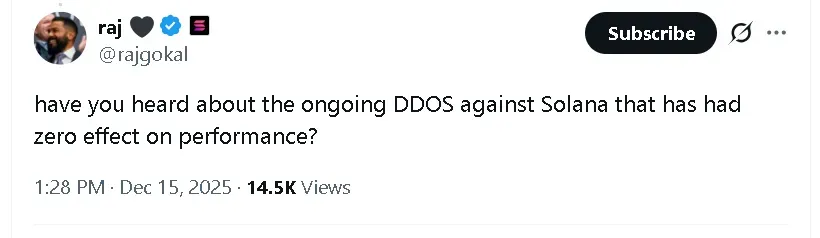
- The attack was first flagged off by Solana co-founder Raj Gokal.
- According to Pipe Network, the attack trailed only Google Cloud’s record event and two Cloudflare attacks in scale.
- Transaction confirmation times and block production remained stable throughout the incident as per publicly available data.
Solana’s (SOL) network continued to process transactions normally over the past week during what Pipe Network described on Monday as the fourth-largest distributed denial-of-service attack (DDoS) in internet history.
The attack, which peaked at roughly 6 terabits per second, ranks behind only the record-setting assault on Google Cloud and two separate Cloudflare incidents, according to the researchers. The attack was first flagged off by Solana co-founder Raj Gokal.
Solana’s price was trading at around $126 on Monday night, down 4.8% in the last 24 hours amid weakness in the broader crypto market. Retail sentiment around the altcoin on Stocktwits trend dropped to ‘bearish’ from ‘bullish’ territory over the past day as chatter remained at ‘low’ levels.

Network Performance Holds Under Extreme Load
Under attack conditions of this scale, blockchains typically experience rising latency, missed blocks, or transaction confirmation delays. Solana’s on-chain data, however, showed little sign of degradation, according to Pipe Network.
It noted that median transaction confirmation times held near 450 milliseconds, with the 90th percentile remaining below 700 milliseconds. Slot latency stayed within a range of zero to one slots, indicating that block production continued largely uninterrupted despite the volume of incoming traffic.
Those metrics suggest that the attack, while significant in raw size, did not materially affect user-facing performance or validator operations. The network remained usable throughout the event, according to publicly available data.
Solana Isn’t Out Of The Woods Yet
DDoS attacks are measured by peak bandwidth and packet volume, with the largest incidents often targeting cloud providers or global content delivery networks. Google Cloud disclosed the largest attack on record in 2023, followed by two Cloudflare incidents that exceeded multi-terabit thresholds.
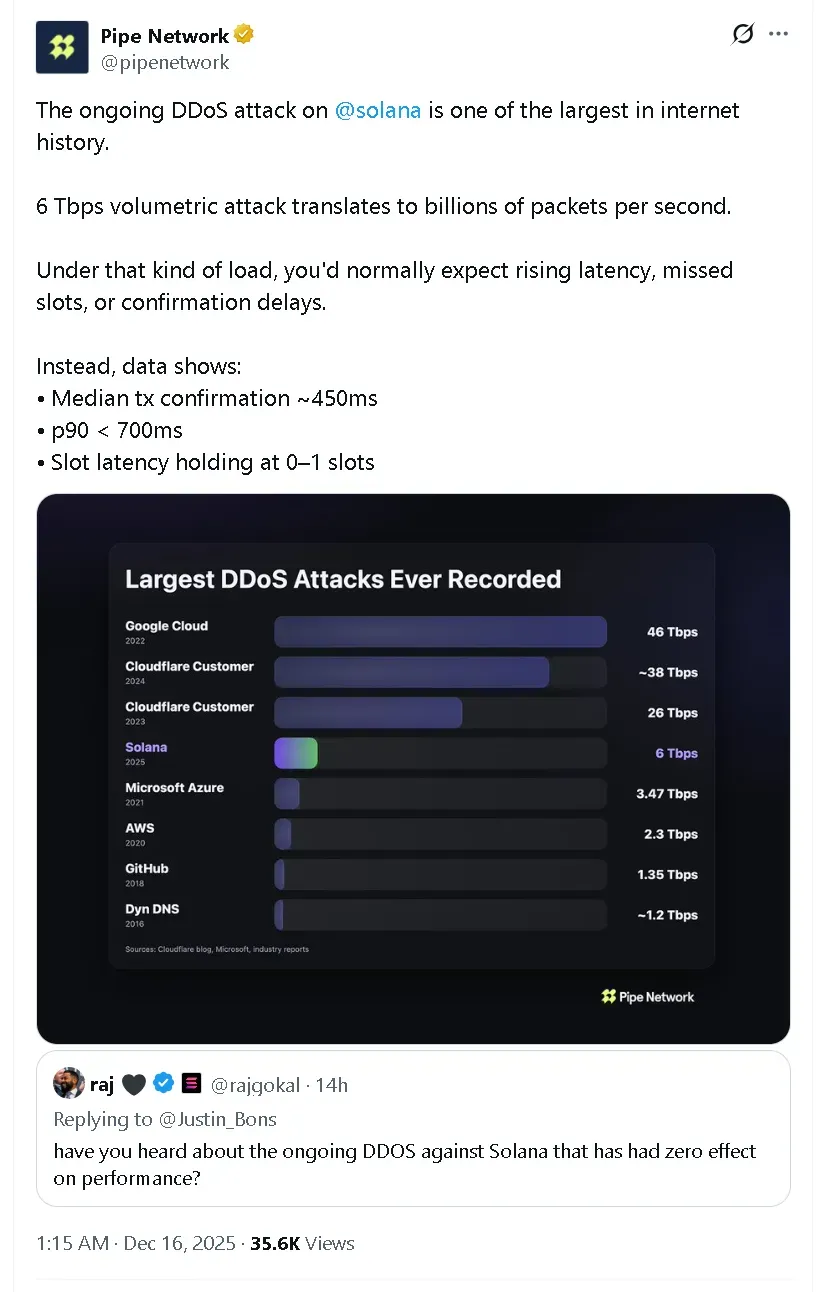
The Solana attack now ranks fourth on that list, placing a public blockchain alongside hyperscale cloud platforms in terms of attack magnitude.
At the same time, Solana is contending with a decline in validator participation. Data showed the number of validators has fallen from roughly 2,560 to about 906 over the past two years. A shrinking validator set could raise concerns around decentralization and resilience by concentrating stake among fewer operators, even as the network continues to demonstrate operational stability under extreme conditions.
Read also: Bitcoin Retail Traders Split On Timing Of Next All-Time High While Sentiment Turns ‘Extremely Bearish’
For updates and corrections, email newsroom[at]stocktwits[dot]com.<