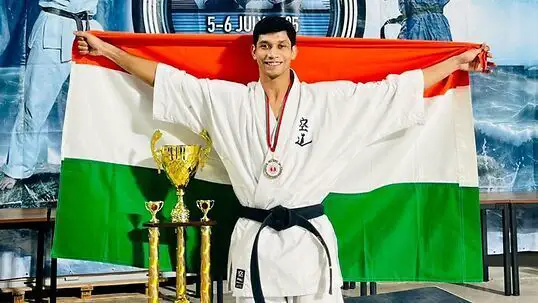
At 26, Sohail Khan has built an enviable career in Kudo. He has won an overwhelming 25 national gold medals and capped that absolute domination in India with seven international gold medals.
He is now at the forefront of Kudo’s growing popularity among India’s combat sports communities.
His rise from Sagar, a district in Madhya Pradesh regarded as the hub of Indian kudo, to the international level tells the tale of the rise of Kudo in India, a Japanese combat sport finding an identity of its own, opening doors for competitors from different backgrounds and producing champions despite limited resources.
Kudo brings together elements of and traditional martial arts, incorporating punches, kicks, elbows, knees, throws and ground fighting, making it one of the most complete self-defence sports. Its combination of diverse combat techniques and an emphasis on safety is central to its appeal.
For Sohail, the road to becoming a Kudo champion was far from straightforward. He began his martial arts journey with karate in 2012, switched to taekwondo following an administrative dispute in the sport, and eventually explored other martial arts before finding his true calling in Kudo.
“When I understood martial arts better, I felt I was restricted to just kick sports. I didn’t feel I was learning martial arts as an art,” Sohail told Sports Now.
He discovered Kudo in late 2014, when his coach, Dr Mohammad Ezaz Khan, introduced him to the discipline in Sagar.
The sport’s arrival in India was dramatic. In 2012, Bollywood superstar Akshay Kumar and Hanshi Mehul Vora introduced the sport to India. They laid its early foundation, and both have been key to its rising stature in the country.
Sagar, the Mecca of Kudo
Kudo’s Indian journey has deep roots in Sagar, Sohail’s hometown. Around 2012-13, Mohammad Ezaz Khan, the pioneering coach, began developing the sport in Madhya Pradesh, turning the town into a hub for the discipline. Today, Sagar is fondly called the ‘Mecca of Kudo’, with several Kudo players, including Sohail, emerging from the region.
Madhya Pradesh’s influence is equally evident on the national circuit. The state emerged as the most successful across three national-level events held in Ahmedabad earlier this month, winning 61 gold medals at the national tournament this year.
If Madhya Pradesh is the most dominant state, Sohail is its face. He is a trailblazer. At the national-level events, Sohail has been among the state’s most successful players. He recently won three gold medals, at the 17th National Kudo Tournament, 7th Federation Cup and International Akshay Kumar Tournament in Ahmedabad.
“With these three gold medals, my national streak has reached 25. That means I am now a 25-time national gold medallist and a seven-time international gold medallist,” he boasted.
At the international level, his remarkable rise inspired fellow Kudo players strive for success . His tally includes a junior World Championship gold in 2017, a Eurasian Cup bronze in 2024 and a landmark silver at the Senior World Cup in Bulgaria in 2025. India also won four senior medals at the competition – two silver and two bronze each.
A second life
Kudo has offered a second life to athletes from other combat sports, including karate, boxing, taekwondo, wushu and wrestling. They are increasingly turning to the sport, finding a fresh competitive zeal.
“Several athletes are moving from other martial arts to Kudo, including those who could not progress because of federation disputes,” Sohail said.
While Madhya Pradesh has established itself as the nerve centre of Indian Kudo, states such as Rajasthan and Haryana, with their strong traditions in boxing and wrestling, are catching up fast. Kudo is also gaining ground in the Northeast, with players increasingly emerging from the region.
Challenges remain
While Kudo has gradually found its feet in India, the Kudo International Federation India (KIFI) has made concerted efforts to develop the sport. These efforts culminated in recognition from the Ministry of Youth Affairs and Sports in 2019 and affiliation with the Kudo International Federation (KIF), which now has more than 60 affiliated national bodies worldwide.
This opened up opportunities for players to earn a livelihood by securing employment through the sports quota. Sohail himself reaped the benefits by landing a govt job as the Income Tax Officer in Mumbai.
Yet, securing a government job remains the exception rather than the norm, underscoring the wider financial struggles facing the sport. Despite India’s growing international presence, Kudo athletes often have to fund their own participation in major competitions.
“Even after representing India at such a high level, we still have to arrange the finances for international competitions ourselves. We are not receiving government funding for major tournaments such as the World Championship and World Cup,” Sohail apprised.
With no sponsorship coming their way, the situation threatens to leave promising athletes behind, with many unable to afford the opportunity to compete internationally.
The federation, headed by president Megha Vora, is working to expand the sport’s reach, pursue inclusion in the National Games and strengthen its international standing. The international federation’s membership of TAFISA has also added to its global outreach.
“There should be more government funding and private institutions willing to come forward and support the sport,” Sohail pleaded.
He is now preparing for the World Championship selection trials, scheduled for March in India, ahead of the competition in Tokyo from March 21 to 23.
Kudo has given Sohail and his compatriots a second chance to pursue their sporting ambitions. But as India’s medal count grows, the bigger fight is to ensure that its athletes do not have to pay out of their own pockets to represent the country.