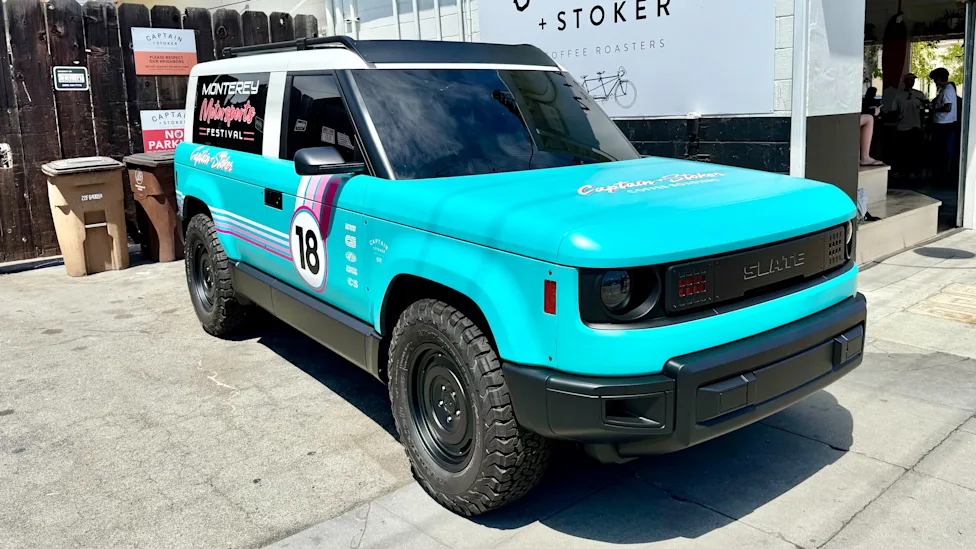
In an automotive world obsessed with connectivity, subscriptions, and data collection, Slate Auto is taking a dramatically different route.
The Indiana-based EV startup is preparing to launch a minimalist electric pickup truck that challenges many of the industry’s assumptions about what modern vehicles should be. While most automakers are adding more screens, sensors, and connected services, Slate is doing the opposite. Its upcoming electric truck is designed to be simple, affordable, repairable, and perhaps most notably, private.
For drivers who are increasingly concerned about how much data their vehicles collect, Slate’s approach could feel like a breath of fresh air.
A Back-to-Basics Electric Truck
The Slate Truck is built around an unconventional philosophy. Instead of packing the vehicle with advanced digital features, the company has reduced its design to roughly 600 parts and components.
Inside, buyers will find a cabin that feels refreshingly old school. There are only two seats. Windows are operated manually with traditional hand cranks. There is no built-in infotainment system dominating the dashboard.
At a time when even budget vehicles come loaded with touchscreens and cloud-connected software, Slate’s stripped-down approach stands out.
The company believes that fewer components mean lower costs, easier maintenance, and greater reliability. But simplicity is only part of the story.
No Embedded Modem, No Constant Tracking
Perhaps the most unusual aspect of the Slate Truck is what it doesn’t have.
Unlike most modern vehicles, the truck does not include an embedded cellular modem. That means it cannot continuously communicate with external servers or provide remote access features that have become common across the industry.
Drivers can use a companion smartphone app to access vehicle settings, check charging information, monitor range, and switch drive modes. However, the connection works only when the phone is locally connected to the vehicle.
Leave your smartphone at home, and the truck effectively becomes a disconnected machine.
For privacy advocates, that’s a significant selling point.
Privacy as a Product Feature
Slate says customer privacy is not just a legal requirement but a core part of the ownership experience.
According to the company, any information collected through the app is limited to functions that directly improve vehicle ownership. This may include diagnostics, maintenance alerts, charging information, software update status, customer support, and product improvement insights.
The company has also emphasized that it does not intend to sell customer data.
“We collect data to make ownership better, not to turn the owner into the product,” Slate said in comments reported by SAE International.
That message arrives at a time when consumer trust in connected vehicles is under increasing scrutiny.
Swimming Against Industry Trends
The broader automotive industry has largely embraced connected services as a major source of future revenue. Automakers increasingly collect driver behavior, vehicle performance, and usage data, often using that information to develop new services or business models.
Concerns about data privacy have grown in recent years, particularly after reports revealed that some manufacturers shared driving data with third parties. Regulators in both the United States and Europe have paid closer attention to how vehicle data is collected, stored, and monetized.
Despite those concerns, consumer demand for connected features remains strong. Buyers continue to prioritize smartphone integration, remote access, and real-time digital services.
That makes Slate’s strategy a bold gamble.
Can Simplicity Win?
The real question is whether enough buyers are willing to trade connected convenience for privacy and simplicity.
If the Slate Truck succeeds, it could prove there is a meaningful market for electric vehicles that prioritize ownership, affordability, and personal privacy over constant connectivity.
For now, Slate Auto is betting that some drivers still want a vehicle that simply gets them from point A to point B without reporting every mile along the way.
In an era where nearly everything is connected, that may be one of the most radical ideas in the automotive industry.