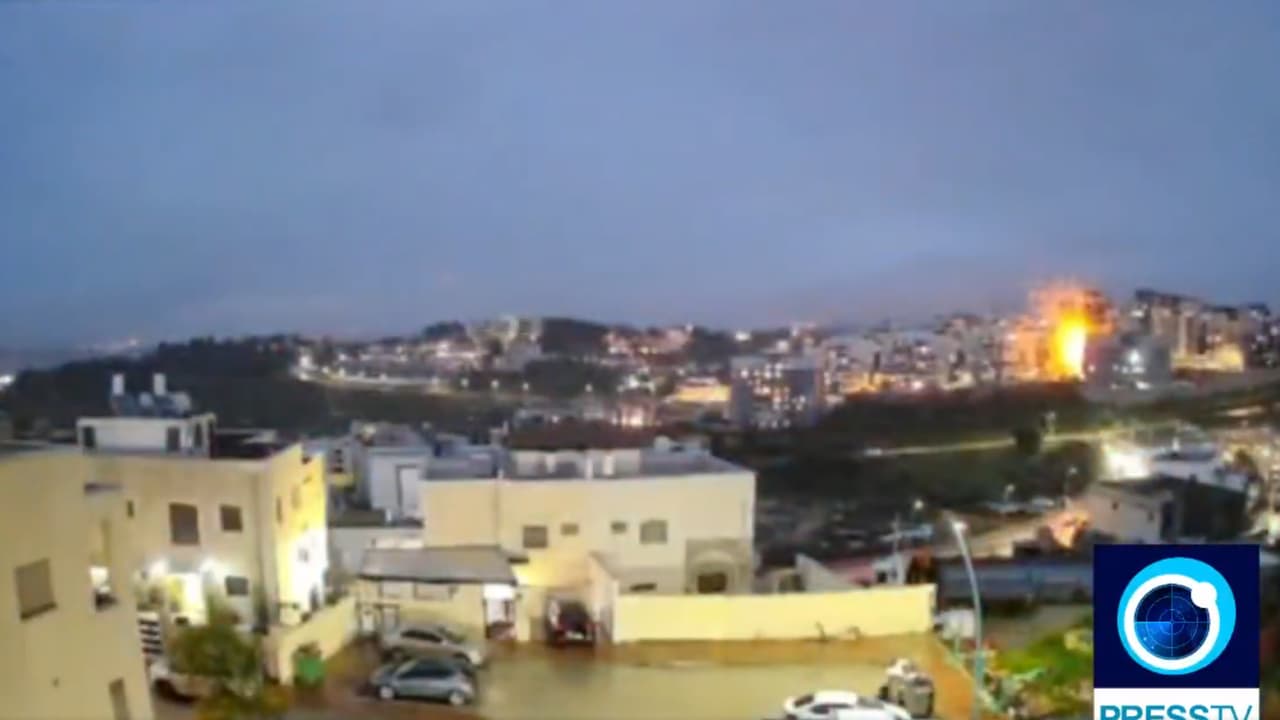
An Iranian missile strike caused a powerful explosion in Dimona, southern Israel, near a sensitive nuclear facility. The attack resulted in civilian injuries and significant damage to residential buildings. Israel’s air defense systems failed to intercept some missiles, prompting an investigation by the IDF. Iran claimed the strike was retaliatory.
A powerful explosion shook Dimona in southern Israel after Iranian missile strikes targeted areas near one of the country’s most sensitive nuclear facilities. Dramatic visuals from the scene showed a massive fireball lighting up the night sky, with thick smoke billowing as sirens wailed across nearby towns. The blast triggered panic among residents and prompted an immediate emergency response.
Video Captures Moment of Impact
Videos widely shared on social media captured the exact moment of impact, showing a loud explosion followed by flames rising into the air. The footage highlights the intensity of the strike and the proximity to critical infrastructure, raising fears over the safety of strategic installations.
Scroll to load tweet…
Emergency responders, including firefighters and medical personnel, quickly reached the site and launched rescue efforts. The injured were promptly transported to hospitals for treatment.
Videos shared online appeared to capture the moment of impact, followed by a loud explosion, though the authenticity of the footage could not be independently verified.
Also Read: Eid Celebrations in Tehran Clouded by Nuclear Plant Attack Reports, No Radiation Leak
Several homes near the strike zone sustained severe damage, with buildings left shattered and debris strewn across the surrounding neighbourhood.
Scroll to load tweet…
Strikes Close to Israel’s Nuclear Facility
Reports indicate that Iranian missiles struck areas around Dimona, including nearby towns like Arad. One of the projectiles is believed to have landed dangerously close to Israel’s nuclear research centre, widely known as the Shimon Peres Negev Nuclear Research Center.
The missile strike hit Dimona, a city known for housing Israel’s nuclear research facility, which was established in 1958.
Air Defence Breach Raises Alarm
The Israel Defence Forces (IDF) acknowledged that some missiles were not intercepted, exposing potential gaps in the country’s advanced air defence systems.
The IDF stated that it is examining why the Iranian ballistic missile was not successfully intercepted. According to the military, air defence systems were activated and attempted to stop the incoming missile, but the interceptors were unable to bring it down.
“The incident will be investigated,” the IDF said.
Emergency services confirmed that dozens of civilians were injured in the attack, with some reported to be in serious condition. Residential buildings suffered heavy damage, while fires broke out in multiple locations due to the impact of high-explosive warheads. Rescue teams rushed to evacuate residents and control the situation.
Iran Signals Retaliation Motive
Iran claimed responsibility for the strikes, framing them as retaliation for recent attacks on its own nuclear and military facilities. Tehran has maintained that its targets include strategic sites, indicating a shift toward high-value infrastructure in this escalating conflict.
Also Read: War Expands? Iran Fired Missiles At Joint US-UK Base In Indian Ocean: Report
No Radiation Leak, But Global Concern Grows
Despite the proximity of the strike, there have been no reports of radiation leakage or direct damage to the nuclear facility. However, the incident has sparked global concern over the dangers of military operations near nuclear infrastructure, with fears of catastrophic consequences if such sites are hit directly.
The Dimona strike comes amid intensifying hostilities involving Iran, Israel, and the United States. With missile exchanges increasing and threats escalating on both sides, the situation remains volatile. The attack underscores how quickly the conflict is expanding, raising fears of a broader regional war with global implications.