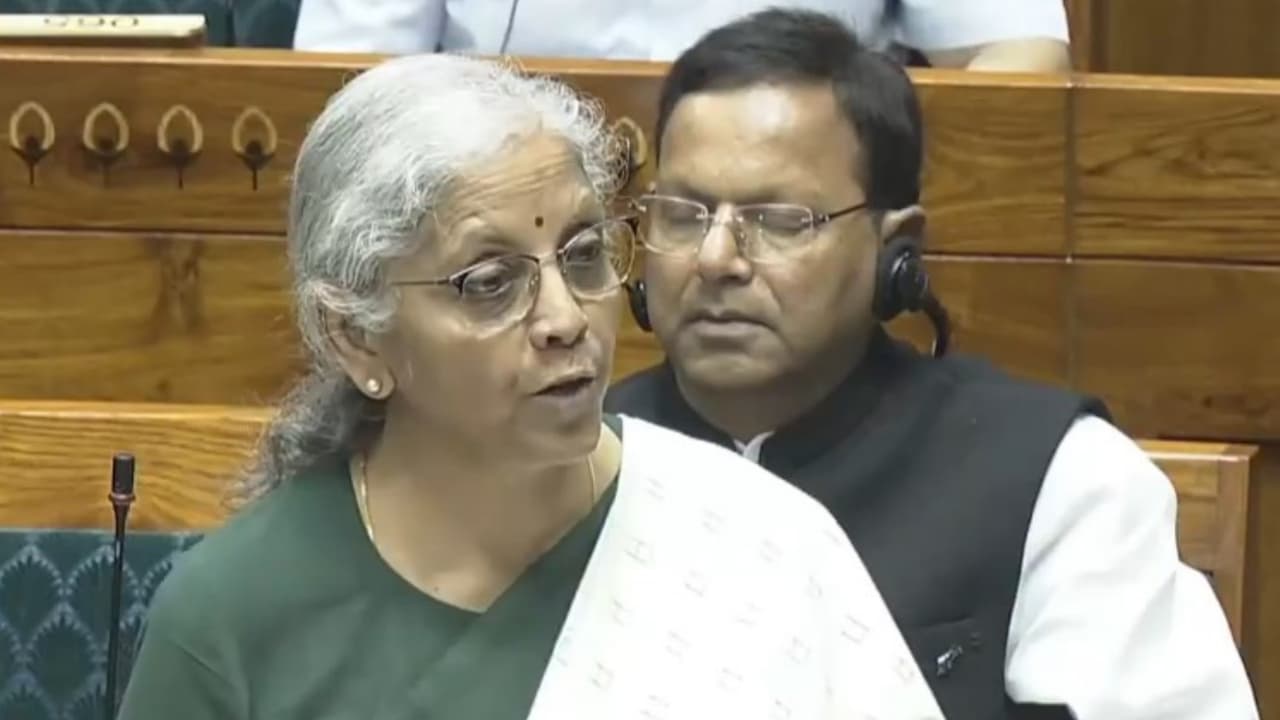
Finance Minister Nirmala Sitharaman countered TMC and DMK allegations as the Lok Sabha passed the Finance Bill. She accused Bengal of blocking welfare schemes and detailed the positive impact of GST cuts on Tamil Nadu’s economy and manufacturing.
Sitharaman Targets Trinamool Congress
“PM KISAN, which is given to all the small farmers, was blocked for two years in Bengal. Distributive justice? Ayushman Bharat was blocked for 1.5 crore Bengali families. They may even be working somewhere else. They couldn’t get the benefit of Ayushman Bharat because you denied health for them. Now, is that distributive justice? Are you hitting at the poorest of the poor & giving lectures to us? INDI Alliance parties, including Communists, broke the spine of Bengal. It was an industrial hub. Communists, like the way in Kerala they have this ‘Nokku Kooli’ business, in Bengal also they did all the kind of strangling of businesses, entrepreneurs and broke its spine,” she alleged.
“Now, TMC came to power, and the spine, which was broken, stayed broken. They did not help the industry to come to Bengal. Syndicates were operating in Bengal & they made it difficult for people even to buy cement from somebody to build a room or to repair their houses. Their distributive justice has one filter – Are they TMC’s cardholders or party members? Then they’ll give everything to them. Chai Bagaan workers aren’t TMC members, so they won’t get it. Are they talking about distributive justice? I’m ashamed to hear it,” she added.
Sitharaman alleged that in West Bengal, “3.79 lakh Chai Chaa Bagaaner Shromiker Sathey Onnay Korechey (There has been injustice with 3.79 tea garden workers).”
“They have not introduced it. Not only that, the state-level committee, which was supposed to have been formed five years ago, have not been formed. There is zero implementation of the Cha Shramik Protsahan Yojana, and 3.79 lakh tea garden workers have been denied a benefit, and distributive justice is concerning them,” she said.
“If distributive justice is really the concern of the TMC, I would like to ask them as to why they are acting in vengeance and making the poorest of the poor suffer. Pradhan Mantri Cha Shramik Protsahan Yojana was introduced in 2021-22 for better schools among tea garden workers, better schools, better healthcare, better housing for the poorest and the most vulnerable sections. Assam government, which also has Chai Bagan, introduced it, and Rs. 293 crore has been spent on those Chai Bagan workers. More than 7 lakh Chai Shramiks from 800 tea gardens across 18 districts of Assam have benefited,” she added.
Slams UPA’s Economic Legacy
Sitharaman alleged that the UPA left the country in a Fragile Five situation, the twin balance sheet problem and the situation of the banks in such a serious state. “Yet they are standing and talking today, when the condition of our banks is fine. For 22 months continuously without disruption, double-digit inflation existed during their tenure. That’s their record. Actual fiscal deficit for 2008-09 would have been 7.9%, but the books were whitewashed, the burden was shifted to the books of oil marketing companies, and it was shown to be 6.1%. We inherited total outstanding debt of Rs. 1.34 lakh crore on their oil marketing bonds,” she said.
Rebuts DMK on GST Impact
She said DMK members had made allegations against the government, but were not present to listen to a reply. “They (INDIA Alliance) fight each other in one state, but stand together here to defend DMK. What a shame. When members raise issues in this House, they should be present to hear the reply. This is not the first time that members from DMK and Trinamool Congress are absent during my response, yet they make allegations and then question the reply. I take objection to such conduct. If false allegations are made, I will respond,” she said.
The Minister said DMK member Arun Nehru said that the GST rate cuts in September 2025 haven’t worked. “I’m shocked at his observation. Retail passenger vehicle sales recorded a 26.1% increase, the highest ever for any February. Rural passenger vehicle sales surged by 34%, while urban sales grew by 21%. This surge has directly benefited Tamil Nadu, especially the Chennai-Sriperumbudur-Oragadam automobile corridor, known as the “Detroit of Asia,” spread across Kanchipuram and Thiruvallur districts. Two-wheeler sales rose by 25% after the GST cut. Royal Enfield’s state-of-the-art plant in Oragadam, Tamil Nadu, is benefiting from rising demand, with more jobs being generated. Automobile companies in Hosur and Sriperumbudur are seeing increased activity with overtime shifts happening there,” the minister said.
“This is not going to be unnoticed, as its flagship companies with 28 assembly lines are capable of producing up to 4 million bikes a year. They’re located in Tamil Nadu & are going to benefit by the increase and surge in the demand as a result of GST reduction. Every Jupiter scooter, Apache bike, and Classic 350 motorcycle, many of which are produced in Tamil Nadu, are seeing strong demand across the country,” she added.
GST Benefits for Tamil Nadu Detailed
Sitharman said that the impact extends further within the Tamil Nadu state. “Madurai, a key tractor production hub, saw a 36.4% increase in tractor purchases. Cement production has also gone up by 9.3%, including in regions like Ariyalur near the member’s constituency & he didn’t even know about it. GST collections reflect this growth. There was a 6.1% year-on-year increase in December 2025, 6.2% in January 2026, and 8.1% in February 2026, with overall growth of 8.3% in 2025-26. Tamil Nadu’s GST revenues have also risen significantly, with 8% growth in December 2025, 5% in January 2026 and a sharp 18% increase in February 2026 (post-SGST settlement). These figures clearly show that the GST reduction has boosted demand, strengthened manufacturing in Tamil Nadu and increased revenues for the state.”
Five Principles of the Finance Bill
Sitharaman said that India is moving forward with reform not out of compulsion, which is what has happened earlier, but out of conviction, with clarity, confidence and commitment.”India is riding on the reform express under the leadership of PM Shri Narendra Modi.”
The Minister said that the Finance Bill 2026-27 rests on five clear principles “A trust-based tax administration is being improved, reducing unnecessary hardship for honest taxpayers. 2. Ease of living for common citizens and ease of doing business, ensuring that people are not burdened by compliances, permits, quotas, and licenses for legitimate activities. 3. Empowering MSMEs, farmers, and cooperatives, which are at the heart of employment generation, production, and overall development, through measures that improve liquidity and reduce compliance burden. 4. Making India a stronger global business hub by bringing clarity in taxation and supporting key sectors such as digital infrastructure, electronics manufacturing, marine products, leather, critical minerals, nuclear energy and more. 5. Enabling seamless trade facilitation and bringing in customs reforms to simplify processes and improve efficiency in trade.”
Focus on MSMEs, Cooperatives, and Fisheries
She said this Budget advances a clear philosophy of “facilitate first, enforce where necessary.”
“By reducing TCS rates, decriminalising minor business offences, automating MSME tax relief and expanding deductions for rural cooperatives, we are strengthening agriculture, cooperatives, and fisheries. Primary cooperative societies already benefit from deductions on supplies of milk, fruits and vegetables to federal cooperatives. This Budget extends those deductions to include cooperatives supplying cattle feed and cottonseed, recognising the integrated nature of rural value chains. Under the new tax regime, dividend income received from other cooperative societies is now tax-deductible, provided it is further distributed to members, thereby strengthening cooperative federations. In addition, a three-year tax exemption has been granted on dividend income received by notified national cooperative federations. To improve price realisation and enhance global competitiveness for Indian fishermen, fish caught by Indian fishing vessels in the Exclusive Economic Zone (EEZ) or on the high seas will now be fully exempt from customs duty. Further, landing such fish at a foreign port will be treated as an export.”
The minister said the government recognises the MSME sector as a core driver in India’s Reform to Perform Express, powering employment and production. “To empower MSMEs, this Budget for Viksit Bharat places a strong focus on a ‘facilitate first, enforce where necessary’ approach. This marks a decisive shift from the earlier “‘ penalise first” approach championed by the Congress party. Penalties for technical defaults, such as failing to get accounts audited, have been converted into predictable, fixed fees, removing the threat of existential compliance risks and adversarial litigation for small business owners”.
On Fiscal Deficit and National Debt
Sitharman said the fiscal deficit has also come down. “In 2020-2021, even with COVID, it was 9.3%. From there, we brought it down to 4.3%, the BE projection for 2026-27. In one stretch from there. We didn’t violate the glide path, which was given in this house. We have completely abided by it. And that’s why we’ve reached 4.3%. Global comparison is also important. Since 2008, the world’s overall debt burden has increased 41%. China’s debt exploded 139%. India has actually reduced its total debt burden by 4% of GDP,” she said.
“The US Debt to GDP stands at 124%. China at 88%. Japan is at over 250%. India’s combined figure, the Debt to GDP, is 83% approximately. It is lower than most major economies and is on a declining path. And that too, after COVID. We have retained a sense of calm and given free vaccines to all the citizens, but still that fiscal deficit of 9.3% has been brought down. The erstwhile UPA couldn’t withstand a global financial crisis, which had a relatively limited impact on the Indian economy,” she added.
Referring to debt, the Centre alone cannot be responsible for debt. “Actually speaking, the Centre-State debt of 84.2% of GDP is also because the states are also coming into the picture of debt. Centre has an have oversight on the states and can tell them not to go on borrowing beyond their FRBM. But the Centre alone cannot completely control state borrowing. If concerns about debt to GDP is an issue, he should spend some more time with Karnataka & Himachal Pradesh and help them to bring their debt down also,” she said.
Defends Use of Cesses and Surcharges
Referring to concerns of members that money collected through cess does not go to the states, Sitharaman said that in the last six-year period, 2019-20 to 2024-25, the cumulative utilisation of cesses has exceeded the collection. She said Rs. 15.14 lakh crore were collected. “How much was sent? Rs. 15.97 lakh crore have been sent to the states under various schemes. So, more than what is collected under cesses and surcharges is being spent. Similarly, health and education cess, Rs. 74,000 crore extra has been spent over and above what has been collected under cesses and education health cess. Rs. 7.03 lakh crore was collected, and that is between 2014-15 and 2026-27. Against this, the total utilisation stands at Rs. 7.77 lakh crore,” she said.
“Constitution makers knew what they were doing, and we all pay respect to them. There is a provision for levying cesses and surcharges, which is given to the Centre. We are using a provision that is legitimately provided. We are allowed to do it, and we are doing a legitimate thing. But having collected it, are we not spending it only on the States, providing hospitals, schools, and laying the roads?” she asked.
The Minister said that more than what is collected as cesses and surcharges is spent on schemes for the states. “Samagra Shiksha and the Midday Meal Scheme, implemented through state governments, are financed through the Health and Education Cess. National Food Security Act, where the centre bears the bulk of the cost, and states distribute. National Health Mission, even in the recent Supplementary demand for grant, which was passed in this house only a few days ago, Rs. 11,627 crores was transferred to PM Swastya Swaraksha Nidhi to meet NHM expenditure. So, resources from many Cesses are 100% transferred to states.”
(Except for the headline, this story has not been edited by Asianet Newsable English staff and is published from a syndicated feed.)