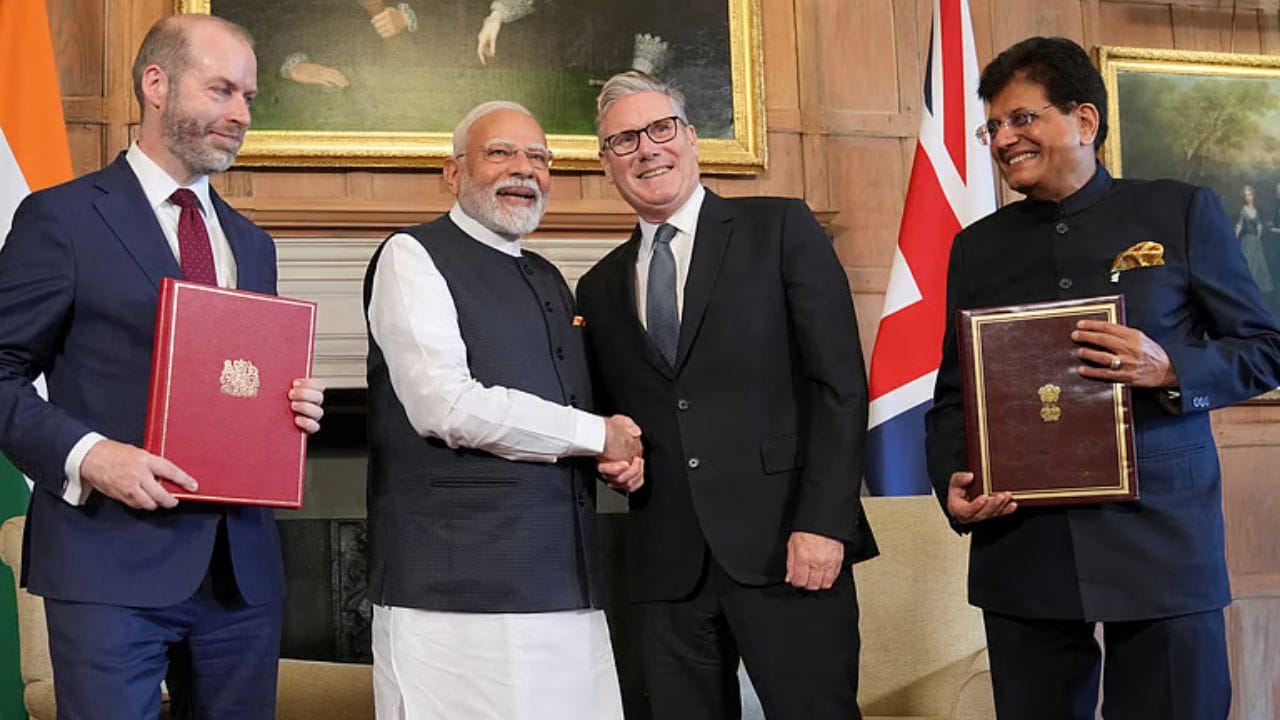
India-UK trade dealImage Credit source: PTI PHOTOS
The India-UK Free Trade Agreement signed between India and Britain in July 2025 is likely to come into force in April 2026. Giving information, an official said that India and Britain signed the Comprehensive Economic and Trade Agreement (CETA) on July 24, 2025. Under this agreement, 99 percent of India’s products will be able to be sent to Britain without any duty, while there will be less duty on cars and whiskey coming to India from Britain. The official said that we hope to implement this agreement in April. Both countries have also signed the Double Contribution Convention (DCC), so that temporary workers do not pay social taxes twice in either country. The official said that both the agreements can be implemented simultaneously.
Approval process is ongoing
Before coming into force, this agreement will have to be approved by the UK Parliament. In India, such trade agreements are approved by the Union Cabinet. India-UK CETA was debated in the British House earlier this week. Chris Bryant, Minister of State at the Department of Trade and Commerce, described the agreement as an important achievement and said that it goes further than India’s previous example in opening doors to UK businesses. The British Parliament is currently in the process of ratifying the agreement, which involves debate in both the House of Commons and the House of Lords, as well as committee-level reviews. After completion of the approval process, this Agreement will come into force on a mutually agreed date.
Impact of this agreement on trade
CETA aims to double the current $56 billion trade between India and Britain by 2030. India has opened its markets to many British consumer products including chocolate, biscuits and beauty products. In return, Indian exporters are expected to get better access to the UK market for products such as textiles, footwear, gems and jewellery, sporting goods and toys. Under the agreement, duty on Scotch whiskey will be reduced from 150 percent to 75 percent immediately and further reduced to 40 percent by 2035.
On automobiles, India will gradually reduce tariffs from 110 percent to 10 percent over five years under a quota-based system. In return, Indian manufacturers will get market access in Britain for electric and hybrid vehicles under the quota structure. This agreement is an important step towards strengthening economic ties between the world’s fifth and sixth largest economies and is expected to reshape trade flows after its implementation.