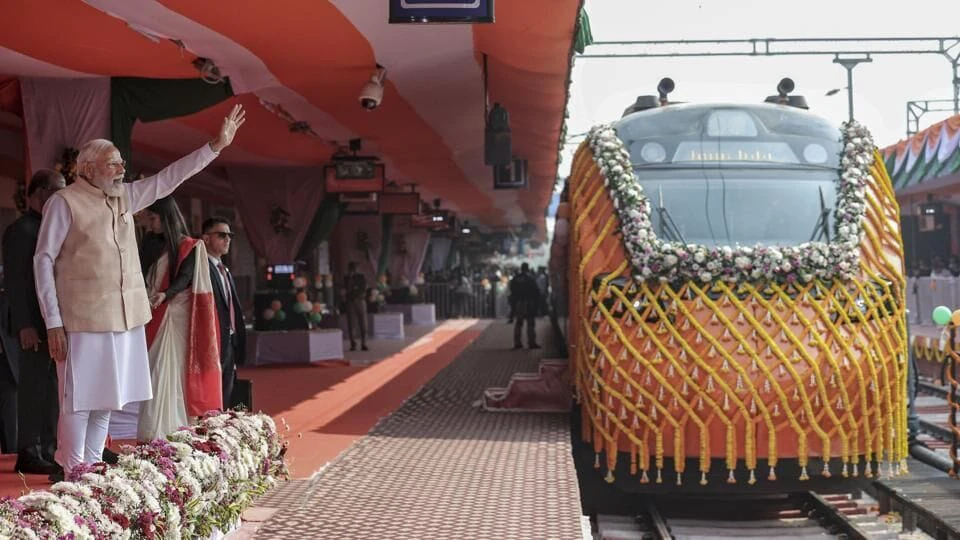
Modi’s visit to Singur comes after the Prime Minister on Saturday visited Malda, where he lashed out at the TMC government for its “politics of hatred” and pitched Bengal as being central to India’s plans of becoming a developed economy by 2047.
Announcing his schedule for the visit to Bengal’s Singur, PM Modi wrote on X, “Our Government is committed to adding momentum to West Bengal’s growth journey. In Singur today, important development works will be launched or their foundation stones laid.”
“The works include: Laying the Foundation Stone of the Extended Port Gate System at Balagarh, including the Inland Water Transport (IWT) Terminal and Road Overbridge. Launching of the Electric Catamaran at Kolkata. Inauguration of the new rail line between Jayrambati and Maynapur. Flagging off of trains, including Amrit Bharat trains,” the Prime Minister said.
Modi will kick off the inauguration spree at around 3 pm on Sunday, as per the Prime Minister’s Office (PMO).
The significance of Singur in Bengal’s politics
The Prime Minister’s visit to TMC-ruled Bengal comes not just ahead of the polls, but targets sore points in the state’s political history, with the launching of infrastructure projects in Singur carrying significant political weight.
Shortly after coming to power with a thumping majority in 2006, the incumbent CPI(M) government in Bengal had announced a Tata Motors plant for the production of the Nano model, backing up its poll promise of industrializing the state and creating employment.
Although the project, which would require around 1,000 acres of land, sparked protests from locals in Singur, the government went ahead with land acquisition for the plant, and construction began on Tata factory.
However, in 2007, Mamata Banerjee reignited protests in Singur, becoming the face of the anti-land acquisition movement against the Left government.
Prevented from entering the area by government forces, Mamata began a 26-day hunger strike in Kolkata, drawing support from various sections of society, including activists and intellectuals.
Despite the hunger strike, in 2008, the Calcutta High Court upheld the land acquisition for the Tata plant in Singur as legal.
In response, Mamata intensified her anti-land acquisition agitation, and expanded it to Nandigram over a proposed chemicals industry plant.
With Mamata’s agitation gaining steam, then Bengal Governor Gopalkrishna Gandhi attempted to mediate between the Left government and the protesting Mamata, but failed, eventually leading to the withdrawal of Tata from Singur.
The Nano plant, incidentally, was then set up in Sanand Gujarat, where the Narendra Modi-led government was in power.
Since then, the Singur case has reared its head time and again as a poll issue in Bengal-while it continues to remain a symbol of Mamata’s rise to political power, it has also been used by her opponents to highlight the TMC government’s failure to industrialize Bengal.
With polls coming up, the BJP has already attacked the Mamata government, describing her economic policies as the root cause of Bengal being an “industrial graveyard”.
In fact, just ahead of Modi’s visit to Bengal, state BJP chief Samik Bhattacharya highlighted the sorry state of affairs in the eastern state, citing data from the Union Ministry of Commerce and Industry to emphasize how Bengal had fallen behind the likes of highly industrialized states such as Maharashtra and Gujarat.
“What is the more dangerous truth is the implementation of investment proposals. In Gujarat, 921 proposals were implemented worth ₹3.24 lakh crore. Maharashtra implemented 850 proposals worth ₹1.99 lakh crore. And West Bengal? Only 116 proposals were implemented worth only ₹15,184 crore,” Bhattacharya wrote in a post in Bengali on X.
Pitching Bengal as the next hub of development if BJP comes to power, Bhattacharya added, “West Bengal will not be left behind. West Bengal will not send its youth outside the state. West Bengal again will be the state of industrialisation and employment. We want Bengal’s future to be brightened with industry, investment and employment.”