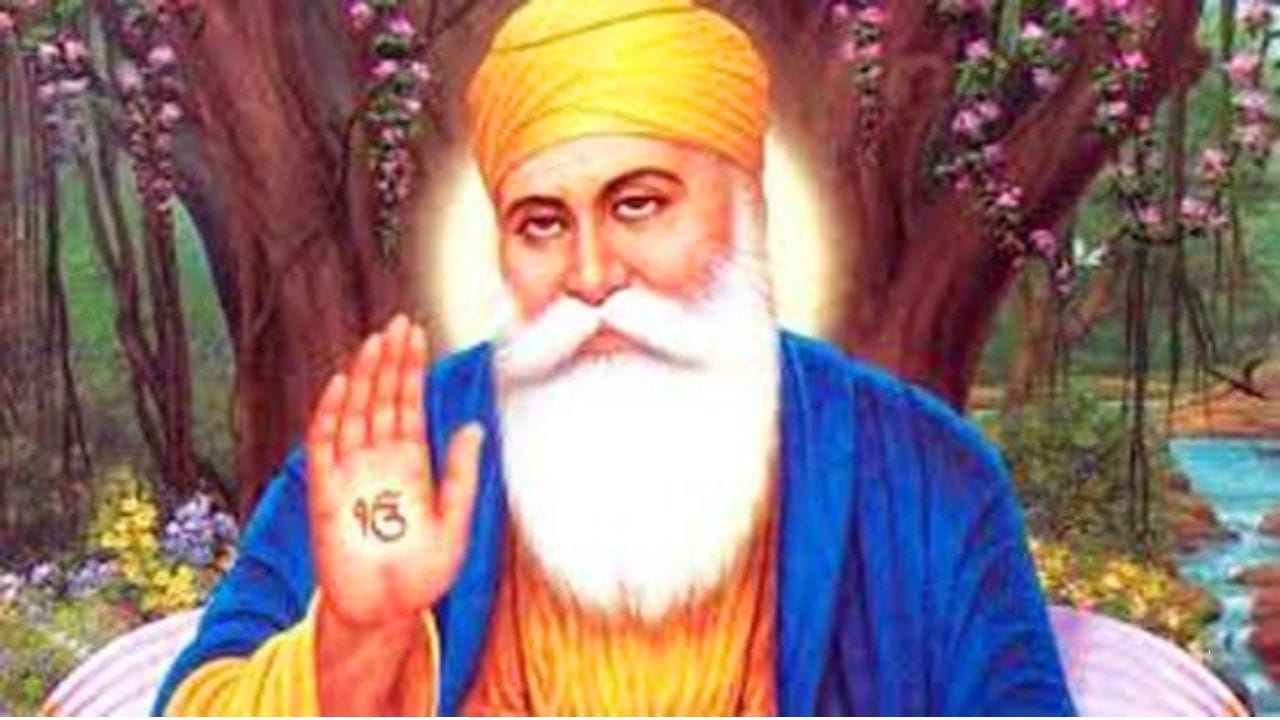
Guru Nanak Dev Ji.
Sikhism is not just a spiritual path, it is a unique saga of supreme sacrifice for justice, truth and religion. The tree of equality and ‘Ek Omkar’ planted by Guru Nanak Dev Ji has been watered again and again with the blood of martyrs. Among the brightest stars of this great tradition is the ninth Sikh Guru, Guru Tegh Bahadur Ji, who sacrificed his life to protect religious freedom.
Guru Tegh Bahadur Ji was born on 1 April 1621 in Amritsar to the sixth Guru, Guru Hargobind Ji. His original name was Tyagamal. His extraordinary bravery displayed in a battle against the Mughals earned him the name ‘Teg Bahadur’, which means ‘valiant of the sword’. After his father’s death, he spent about 26 years in spiritual solitude in the village of Bakala, absorbed in meditation and devotion, earning him the name ‘Baba Bakala’.
Message of selfless service and fearlessness
In 1664, the eighth Guru, Guru Har Krishna Ji, indicated that his successor would be found in Bakala, and thus this great spiritual seeker became the ninth Guru of the Sikhs. After assuming the post of Guru, Guru Tegh Bahadur Ji actively spread the message of truth, compassion, selfless service and fearlessness through extensive travels in North India. He founded the holy city called Anandpur Sahib, which later became the center of the Khalsa sect. His divine hymns included in the Guru Granth Sahib inspire people to abandon fear, ego and attachment and connect with God.
‘Hind Di Chadar’
In the 17th century, the Mughal emperor Aurangzeb launched a brutal campaign of forced conversion, particularly targeting Kashmiri Pandits. Holy Hindu temples such as Kashi Vishwanath were destroyed, idols were desecrated, and those who refused to convert were subjected to extreme torture and death penalty.
Disturbed by these atrocities, a delegation of Kashmiri Pandits came to seek help from Guru Teg Bahadur Ji. Guru ji advised him to challenge Aurangzeb and declare, if Guru Tegh Bahadur accepts Islam, we will also accept it. By doing this Guru Tegh Bahadur Ji took upon himself the responsibility of protecting the religious freedom of India.
Guru Teg Bahadur Ji arrested in 1675
As a result, in 1675 Guru Tegh Bahadur Ji was arrested and taken to Delhi, where he was subjected to brutal torture to force his conversion. Before his death, three devout Sikhs—Bhai Matidas, Bhai Satidas and Bhai Dayala—were martyred in a horrific manner. Bhai Matidas was cut alive with a saw, Bhai Dayala was boiled to death and Bhai Satidas was burnt alive by wrapping him in cotton.
Despite witnessing these cruel acts, Guru Tegh Bahadur Ji remained steadfast. On 24 November 1675, on the orders of Aurangzeb, he was beheaded in Chandni Chowk, Delhi.
Guru Teg Bahadur Ji’s sacrifice was not only for Sikhism, but to protect the religious freedom of all Indians. That is why she is worshiped as ‘Hind Di Chadar’. The holy Gurudwara Sis Ganj Sahib is situated at the place of his execution. His martyrdom became a source of inspiration for his son and the 10th Sikh Guru, Guru Gobind Singh Ji.
Martyrdom of Guru Arjan Dev Ji
The foundation of this sacrifice was laid 50 years ago, when the 5th Guru, Guru Arjan Dev Ji was arrested by the Mughal Emperor Jahangir and forcibly converted to Islam. On refusing, Guru Arjan Dev Ji was brutally murdered. This incident awakened the Sikh community to the need for self-defense. As a result, Guru Hargobind Ji introduced the principle of ‘Miri and Piri’, symbolizing temporal and spiritual power, and encouraged the Sikhs to increase military power. Later, inspired by the sacrifices of his predecessors, Guru Gobind Singh Ji founded the Khalsa Panth in 1699 to fight tyranny.
Sacrifice of Guru Gobind Singh’s sons
All four sons of Guru Gobind Singh ji attained martyrdom for religion. His elder sons, Sahibzada Ajit Singh Ji (18 years) and Sahibzada Jujhar Singh Ji (14 years), were martyred while fighting bravely against the Mughals in the battle of Chamkaur in December 1704. His younger sons, Sahibzada Zorawar Singh Ji and Sahibzada Fateh Singh Ji, aged only 6 and 9 years, were burnt alive with bricks in Sirhind on 26 December 1704 for refusing to accept Islam. Their sacrifice is one of the most extraordinary examples of courage and faith in world history.
Banda Singh Bahadur
After Guru Gobind Singh Ji, his follower Banda Singh Bahadur led the Sikh army against the Mughals. He was captured along with his four-year-old son and hundreds of followers and was brutally executed for refusing to convert. His body was mutilated, yet he did not abandon his religion. This unbroken tradition of sacrifice in Sikh history proves that for the Sikh community, ‘religion’ and ‘honor’ are more dear than life.
‘Given my head, but did not give my head’
Meaning: ‘I gave my head, but not my religion. This line symbolizes the unwavering courage and selfless dedication of these great martyrs, who not only protected religious freedom with their blood, but also inspired the coming generations to stand for truth and justice.