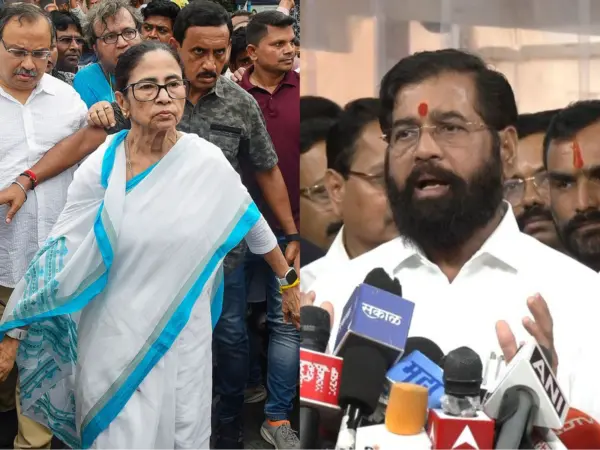
The political landscape witnessed fresh turbulence on Tuesday as two major Opposition parties — Shiv Sena (UBT) in Maharashtra and the Trinamool Congress ( TMC) in West Bengal — grappled with dramatic internal splits.
While ruling alliances hailed the developments as proof of their growing influence, opposition leaders described them as acts of betrayal, political engineering, and a threat to democratic norms.
The twin crises have triggered a war of words across party lines, with allegations of inducements, defections, and attempts to weaken Opposition forces dominating the political discourse.
The political crisis in Maharashtra escalated after six Shiv Sena (UBT) Lok Sabha MPs — Sanjay Haribhau Jadhav, Bhausaheb Rajaram Wakchaure, Omprakash Bhupalsingh Nimbalkar, Sanjay Dina Patil, Sanjay Uttamrao Deshmukh and Nagesh Bapurao Patil Ashtikar — formally joined the Eknath Shinde-led Shiv Sena on Monday.
The move reduced Uddhav Thackeray’s strength in the Lok Sabha to just three MPs and marked another major setback for the UBT faction following the 2022 split.
Leading the celebrations, Eknath Shinde declared that “Operation Tiger” had succeeded.
“I don’t leave anything half done. Operation Tiger is successful,” Shinde said while inducting the MPs.
Insisting that the move followed constitutional and parliamentary norms, Shinde said the MPs joined for development-oriented governance and constituency work.
“When I was Chief Minister, I behaved like a worker, and even today I work as a worker. All these MPs will also have to behave like common workers. Their trust in joining us will be respected,” he said.
Promising support for their constituencies, Shinde assured the defectors that ministers and the state government would actively address local issues.
Maharashtra Minister Yogesh Kadam indicated that the exercise was far from over.
“This operation will continue. Because of the unrest in Uddhav ji’s group, their people are approaching us to induct them into our party,” Kadam said, claiming several UBT leaders privately expressed dissatisfaction with their leadership.
Yavatmal-Washim MP Sanjay Uttamrao Deshmukh dismissed allegations that money or pressure from central agencies influenced the switch.
“NDA doesn’t need MPs right now. They have the numbers. We joined them for development works,” Deshmukh said.
He claimed multiple projects in his constituency had stalled due to a lack of funds and alleged that remaining outside the ruling alliance was hurting local development.
“Farmers are dying by suicide in my constituency. Several development works were not being done because we are not in power,” he said.
Deshmukh further claimed that after joining Shinde’s camp, nearly 50 corporators from Washim and Yavatmal contacted him expressing interest in switching sides.
Parbhani MP Sanjay Jadhav also defended the move, saying development concerns drove the decision. “Loyalty is important, but we must also think about development and the interests of our people,” he said, while objecting to UBT leaders calling the defectors traitors.
Interestingly, Shiv Sena MLC Bacchu Kadu struck a conciliatory note and called for reconciliation.
“In my personal opinion, both Shiv Sena parties should come together for Maharashtra,” Kadu said.
The strongest response came from Shiv Sena (UBT) MP Sanjay Raut, who launched a blistering attack on the defectors.
In a post on X, Raut questioned allegations of financial inducements. “85 crores! The price of this Member of Parliament! Loot the public’s wealth! Who is paying lakhs of rupees for the charter plane?” he wrote.
At a press conference, Raut accused the MPs of abandoning the party for personal gain. “Just as covered statues are unveiled, the faces of hidden traitors have also been revealed,” he said.
Rejecting the argument that the switch was made for development funds, Raut claimed the MPs had failed to utilise existing allocations. “They say they left for development funds. But data shows that they could not even utilise the funds they had already received. For them, funds mean contracting,” he alleged.
Raut also accused the Shinde faction of abandoning Bal Thackeray’s ideals and alleged that leaders joining the camp were encouraged to make false statements. “After joining the Shinde faction, people are given a pill to lie,” he remarked.
He warned against attempts to intimidate Shiv Sena workers. “Do not try to show guns to Shiv Sainiks. Remove your security and come face me,” he said.
Shiv Sena (UBT) MLC Ambadas Danve called the defections a clear betrayal. “They were elected under Uddhav Thackeray’s leadership. They should have resigned and then contested elections,” Danve said.
Shiv Sena (UBT) chief Aaditya Thackeray, meanwhile, intensified his attacks on Eknath Shinde, whom he repeatedly referred to as “Fakenath Minde.”
Accusing the Deputy Chief Minister of avoiding accountability, Aaditya alleged that Shinde routinely delegated responsibility during Assembly sessions while retaining key portfolios.
“The questions raised are the public’s questions. Yet in every session, he designates someone else to answer. Why then hold onto those departments?” Aaditya asked.
He further accused the government of prioritising corruption over governance. “You keep the portfolio for yourself to siphon off funds, commit scams and engage in corruption, but you run away whenever the time comes to provide answers,” he alleged.
The developments also drew reactions from Congress leaders.
Senior Congress leader P Chidambaram claimed the defections reflected a wider national trend. “Operation Lotus is in full vigour,” Chidambaram wrote on X.
Listing recent upheavals in parties including the BJD, AAP, Trinamool Congress and Shiv Sena (UBT), he said the Tenth Schedule of the Constitution had become “a mute spectator.”
Former Union Minister Salman Khurshid described the defections as a threat to democracy.
“Those who are leaving parties that they have vouched for in such vigorous terms and passionate commitment, leaving those parties just because they’ve lost power in the state, and those who are enticing them and trying to win them over — I think it’s an extremely regretful matter, destroying our democracy completely,” Khurshid said.
Calling for Opposition unity, he warned that democratic institutions themselves were at stake. “If we are not able to secure democracy, then there is nothing left for us at all,” he said.
Even as Maharashtra politics reeled from the Shiv Sena developments, West Bengal witnessed its own political earthquake.
A rebel faction led by Leader of Opposition Ritabrata Banerjee announced the formation of a new leadership structure within the Trinamool Congress and appointed senior MLA Arup Roy as party chairperson.
The faction also constituted a 30-member National Working Committee (NWC), naming Firhad Hakim, Aroop Biswas, Rathin Ghosh, Sabina Yasmin, Javed Khan and others to key positions.
Ritabrata Banerjee reiterated that Mamata Banerjee should remain associated with the organisation as a mentor. “We want Didi to assume the responsibility of a mentor and guide us,” he said.
The rebel faction claims support from a large section of TMC legislators and has asserted that it represents the “real TMC.”
Ritabrata Banerjee questioned the legitimacy of decisions taken by Mamata Banerjee’s camp. “That party doesn’t exist anymore,” he claimed.
He alleged that appointments announced by the rival camp were illegal and accused party leaders of acting without consulting members. “The fight of the collective against the individual will only strengthen,” he said.
Arup Roy thanked members for electing him as chairperson. “It is a big responsibility. We have to stand by our workers and continue fighting for the people of Bengal,” Roy said.
TMC MLA Sabina Yasmin described the decision as unanimous. “After gathering everyone’s opinion, Arup Roy was appointed Chairman. It was a decision made with everyone’s consent,” she said.
The rebel faction also raised questions over party finances. Former treasurer Aroop Biswas sought a freeze on party bank accounts while Ritabrata Banerjee called for a probe into party funds.
Mamata Banerjee’s faction responded aggressively. The TMC disciplinary committee issued show-cause notices to several senior leaders, including Firhad Hakim, Aroop Biswas, Arup Roy, Javed Khan, Rathin Ghosh, Biplab Mitra, Snehasis Chakraborty and Sabina Yasmin, accusing them of anti-party activities.
Later, all eight leaders were expelled from the party.
Mamata Banerjee also moved swiftly to reinforce her authority, submitting an official list of office-bearers to the Election Commission, identifying herself as party chairperson.
The list showed Subrata Bakshi as vice-president, Abhishek Banerjee as national general secretary, Derek O’Brien and Dola Sen as joint secretaries and Subhasish Chakraborty as treasurer.
The TMC also replaced Firhad Hakim as Chief Whip and nominated Madan Mitra for the role.
Senior TMC leader Kunal Ghosh accused the rebels of illegally using the party’s name. “Trinamool Congress means Mamata Banerjee and Mamata Banerjee means Trinamool Congress,” Ghosh said.
He accused rebel leaders of betrayal and challenged them to openly resign. “If you have the courage and wish to leave the party, then come to Didi and say you are leaving. But you lack that courage,” he said.
Ghosh further argued that Bengal’s people would reject what he called a culture of betrayal. “Let the elections come. If we don’t ensure every one of these traitors loses, then we aren’t Trinamool Congress,” he declared.
TMC MP Saugata Roy was equally dismissive. “This is a joke. This is a circus,” Roy said. “Mamata Banerjee founded the Trinamool Congress. Now who is going to remove her?” he asked.
Questioning Ritabrata Banerjee’s credentials, Roy said he was a recent entrant from CPI(M) and lacked legitimacy within the party.
Referring to Firhad Hakim’s rebellion, Roy expressed disappointment. “Mamata Banerjee supported him so much. Why he left the party, we don’t know,” he said.
Calling the rebels “traitors,” Roy said they should either return to the party or join the BJP.
The BJP seized on the turmoil within the ruling party. West Bengal minister Dilip Ghosh described the developments as political theatre. “TMC is a drama party. I used to call it a circus party,” Ghosh said.
Questioning the repeated changes in leadership claims, he asked, “Who had told them to make her the chairperson? Who told them to remove her?”
He argued that the internal battle held little significance for ordinary citizens and accused the TMC of failing Bengal. “TMC has given people nothing. Under our government, people are receiving benefits while sitting at home,” he said.
The twin political crises in Maharashtra and West Bengal have reignited concerns about the effectiveness of India’s anti-defection framework.
With both Shiv Sena (UBT) and TMC facing major organisational battles, the coming weeks are expected to witness fierce political confrontations that could reshape the opposition landscape ahead of future electoral contests.