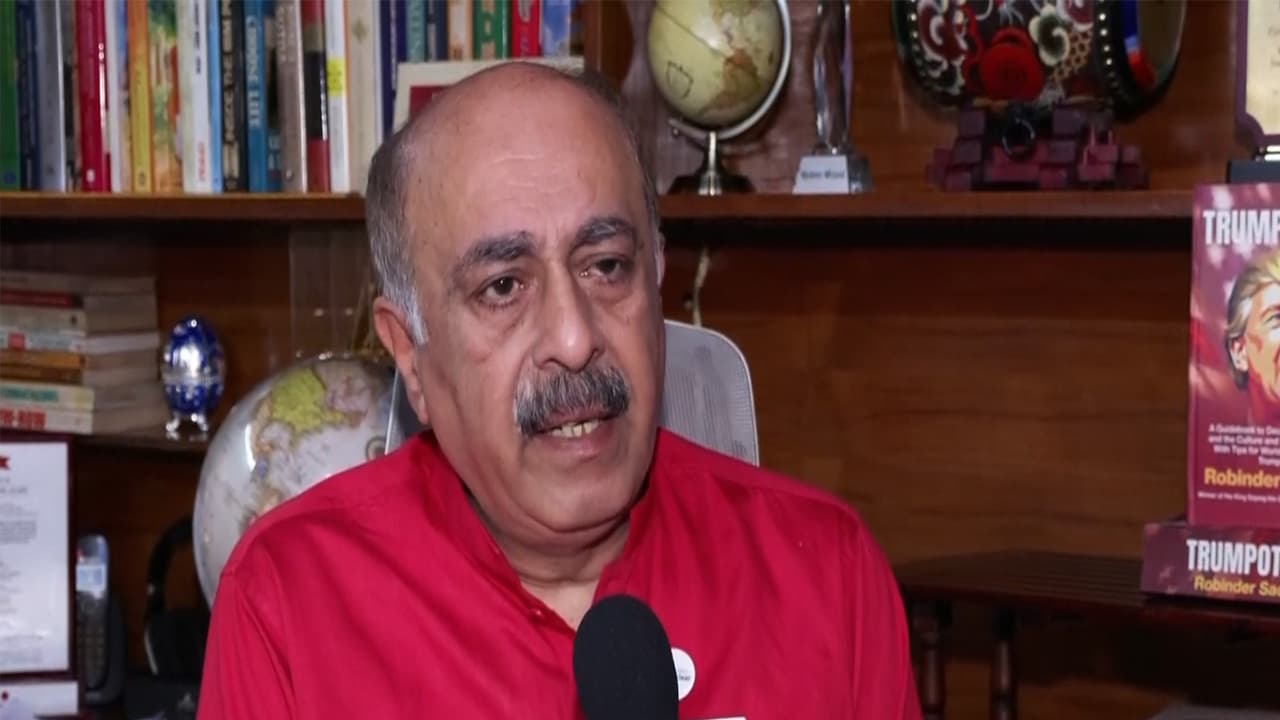
Foreign Affairs Expert Robinder Sachdev stated that any ship loading oil from Iran’s Kharg island will be slapped with sanctions, including frozen financial assets and blacklisting of dollar transactions, as the US aims to halt Iran’s oil revenue.
Details of US Sanctions on Iran
Foreign Affairs Expert Robinder Sachdev on Monday said that as of now, it is notified that any ship which loads oil from Kharg island, will be slapped with sanctions.
Ships Loading from Iranian Ports
Talking to ANI on US President Donald Trump’s Strait of Hormuz blockage threats amid nuclear mistrust, Sachdev said that the owners of any ship loading cargo from these locations would be put under sanctions similar to those implemented in 2018. “Clarity about the blockade will emerge in the coming hours and days once the US Central Command operationalizes what Trump has ordered. As of now, what can be decoded is that any ship which loads from an Iranian port–mostly Kharg, as about 90% of Iranian oil is exported from there–will be intercepted. Iran has also opened other loading points on the east of the Hormuz,” he said.
Sachdev said that the company’s financial assets will be frozen if they are found loading from the Strait of Hormuz. “Technically, the owners of any ship loading cargo from these locations would be put under sanctions similar to those implemented in 2018. Under those sanctions, financial assets can be frozen in the United States, all dollar transactions via the Swift network will be blacklisted, and visas will be denied to anyone associated with those companies,” he said.
Sachdev further stated that the US wants to ensure prevention of Iran from earning revenue from its oil exports. “The goal is to ensure America prevents Iran from earning revenue from its oil exports. As of now, Iran is exporting about 1.8 million barrels a day. Even if oil is priced around $100, Iran is earning between $1.8 and $2 billion a day through its oil exports. Trump wants to turn off that spigot,” he said.
Ships Paying Tolls in Persian Gulf
Sachdev further told ANI that all ships inside the Persian Gulf exiting with cargo that pay a toll to the Iranians to cross the Strait of Hormuz would also be sanctioned. “Furthermore, all ships inside the Persian Gulf exiting with cargo from Kuwait, Qatar, the Emirates, Saudi Arabia, or Iraq that pay a toll to the Iranians to cross the Strait of Hormuz would also be sanctioned. The problem here is how the US will determine which ships have paid. Tolls could be paid in yuan or cryptocurrency, and captains may not keep documentation. American Marines could board ships to ask for documents, but that in itself could set up diplomatic storms,” he said.
Sachdev said further, “Broadly, there are two categories: any ship loading from Kharg or Iranian ports will be stopped and the buyers sanctioned, and any ship from inside the Persian Gulf that pays a toll will have its owners or the associated oil companies sanctioned.”
Failure of Islamabad Talks
Sachdev further said Iran hinted that a deal was within reach, but the US blocked it. “Regarding the recent 21-hour marathon meetings in Islamabad, the Iranian Foreign Minister has hinted that a deal was within reach and there could have been an Islamabad MoU. However, he accused the US of shifting goalposts and taking a maximalist approach that led to the failure of talks,” he said.
Sachdev added that the US traded the blame to Iran, saying that Iran is shifting goalposts. “The Americans might say the same thing–that the deal was close, but the Iranians were shifting the goalposts. The bottom line seems to be that the US took a “take it or leave it” approach. Though much homework was likely done between the Iranians, Americans, and Pakistanis to bring both sides to the same page, there was an absolute divergence,” he said.
Dispute Over Uranium Enrichment
“The US claims the primary reason for the failure was that Iran did not want to give up its pursuit of a nuclear weapon. However, it appears the core factor was that Iran refused to give up the enriched uranium it already has. They do not want to hand it over to a third party because it would look like they were yielding to pressure,” he added.
Sachdev then said that the issue was more about enrichment. “The issue was more regarding enrichment matters–with Iran pushing for the right to enrich up to 20% for medical research–rather than the nuclear weapon itself. For the US, however, it makes for better optics to say the issue was the nuclear weapon,” he said.
Impact on India and Global Trade
Sachdev then added that the Strait has become a “super weapon” for Iran. “The situation in the Strait of Hormuz is likely to become more chaotic. The IRGC has warned Trump against a blockade, and since the start of the war, the Strait has become a “super weapon” or a Brahmastra for Iran. While it was known Iran had the capability to block it, they have now battle-tested that weapon and will likely never give it up. This blockade of a blockade will definitely impact India. While we are not buying much Iranian oil currently, the bigger problem is the other items we purchase from Gulf countries,” he said.
Sachdev had then said that if Iranians impose a toll, the ship pays it like a ransom so the cargo can reach the destinations. “For example, if we buy LPG from Qatar, the ship must cross the Strait. If the Iranians impose a toll, the ship pays it like a ransom so the cargo can reach India, even if it is slightly more expensive. But now, if a ship pays that toll, the Americans will sanction the entity, freeze their dollar accounts, and block them from the financial system. Consequently, none of these countries will be able to export and we will not be able to import. The impact on India will be even more severe than what we are already facing,” he said.
China’s Potential Involvement
Sachdev said that at this juncture, if China supplies weapons to Iran, the position becomes tougher for Trump. “Meanwhile, US intelligence says Beijing could be preparing to ship air defense systems to Iran, to which President Trump has responded by threatening 50% tariffs on China. This comes just weeks before Trump is scheduled to visit China for a state visit regarding a major trade deal,” he said.
“So far, China has only supplied components like solid fuel and electronics. If they supply a complete weapon system, it remains to be seen if Trump will actually jeopardize a pending trade deal by imposing such high tariffs. This raises a bigger question: if a country is at war and buying weapons from a vendor–as Israel does from America or as India does from its various partners–does this mean the US will now move toward sanctioning any supplier that goes against American interests? That is the broader challenge ahead,” he added.
The comments come as the US military has said it will begin a blockade of all Iranian ports Monday onwards after Trump announced the naval blocking of the Strait of Hormuz, through which a fifth of global crude supply normally passes. (ANI)
(Except for the headline, this story has not been edited by Asianet Newsable English staff and is published from a syndicated feed.)