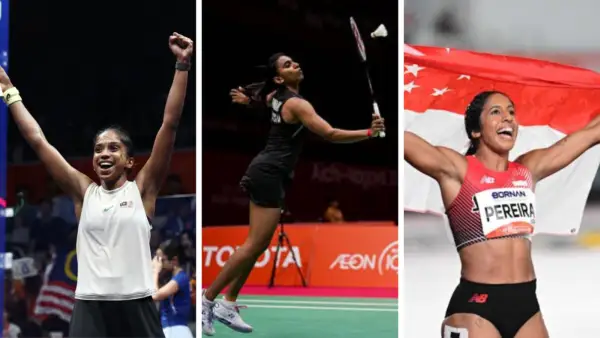
This silk route actually ferried Kanjivaram and Katan silk sarees from India to the Kedahan province in Malaysia where Sivasangari Subramaniam adorned the most gorgeous Indian weaves.
Peacock blues and fuschias and royal purples for temple visits every Diwali has been a tradition, accompanying her parents Subramaniam Kaniappan and Valli Nagappan in Sungai Petani. The town has one of Mahatma Gandhi’s tallest statues and a thriving Tamil community.
The city answered an unlikely question to the most desperate search for the next Malaysian squash star after the legendary Nicol David. Sivasangari (pr ~ shivashankari) was a petite and super-motivated prodigious youngster, and when she returned from the U15 British Juniors in 2012, her entire class at SMK Sultanah Asmah landed to receive her at the airport.
Having sealed the first-ever Olympic singles spot for squash after beating Anahat Singh in the final, the Cornell University graduate will be greeted similarly on her return to Malaysia.
Sivasangari is one of three Asiad champions with Indian roots, born and raised in the South-East Asian sporting system. Badminton star Thinaah Muralitharan, who ensured a medal after defeating Treesa Jolly-Gayatri Gopichand alongside partner Pearly Tan, and Singapore’s 200m sprint champion Shanthi Pereira are the others.
The talent of Sivasangari, now World No.5, was evident at 9, and she only got better developing skills and smarts in the super-competitive Malaysian clubs. While she was making quick strides in sport winning NCAA titles for Cornell University, a road accident when her car rear-ended into a lorry, shook Malaysia. It was on the same stretch that had witnessed Kento Momota’s accident a few years ago, and the country prayed as she was taken into emergency surgery with injuries to her head and C1 vertebrae.
Sivasangari proceeded to return to the PSA Tour, win Asiad titles and was also the bearer of the Malur Gemilang (national flag) at Hangzhou. Malaysian Prime Minister Datuk Seri Anwar Ibrahim would call her “proof of the determination, discipline, and fighting spirit of our athletes in bringing honour to Malaysia internationally.”
The high-achieving and hard-working Tamil community of Malaysia found a new hero after Nicol David, the eight-time Malaysian world champion and five-time Asiad gold winner, whose father Desmond David is an engineer of Tamil descent.
200m champ with Indian roots
Shanthi’s favourite satins are ribbons in white and red, so when she sprints over the curve to hit the home stretch of the 200m, Singapore’s colours trail her like a comet’s tail. Then the gold gets added on the podium.
Her father Clarence Pereira moved to Singapore from Thiruvananthapuram. Her mother, Bridget Jeet Pereira, came from Amritsar. Her siblings are Shobana, Anand and Seema, and when she’s not sprinting at the Asian Games, clocking 22.78s on Sunday, she dons a Kasavu visiting Kerala often. It was her grandfather who migrated from Vettukad. But Singapore went crazy when she ended their 49-year-wait for an Asiad track & field medal at Hangzhou, taking silver in 100m.
Singapore happily asked their ‘Sprint Queen’ to lead the contingent at the Paris Olympics opening ceremony.
Thinaah, the daughter of Indian-origin doctor and engineer,
has a successful partnership with Tan, and thanks her for brushing up her Mandarin so communicating became easier.
Her father S Muralitharan had been an engineer, and mother Parimala Devi Kalingam a doctor. The pressure of academics weighed on her as she grew up in Selangor.
But badminton is a religion in Malaysia, and her siblings all trained at a club.
“It’s like a family thing,” she would once tell lifestyleasia.com. “My sister stopped because she’s more of the studious type. And my brother is an engineer now. So, I’m the only one in the badminton field (laughs). My family background is quite studious, I’m the ‘odd’ one in the family. I wanted to prove a point, that sports could bring me somewhere as well.”
The World Championships silver medallist and twice Commonwealth Games champ, now 28, finally ensured a long coveted Asian Games medal after beating Treesa-Gayatri in an attacking barrage to make the semis. The partnership had made badminton sense, both tall, powerful hitters. But communication had been an issue, so Thinaah added Mandarin to English, Malay and Tamil that she speaks fluently.
“When I’m angry I don’t know what language I speak. But she (Tan) understands,” she would chuckle.
They didn’t forget their Indian roots, but with a World Top 5 in squash, doubles badminton star and a 200m gold medallist sprinter, they bust myths of restrictive genetics, even as Malaysia and Singapore flaunt their champions.