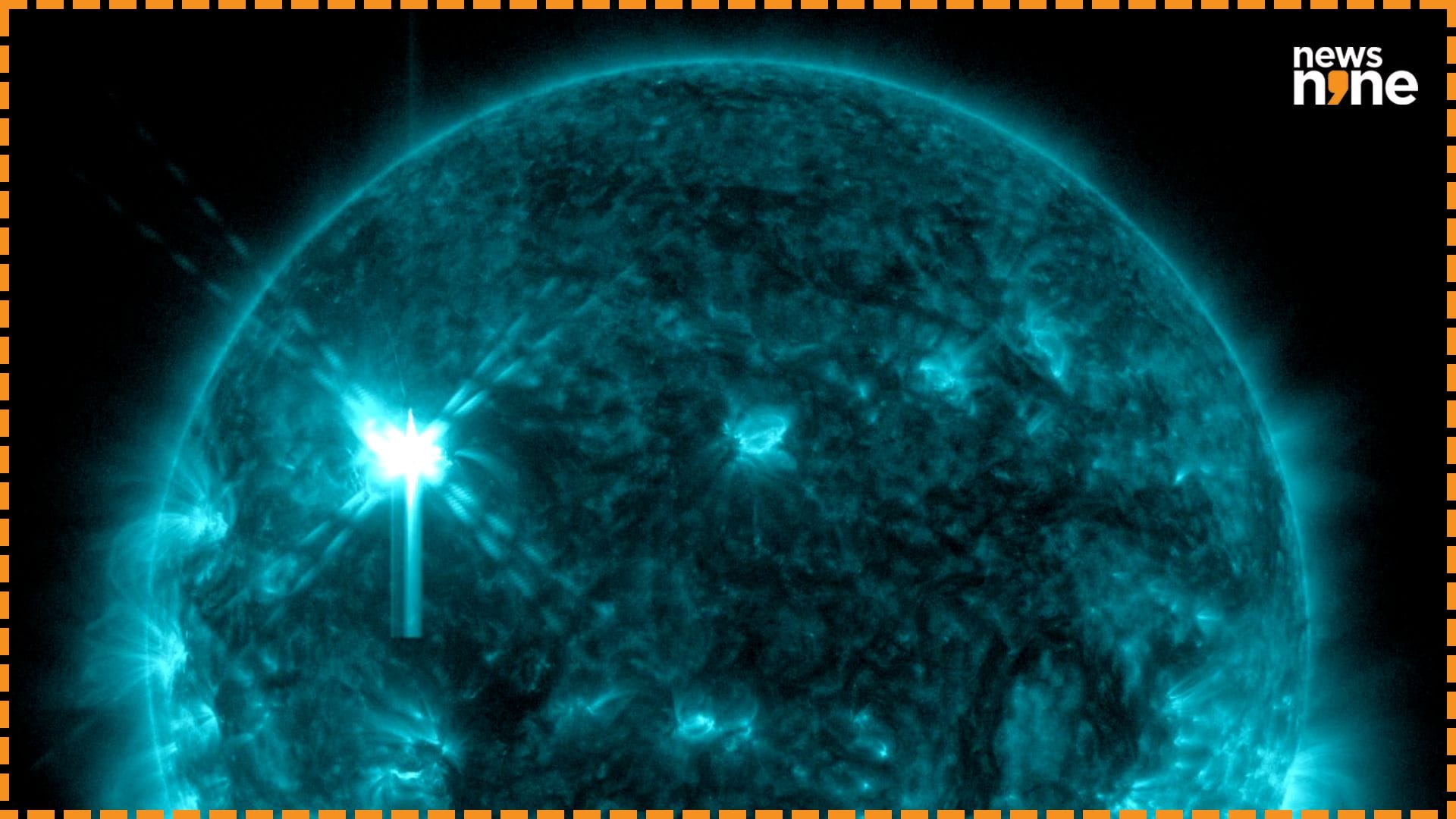
New Delhi: After rotating into view a few days ago, the cluster of sunspots designated as Active Region (AR) 4366 by the Space Weather Prediction Centre (SWPC) operated by the US National Oceanic and Atmospheric Administration (NOAA), and Sunspot Group 784 by the Solar Influences Data Analysis Centre (SIDC) operated by the Royal Observatory of Belgium has grown in size and complexity. Over the past 24 hours, this region has fired off five X-class flares, the most intense category of solar flares, and 16 M-class flares, which is the second-strongest category. These included an extremely powerful X8.1 flare which is the strongest of the year so far, and the third strongest in the ongoing Solar Cycle, Solar Cycle 25 which began in 2019.
According to the Centre of Excellence in Space Sciences India (CESSI) hosted by the Indian Institute of Science Education and Research (IISER) in Kolkata, “The Sun has launched multiple solar flares over the past 24 hours, the strongest one being an X8.1 flare at 2026/02/01 23:57 UT. These strong flares are associated with magnetically complex active region 14366. Our analysis shows a rapid energisation and escalation of its flare productive parameters is ongoing. There is a high probability of flares and associated Earth directed CMEs over 48 hours. We are issuing an advisory of likely severe to extreme Space Weather over the next few days during which period the highly active AR 14366 – with complex magnetic configuration – will rotate towards the Sun-Earth line. Associated CMEs will be in the Earth strike zone.”
Severe Space Weather ahead
Region 4366 is complex, and contains a high flare position, and may erupt in additional X-class flares. The cluster of sunspots is aimed straight at the Earth, and will be for the next few days. Any Coronal Mass Ejections (CMEs) that erupt during this time period will be aimed straight at the Earth. This is good news for aurora chases, who can expect to see some spectacular displays of polar lights. At the moment, the SWPC has forecasted a minor geomagnetic storm on 5 February, “Activity is expected to increase from unsettled to G1 (Minor) storm levels on 05 Feb due to the anticipated arrival of the complex CME ejecta associated with the 01/2357 UTC X8.1 flare from Region 4366.”