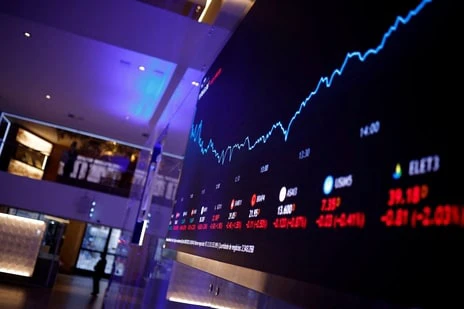
India’s stock market deepened its retreat today, capping a brutal two-day selloff that has erased more than ₹10 lakh crore in investor wealth.
The 30-share S&P BSE Sensex plunged 1,065.71 points to 82,180.47, while the wider Nifty 50 dives 353 points to 25,232.50, as a perfect storm of geopolitical tensions, relentless foreign outflows, and pre-budget jitters hammered risk appetite of investors.
“Domestic markets remained cautious ahead of US Supreme Court’s ruling on Trump-era tariffs, with renewed uncertainty over US trade policy prolonging the recent consolidation,” Vinod Nair, head of research at Geojit Investments, said in a statement. “Continued FII outflows, rising US and Japanese bond yields, and a weakening rupee weighed on investor confidence.”
The selloff accelerated as sentiment soured globally after US President Donald Trump threatened to impose tariffs on eight European nations. The dispute, centering on Trump’s aggressive stance on Greenland, has raised the spectre of a Trans-Atlantic trade war. The EU is reportedly preparing retaliatory tariffs on $108 billion of US goods if Washington proceeds with a 10% levy on 1 February.
“The volatility is likely to continue until clarity emerges regarding US-Europe standoff,” V.K. Vijayakumar, chief investment strategist at Geojit Investments, said in a statement. “Since both sides have hardened their positions, the uncertainty will linger.”
FII outflows from India’s stock market
Compounding the gloom is a mass exodus of foreign capital.
Foreign institutional investors (FIIs) have offloaded more than ₹29,000 crore in Indian equities this month alone. Pankaj Pandey, head of research at ICICI Securities, noted that the selling intensity is “on the higher side”, driven by a weakening rupee and skepticism over a potential India-US trade deal.
Domestically, third-quarter corporate earnings have failed to provide a safety net. Results have been lukewarm, weighed down by the one-time impact of new labour codes, with few positive surprises so far.
Investors are also retreating to the sidelines ahead of Union Budget 2026 on February 1. While the market anticipates measures to boost consumption, fears that fiscal consolidation targets could curtail government capital expenditure are keeping bulls at bay.
As risk-off sentiment takes hold, capital is fleeing to safe havens. Gold and silver prices have surged to record highs, with investors dumping stocks to hedge against the deepening geopolitical fractures and uninspiring domestic growth signals.