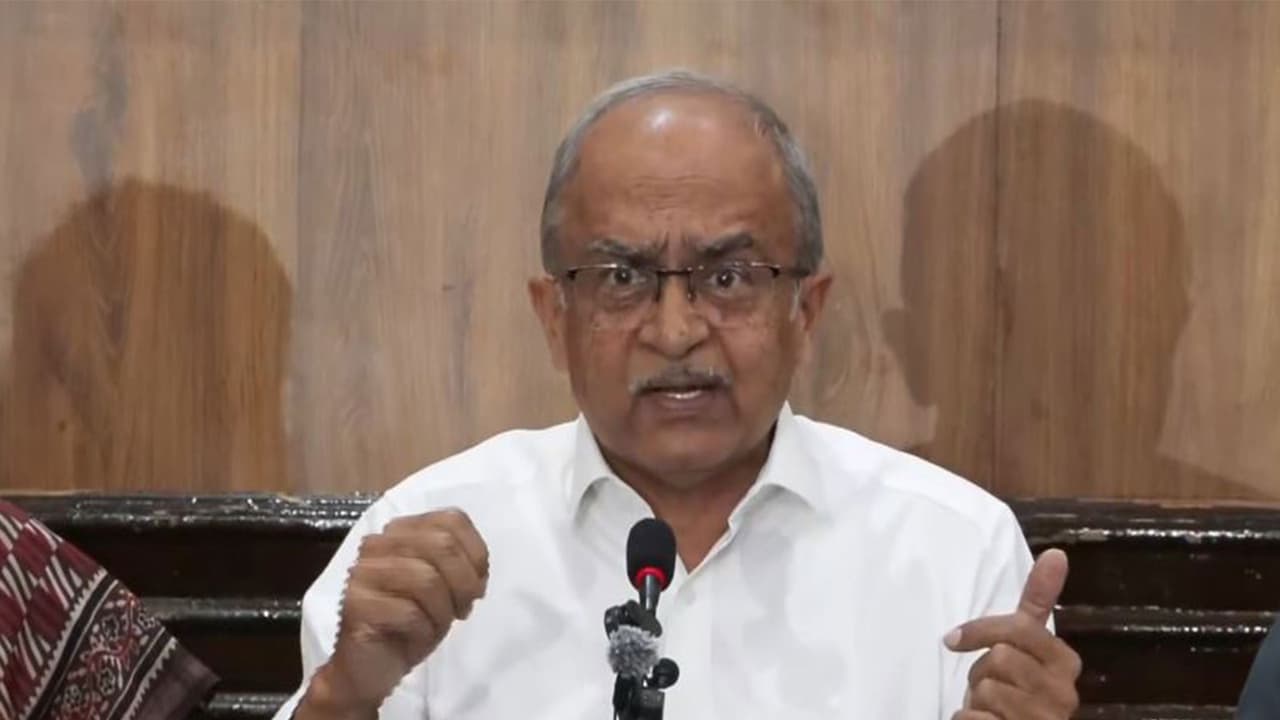
Prashant Bhushan has accused the ECI of filing a false affidavit regarding unauthorized nationwide voter roll revisions, calling for prosecution of officials and highlighting concerns over algorithmic voter exclusions and lineage requirements.
Prashant Bhushan Challenges ECI Affidavit
Senior advocate Prashant Bhushan termed the Election Commission of India’s (ECI) affidavit before the Supreme Court “false,” and demanded the prosecution of officials involved, alleging that far-reaching decisions regarding the nationwide Special Intensive Revision (SIR) and voter roll alterations were executed without formal Commission meetings, statutory backing, or documented records. Addressing a press conference at the Press Club of India, Bhushan stated that Right to Information (RTI) responses revealed the poll body possesses no official record of who authorised the nationwide voter roll revision. “Who took the decision on SIR, when was it taken, and how was it taken? Regarding this, Anjali filed an RTI application seeking documents on who took the decision, when it was taken, and how it was taken. The Election Commission responded, saying that they have no record whatsoever of who took the decision on SIR, when it was taken, or how it was taken,” Bhushan said.
Concerns Over Procedural Irregularities
Criticising the Commission’s submission before the apex court, Bhushan pointed out that the affidavit was filed by a Deputy Election Commissioner claiming delegated authority and email-based concurrence rather than formal deliberations by the full Commission. “The question is: you are conducting SIR across the entire country, something being done for the first time since 1951. An unprecedented decision of this magnitude, rebuilding electoral rolls from scratch across the country, has not been taken in the last 75 years. And regarding that, you are claiming no meeting was held? That we circulated it electronically, and consent was received electronically? What was the emergency to bypass formal meetings for a nationwide SIR?” Bhushan asked.
Allegations Regarding Form 6 and Voter Deletions
Bhushan further accused the Commission of unilaterally changing Form 6 to introduce lineage verification without legal competence, overriding internal dissent. “Form 6 legally requires only three things: proof of age, proof of address, and a self-declaration of citizenship. They added a fourth requirement—asking applicants to show where their parents or grandparents were in 2002 and trace their lineage. Being a statutory form, the Election Commission cannot make such additions, and the other two Commissioners rightly objected to how this was inserted,” he said. He also raised concern over the centralisation of voter additions and deletions to an IT cell in Delhi, divesting field-level Electoral Registration Officers (EROs) of their statutory powers. “None of the substantive issues, the objections raised by the other Election Commissioners have been backed by documents showing when and at what time the other Election Commissioners gave their consent. In my view, this affidavit is false, and the officer who filed it, along with whoever granted him that authority, ought to be prosecuted,” Bhushan asserted.
Issues with Voter Data and Automated Software
Highlighting recent Supreme Court proceedings concerning voter deletions in Delhi, Bhushan stated that 47 lakh names were deleted, with approximately 32 lakh classified as ‘shifted’ and forced to file first-time voter forms. “The Election Commission stated in its FAQs that those who had shifted would be deleted from the draft rolls and must submit Form 6, which is meant for new voters and requires a declaration that one has never voted before. In effect, the Election Commission is asking 31 lakh people to fill Form 6 and submit a false declaration. Why were these people not allowed to file Form 8, which is specifically designed for shifted voters?” he asked. Touching upon the use of automated software to identify voter records, Bhushan added, “The Supreme Court made it amply clear that the issue of logical discrepancies has not yet been decided by the court. However, the bench observed that an algorithm appears to have been developed to mechanically exclude voters, raising concerns that the algorithm was designed in a manner that targets and excludes a particular class of citizens.” (ANI)
(Except for the headline, this story has not been edited by Asianetnews Editorial staff and is published from a syndicated feed.)