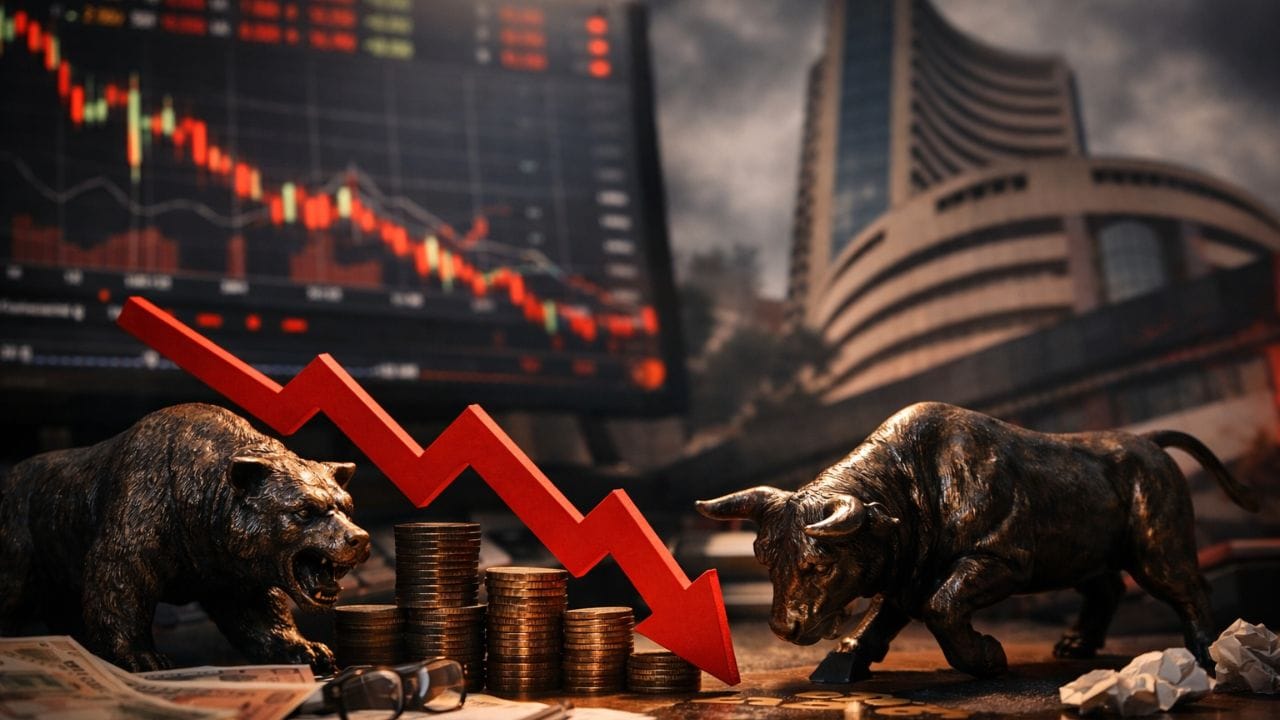
share market down
There was a decline in the Indian stock market on Wednesday also. Sensex and Nifty closed down for the third consecutive trading day. The reasons for this were selling in big stocks, increasing geopolitical tension and weak global signals. The fall which seemed small earlier is now becoming big and this week the market is continuously in the red.
In the last three days, BSE Sensex has fallen by more than 1,144 points. It had closed at 85,762.01 on January 2, but during trading on Wednesday it fell to a low of 84,617.49. At the same time, NSE Nifty 50 has also fallen by about 1% during this period. However, the market recovered some losses in the last hours of trading. The Sensex closed at 84,961.14, down 102 points or 0.12%, while the Nifty closed at 26,140.75, down 38 points or 0.14%.
Main reasons for market fall
- Selling pressure in big stocks- The fall in large and overweight stocks created huge pressure on the market. HDFC Bank shares fell 1.7% on Wednesday, while Reliance Industries closed down 0.4%. Trent shares fell 1.4%. Earlier, there was a big fall of 8.6% due to concerns of increasing competition in the retail sector. The impact of big stocks was also visible on the previous day, when shares of HDFC Bank and Reliance Industries fell by 1.5% and 4.3%, causing huge losses to the market. According to Dr. VK Vijayakumar, Chief Investment Strategist of Geojit Investments, at present there is no clear direction visible in the market. The sharp movement in some selected big stocks is affecting the entire market. He said that despite good institutional buying on the last trading day, Nifty fell because of heavy selling in Reliance and HDFC Bank. This decline is not due to any weak business condition, but due to technical reasons and settlement related activities.
- Geopolitical shock from Venezuela- The ongoing political turmoil in Venezuela and uncertainty over its oil reserves have increased fear in the global markets. The situation worsened when on January 3, in a controversial US military action, President Nicolas Maduro and his wife were arrested and taken to America. Currently Maduro is in New York jail. These incidents have further increased uncertainty and anxiety in markets around the world. Dr. Vijayakumar said that due to news and events in the coming days, there may be sharp fluctuations in the market. He also said that the statements and decisions of US President Donald Trump often influence the market. Besides, the Supreme Court’s decision on the matter related to Trump’s tariffs will also be important for the market.
- Weak global signals and decline in Asia- Indian markets also showed the impact of the decline in Asian markets. Investors sold shares due to concerns about the Venezuela crisis and global energy supply. The fall in Japan’s markets put pressure on entire Asia. Shares in Tokyo fell further after China announced a ban on the export of certain items to Japan that could be used for military purposes. This step was taken after the Japanese Prime Minister’s comments regarding Taiwan. The effect of cautious environment across the world was clearly visible on Indian markets also.
- Technical signals are warning of fluctuations- According to technical data, the recent decline is not the beginning of a major recession, but it could be part of a market stagnation or correction. However, going forward, there may be more fluctuations in the market. According to MK Global expert Jaikrishna Gandhi, since 1991, Nifty has seen seven major bullish periods, each of which was followed by a brief recovery. Since 2009, this improvement has been seen in the form of a long stagnation rather than a sharp decline, which shows the strength of the market. According to him, Nifty has recently completed its time based correction and it is likely to go up to 28,500 in future. At the same time, the level of 25,500 to 25,300 remains a strong support. Sector wise, he described the pharma sector as strong. According to him, there are signs of bullishness in Nifty Pharma index and further growth may be seen in it.