New Delhi: Scientists have known that volcanic activity has shaped vast regions on Mars since the Mariner 9 images in the 1970s revealed massive shield volcanoes and extensive lava plains. The tallest volcano in the solar system, Olympus Mons is on Mars, and rises nearly three times higher than Mount Everest. Alba Mons on mars is the widest volcano, stretching across a distance similar to the continental United States. Most Martian volcanism involved effusive basaltic eruptions, producing calm outpourings of runny lava that deposited in sheets across the surface, and built up features such as Olympus Mons and Alba Mons. This is the style that dominates the volcanic landforms on the Red Planet.
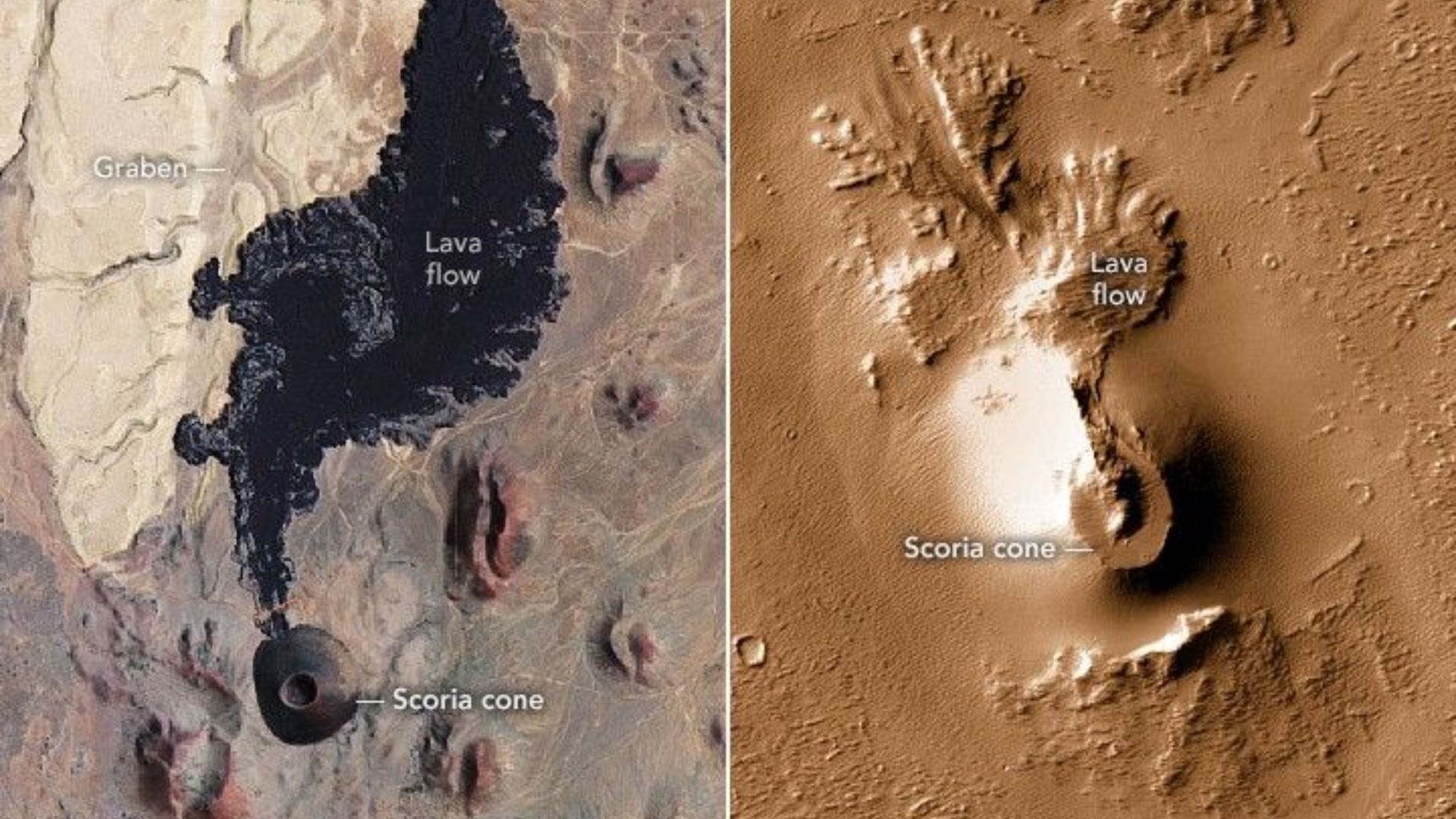
Explosive volcanism creates cones, pyroclastic flows and ash deposits, and are far less common. Mars has a low atmospheric pressure, about 160 times thinner than the Earth. Mars also has a gravity that is only about one-third that of the Earth. Both of these together should make explosive eruptions easier on Mars, at least in theory. However, the features associated with explosive eruptions are rare, with the scarcity puzzling planetary scientists and geologists for decades. In the southern edge of the Ulysses Fossae in Tharsis, scientists identified volcanic cones in the 2010s that are clear evidence of explosive activity. These are known as scoria cones, and enhance the understanding of Martian Volcanism.
What the Scoria Cones reveal
NASA’s mars Reconaissance Orbiter first imaged these features in May 2014. Similar scoria cones appear on Earth as well, including at the San Francisco Volcanic Field in Arizona. Both the sites show rounded hills with circular vents surrounded by dark lava flows. There are older, weathered flows in the background as well as younger, smaller flows spilling from cones. There are also collapsed crustal blocks known as grabens in both locations. There are tens of thousands of scoria cones on Earth, comprising about 90 per cent of land volcanoes. Mars only has a few tens to a few hundreds. Explosive volcanism may never have been widespread on Mars.