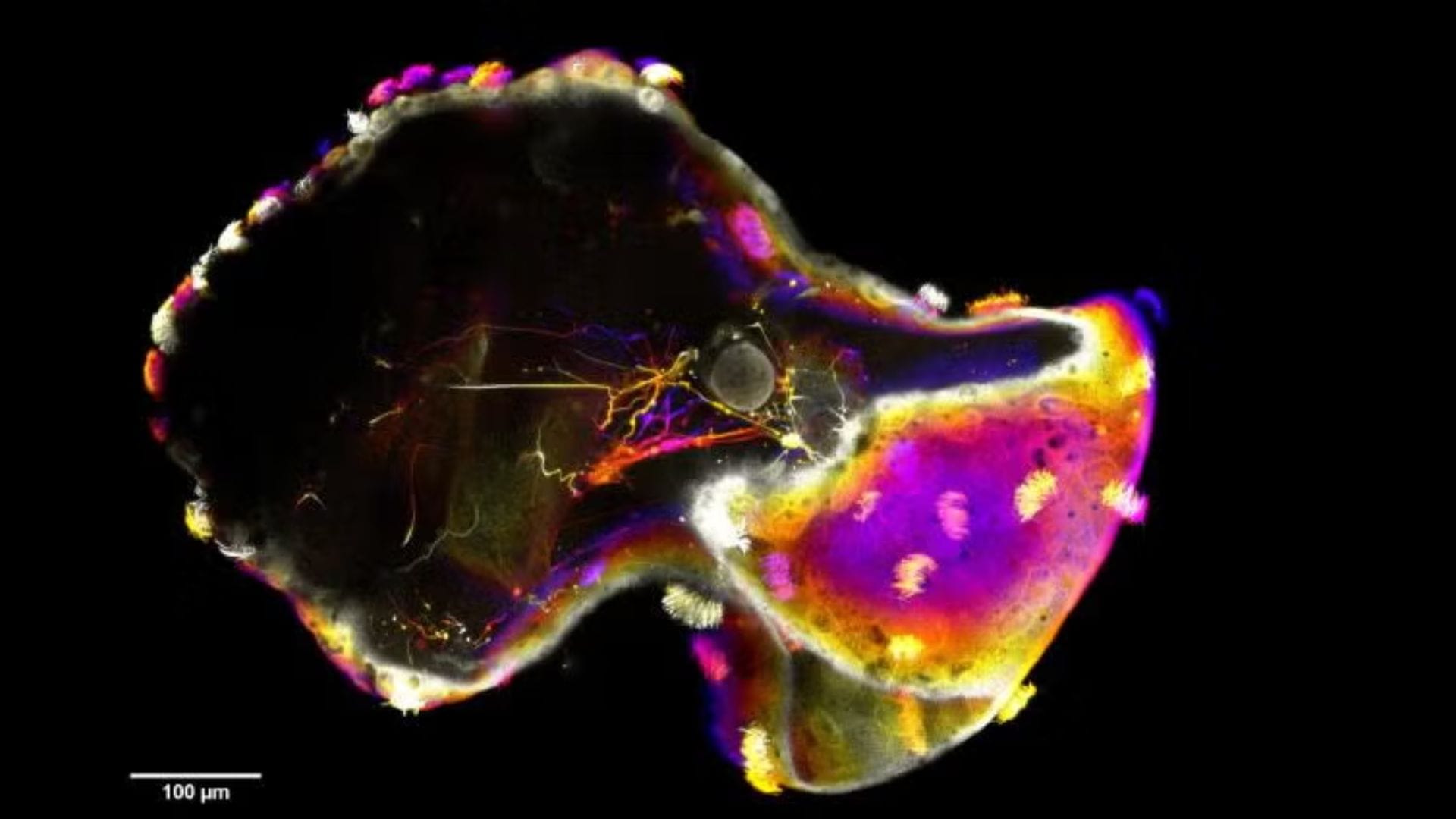
New Delhi: Back in 2020, scientists from Tufts University had developed small synthetic life forms capable of navigating watery environments, healing injuries, and gathering other cells to build copies, known as xenobots. These tiny machines were made using frog cells. Now, the same team has created a new class of living machines called neurobots, by introducing nerve cells to the xenobots. These artificial life forms grow larger, change shape and display more complex movement patterns than the xenobots, their predecessors. The neurobots are made from precursor skin cells of embryos of the African clawed frog. When these cells are placed in a dish, they spontaneously assemble into spherical structures covered in beating cilia that propel them through water.
Researchers implanted clusters of neural precursor cells into the forming spheres. As the neurons matured, they extended axons and dendrites, forming synaptic connections, and began firing in primitive networks. Microscopy and calcium imaging confirmed electric activity in the simple nervous systems. Compared to ordinary xenobots, the neurobots grew elongated rather than spherical, and spent less time motionless. They executed repeated, intricate movement patterns instead of moving in straight lines or simple circles. When exposed to a drug that alters brain activity, the swimming changed in ways that did not occur in non-neural biobots, proving that the new nervous system was driving the behaviour.
Reimagining Life
The research is part of a broader effort to discover the rules by which collectives of cells organise themselves. The researchers wanted to understand what would happen if biobots were given the raw materials needed to build a nervous system. They now have a living platform in which neurons self-organise inside a biological body that can exhibit novel behaviour. Unexpectedly, the nurobots activated genes associated with visual perception, including those for light-sensitive cells. The team is investigating whether the organisms could eventually develop the ability to sense light. The findings can guide future work in synthetic biology and regenerative medicine by revealing how cells solve problems of structure and function under novel conditions.