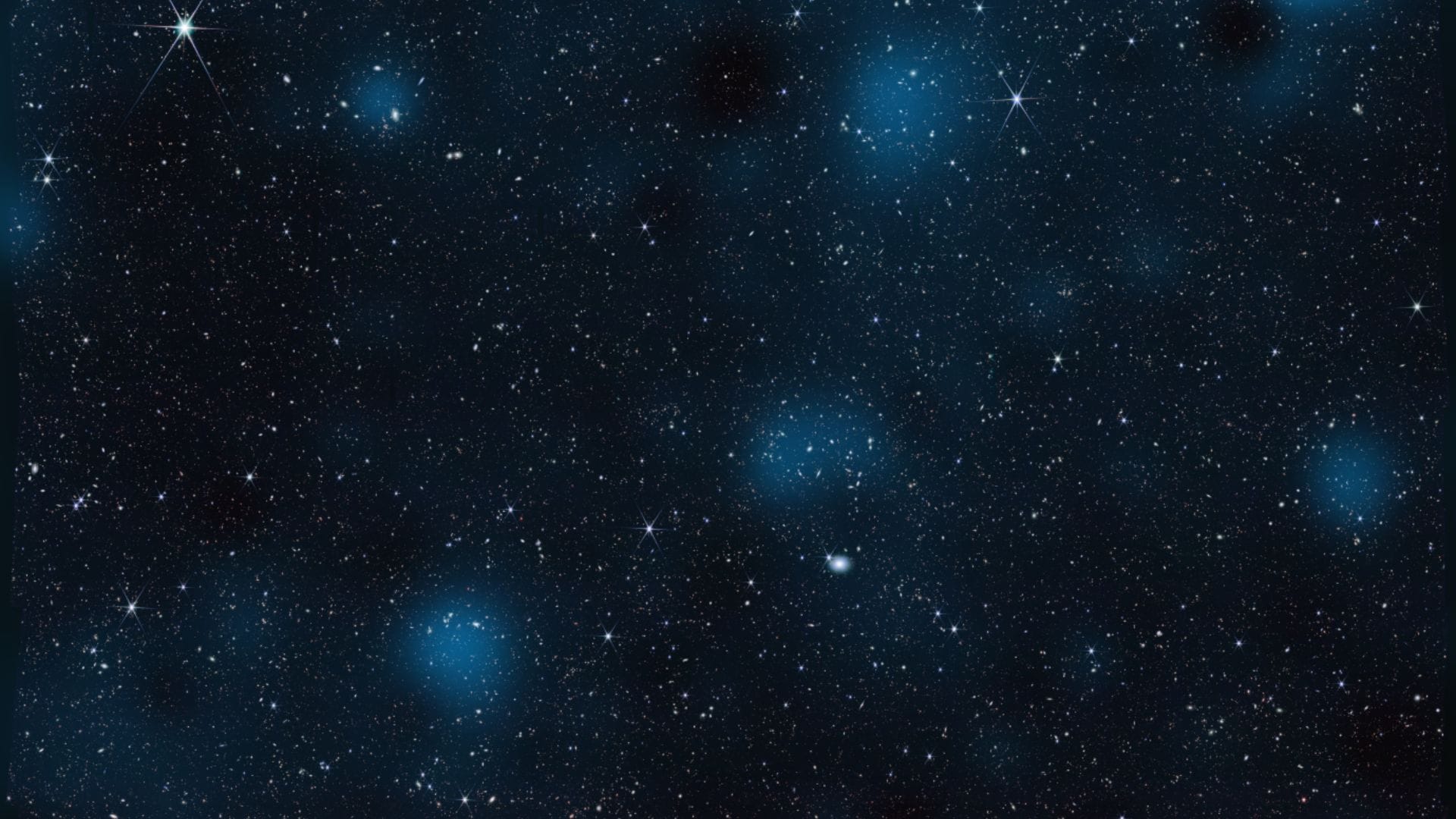
New Delhi: Scientists have used data from the James Webb Space telescope to produce the most detailed, high-resolution map of dark matter so far. The map covers a region in the Sextans constellation, roughly 2.5 times the area of the Moon. The map reveals how dark matter aligns precisely with visible matter, or the atoms that form stars, galaxies and planets. Dark matter is invisible and does not emit, reflect, absorb or block light. It passes through ordinary matter without resistance, and can only be detected through its gravitational influence. It is just an unknown source of gravity, and may not even be matter at all.
Webb detects dark matter through gravitational lensing. Dense regions of the universe such as galaxy clusters are in vast clouds of dark matter, that bend and distort the light from distant galaxies. Webb spent 255 hours observing the region of space, registering nearly 800,000 galaxies, ten times more than ground-based maps, and twice as many as Hubble observations of the same corner of the sky in 2007. The sustained data collection allowed the detection of previously unknown dark matter clumps, as well as finer structures in regions known to contain dark matter. The infrared instruments on Webb were able to peer through galaxies obscured by gas and dust.
Dark Matter and Regular Matter evolved together
Large clusters, with thousands of galaxies are embedded in vast quantities of dark matter. The dark matter halos extend for up to one million lightyears from the visible edges of galaxies in some models. Dark matter provides the gravitational influence necessary to hold galaxies together, or the stars would all have spun out. The map shows that dark matter and regular matter evolved together. In the early universe, both components were diffused.
Dark matter began to form clumps first under the influence of gravity, drawing in ordinary matter into dense regions. These regions collapsed to form stars and galaxies. Earlier star formation meant more generation of stars fused hydrogen and helium into heavier elements needed for rocky planets. This map provides evidence that without dark matter, the elements in the galaxy that allowed life to appear might not exist. Dark matter is not something that we encounter in everyday life, or even in the Solar System, but it has definitely influenced us. A paper describing the research has been published in Nature Astronomy.