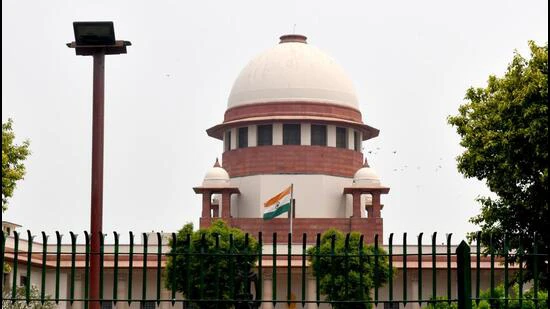
From scissors to the Supreme Court, a seven-year-old dispute over a haircut at a five-star hotel ended with the apex court trimming down a ₹2 crore compensation award to ₹25 lakh.
The court set aside an order of the National Consumer Disputes Redressal Commission (NCDRC) awarding ₹2 crore as compensation to a model who alleged loss of career opportunities after a bad haircut at the ITC Maurya Hotel in Delhi, holding that her claims were unsupported by reliable and admissible evidence.
A bench of justices Rajesh Bindal and Manmohan ruled that the complainant had failed to prove any concrete loss of modelling assignments, film roles, or income attributable to the haircut. It directed that ₹25 lakh, already disbursed to her pursuant to earlier court orders, would remain the final compensation.
The dispute dates back to April 12, 2018, when Aashna Roy visited the salon at ITC Maurya for a haircut. Dissatisfied with the service, she approached the NCDRC, alleging a deficiency in service and negligence, claiming that the haircut adversely affected her confidence, appearance, and professional prospects in the modelling and film industry.
In September 2021, the NCDRC found the hotel guilty of deficiency in service and awarded ₹2 crore as compensation. While the Supreme Court, in February 2023, declined to interfere with the finding of deficiency, it remitted the matter back to the NCDRC for fresh determination of the quantum of compensation.
After remand, Roy enhanced her claim to ₹5.2 crore and produced photocopies of emails, certificates, and other documents to substantiate her alleged loss of assignments and prospects. The NCDRC once again awarded ₹2 crore along with interest at 9% per annum, leading ITC Maurya to move the Supreme Court again.
Allowing the appeal in part, the apex court found serious flaws in the NCDRC’s approach to quantifying damages. The bench noted that documents relied upon by Roy were mostly photocopies, none of whose authors were examined, nor were any steps taken to prove their authenticity.
“Damages cannot be awarded merely on presumptions or whims and fancies of the complainant,” noted the court, stressing that claims running into crores of rupees require “trustworthy and reliable evidence”.
In the judgment released on February 7, the bench also rejected the NCDRC’s reasoning that reliance on photocopies was justified because the complainant may not have preserved originals due to trauma. “General discussion in the impugned judgment may not justify such a huge compensation,” held the court, adding that even after remand, the complainant failed to establish how she had suffered losses to the tune of ₹2 crore.
The court further noted that several documents relied upon were either before or after the haircut and did not demonstrate any direct causal link between the alleged deficiency in service and the loss of professional opportunities.
It underlined that while the Code of Civil Procedure may not strictly apply to consumer proceedings, basic principles of proof cannot be diluted when compensation of such magnitude is sought. The complainant, the court said, had ample opportunity to summon witnesses or have documents authenticated, which she failed to do.
“Claim of compensation was for crores of rupees, for which some loss suffered by the respondent because of deficiency in service was required to be established. This could not be established by merely producing photocopies of the documents. Even the discrepancies in the photocopies produced on record by the respondent, as pointed out by the appellant, have been noticed above. Thus, even after remand, the respondent has not been able to make out a case for the award of such huge compensation,” said the bench.
While modifying the NCDRC’s order to restrict compensation to ₹25 lakh released to the complainant, the Supreme Court did not disturb the concurrent finding of deficiency in service against the hotel, closing a long-running dispute from a salon chair to the country’s highest court.