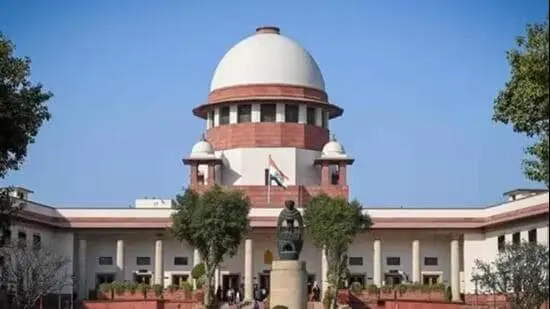
The Supreme Court on Tuesday sought responses from the Centre and other authorities on a plea seeking a Central Bureau of Investigation (CBI) probe into alleged fake advocates, fraudulent law degrees and activities associated with the “Cockroach Janta Party” (CJP) — a satirical online movement that emerged following observations made by Chief Justice of India Surya Kant during a court hearing in May.
A bench comprising CJI Kant and justices Joymalya Bagchi and V Mohana issued notice to the Union government, the Ministry of Electronics and Information Technology (MeitY), the Bar Council of India (BCI) and the CBI on a petition filed by advocate Raja Choudhary, who appeared as a party-in-person.
The plea also seeks examination of what it describes as the “commercial exploitation” and monetised circulation of oral observations made during Supreme Court proceedings, alleging that portions of the May 15 courtroom exchange were selectively clipped and subsequently turned into memes, videos, mimicry, political branding and commercial content.
The petition, however, makes it clear that it does not seek to curb criticism of the judiciary, democratic dissent, satire or free speech guaranteed under Article 19(1)(a) of the Constitution.
Instead, it alleges “organised commercial exploitation”, trademark appropriation and monetised circulation of courtroom observations, arguing that oral exchanges during judicial proceedings cannot be detached from their context and converted into commercial or political digital property.
The controversy traces back to proceedings before a bench headed by CJI Kant on May 15, when the court was considering concerns relating to professional standards in the legal profession and the alleged entry of persons holding fake or fraudulent law degrees.
During the hearing, the CJI expressed concern over unemployed young lawyers moving away from the legal profession towards social media and RTI activism, and had used the expression “cockroaches” while describing such persons.
“There are youngsters like cockroaches who are not getting employment in the profession. Some are on social media, some become RTI activists,” the CJI had observed during the exchange.
The remarks drew considerable attention online and were subsequently circulated widely in clipped videos and memes.
The CJI later clarified that the observation was not directed at unemployed young people or genuine lawyers unable to find work, but at persons allegedly entering professions on the basis of forged qualifications and fake degrees.
“I am pained to read how a section of the media has misquoted my oral observations made during the hearing of a frivolous case yesterday,” the CJI said in a statement issued on May 16, stressing that he held “immense respect” for the youth of India.
The petition filed before the Supreme Court now contends that portions of the courtroom exchange were selectively extracted from the proceedings and circulated without the surrounding context, resulting in trolling, mimicry and viral content.
It further alleges that the controversy was subsequently converted into a vehicle for branding, publicity, online engagement and commercial activity.
The May courtroom exchange also gave rise to the “Cockroach Janta Party”, an online satirical campaign that adopted the expression used by the CJI and turned it into its central political and cultural motif.
The movement, according to the plea, rapidly acquired a substantial social-media following and also saw trademark applications being filed for the expression “Cockroach Janta Party”.
The campaign went beyond satire on the courtroom exchange and organised protests, including a demonstration at Delhi’s Jantar Mantar over alleged examination-paper leaks and issues concerning the education system.
The CJP’s protest targeted then Union education minister Dharmendra Pradhan and sought his resignation over the handling of examination-paper leaks, including the National Eligibility cum Entrance Test (NEET) controversy. Pradhan subsequently resigned from the Union Cabinet.
The petition has now sought an examination of activities associated with the outfit along with the broader issue of alleged commercial appropriation of expressions originating in judicial proceedings.
While linking the two issues, the petition essentially raises two separate concerns — the alleged proliferation of fake lawyers and the subsequent digital and commercial use of the courtroom observations.
On the first, Choudhary has relied on a recent Allahabad high court judgment in Mohammad Kafeel Vs State of Uttar Pradesh and Another, which dealt with concerns over the criminalisation of the legal profession arising from the proliferation of fake lawyers. The plea also refers to a statement attributed to the BCI chairperson that around 35-40% of advocates are fake, and seeks an independent investigation into allegations of fake advocates, fraudulent law degrees and impersonation in legal practice.
The second part concerns the manner in which oral observations made in court are subsequently consumed and circulated online. The petitioner has argued that while criticism of judicial orders is constitutionally protected, courtroom exchanges cannot be “appropriated” for commercial exploitation, political branding, merchandising, trademark benefits or monetised digital circulation after being stripped of their judicial context.
The plea contends that such selective dissemination risks reducing constitutional proceedings to viral digital content and, in the process, affecting public understanding of what actually transpired in court.
The petition has therefore sought directions to competent authorities to investigate and take action, in accordance with law, against persons or entities allegedly involved in the commercial exploitation, trademark appropriation or unauthorised commercial use of oral observations made during Supreme Court proceedings, including activities associated with the CJP.