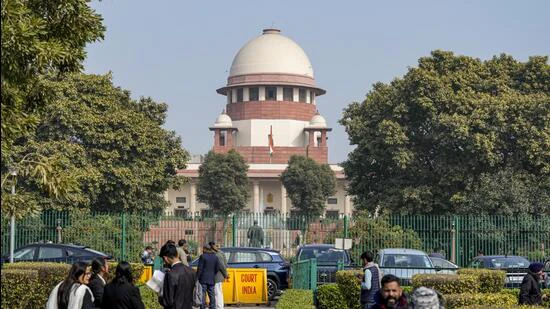
The Supreme Court on Tuesday refused to entertain a petition challenging the discretion exercised by the district collector in allowing “VIPs” to enter the garbhagriha (sanctum sanctorum) of the Shri Mahakaleshwar Temple in Ujjain, observing that courts cannot decide who should be permitted to enter a temple and raising doubts over the justiciability of such pleas.
A bench comprising Chief Justice of India Surya Kant and justices R Mahadevan and Joymalya Bagchi allowed the petitioner to withdraw the plea after a brief hearing and permitted him to make a representation to the competent authorities instead. “In the presence of Mahakaal, nobody can be a VIP,” the bench remarked during the hearing, while cautioning against courts stepping into matters of temple administration. “Whether it should be allowed or should not be, it’s not for the court to decide. We are on the question of justiciability,” the bench said.
The petition, filed and argued through advocate Vishnu Shankar Jain by Ujjain resident Darpan Awasthi, assailed the practice of granting special access to select devotees to enter the innermost precincts of the temple for performing rituals, while denying similar access to ordinary devotees. The plea challenged an August 28, 2025 judgment of the Madhya Pradesh high court that had dismissed a public interest litigation on the issue.
Jain argued before the top court that the absence of uniform guidelines governing entry into the garbhagriha resulted in arbitrary discrimination. “I am asking for uniform guidelines and a consistent policy for allowing people inside the sanctum sanctorum,” he said, contending that preferential treatment violated Article 14 of the Constitution.
“Citizens cannot be discriminated or differentiated on the basis of VIP status. If a person is entering the garbhagriha because of the recommendation of a collector, then an ordinary devotee visiting Mahakal should also have a right to enter and offer water to the deity,” Jain said.
The bench expressed concern over the implications of judicial intervention in such matters. “If courts start regulating who should be allowed to enter or who should not be, it’s too much for the courts,” observed the court, adding that such decisions were better left to authorities “at the helm of affairs”.
When Jain reiterated that citizens must not be discriminated against in the exercise of their right to practise and profess religion under Article 25, the bench cautioned against extending fundamental rights jurisprudence into the sanctum itself. “First, you say I have a right to enter because so and so is entering, then you say I have the right to chant mantras here because I have a right to speech… so all fundamental rights will be there inside the sanctum sanctorum,” the bench said.
Following the exchange, Jain sought permission to withdraw the petition. Recording this, the court’s order stated: “The counsel for the petitioner makes a request to withdraw the petition, submitting that he would be submitting representations and suggestions with the authorities concerned.”
The plea had argued that the Shri Mahakaleshwar Temple administrative committee, constituted under the Shri Mahakaleshwar Adhiniyam, 1982, had no statutory authority to create a separate class of “VIP” devotees. It relied on resolutions of the committee passed in 2023, obtained through the Right to Information Act, which permit “State Guests, VIPs and VVIPs” to enter the garbhagriha under orders of the district collector or the committee chairman.