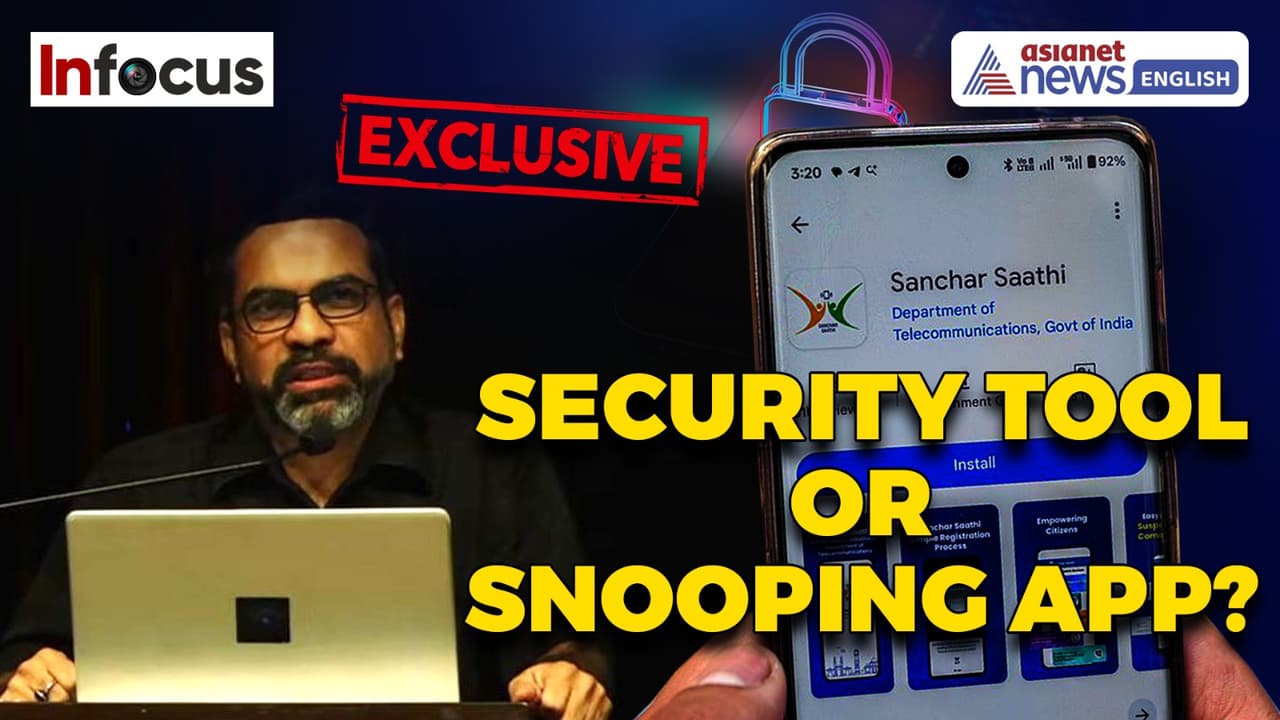
With Sanchar Saathi now mandatory on all smartphones, cyber expert Amit Dubey explains why fears of government snooping are misplaced — and how the app is India’s strongest weapon against cybercrime.
On December 1, the Department of Telecommunications (DoT) issued a significant order: every smartphone sold or imported in India within the next 90 days must come pre-installed with the Sanchar Saathi app.
The goal: combat the skyrocketing cybercrime ecosystem, especially scam calls, IMEI fraud, and phone theft.
But the direction triggered a firestorm of online outrage — fears of privacy intrusion, state snooping, even comparisons to authoritarian surveillance.
Although the Government on Wednesday announced that it will no longer require mobile manufacturers to pre-install the Sanchar Saathi app on all new smartphones, Asianet Newsable English’s Heena Sharma spoke with one of India’s most recognised cybersecurity voices — Amit Dubey – to separate fact from fear.
And the conversation reveals a story far more urgent than the panic suggests.

“Pre-installed does not mean activated”
Dubey begins by correcting the biggest misconception:
“No. It will not be activated. It will be pre-installed, but not activated. You will have to activate it.”
Preloaded apps are common — social media, OTT streaming platforms, UPI wallets — but none become functional without a user login, he stresses.
“For example, when you buy a phone, it comes with pre-installed apps like Facebook or certain UPI applications. These are bundled because of some commercial understandings. Similarly, some phones are pre-loaded with OTT platforms as well. But that doesn’t mean you can start using them. You still need to create an account, log in, configure it, and pay—only then you can use it. So even if the app is installed, it doesn’t do anything on its own. It’s just sitting there on your phone. You must configure and log in first. Only then can you use Sanchar Saathi,” he added.
“Before configuration, it’s not doing anything. And even after configuration, it’s not doing anything for you, because you have to do,” he clarified.
Permissions Panic: The Real Issue Is Communication
Why does the app demand camera, call logs, or SMS access? Dubey explains:
“Giving access of some functionality to an app doesn’t mean that the app is collecting this data. It clearly says that this app does not collect anything. Anything. Anything.”
“It’s not downloaded. It’s not stored anywhere,” he added.
Instead, the access exists only when the user chooses to report:
“You give this camera access because you would like to scan a QR code… if you are getting unsolicited communication… that access is given only during that time when you are reporting that content.”
At its core — the app is used only when citizens choose to act.
A Double Standard? “You Trust Big Tech More Than Your Own Government.”
Dubey argues that technology trust has become selective — irrationally so:
“Facebook knows your political belief… your religious belief… your financial data… They are listening to you all the time. Now there is an app which is not collecting anything… And there’s a huge gap.”
He points out the irony: Users willingly share biometrics, spending habits, and location with private apps — but panic when a government tool seeks only incident-based reporting.
“Government Does Not Need to Install an App to Surveil You”
Dispelling the dystopian surveillance fears, he states bluntly:
“Government does not need to specifically ask you to install something. They don’t, they don’t need to do that. They are empowered enough.”
“They can do it without installing anything, if they want to do it,” Dubey declared.
He stresses this holds true in every nation.
“This is not only with your government. This is with any government, any country. They are powered because they have to ensure security, and they can even ask the telecom operator or to, to any service provider. So don’t think that they are listening to you all the time. Nobody has time, and this country is of 140 crore people. You can’t do that to each other,” he added.
India’s Cyber Reality: Awareness Alone Cannot Save Us
India experiences up to 1 cybercrime every 7 minutes, according to NCRB data. And yet, as Dubey notes:
“Whatever awareness you do, it won’t work in a country like India. We have been doing it since last 20 years, but people still are ignorant for few basic things.”
“Now we’ll have to deduce methods to enable these tools where we can protect them proactively,” he added.
Which is why the app has been pushed harder now.
And despite low awareness — results already show impact:
“Sanchar Saathi app is not a new app. It’s been there for almost one year. The portal is there for almost three years. In last one year, I think it has about 10 million, 10 million downloads already. Almost 1 crore downloads.”
“In last one year, because of this app, we have recovered more than 24 lakhs phones, and the 42 lakhs phones were blocked because of this app,” he revealed.
That’s 66 lakh devices prevented from criminal use.
IMEI Spoofing Isn’t the Crisis You Think It Is
Many fear tech-savvy crooks will bypass the app using IMEI tampering tools. Dubey dismantles this fear:
“We find [IMEI spoofing] in only 0.001% cases… 99 plus percentage of time, criminals are using your phone as it is. That’s why we were able to block it. Otherwise, if they all were spoofed, how could we block that?”
Blocking stolen IMEIs remains highly effective in India.
Cybersecurity Is a Mutual Responsibility
Dubey also raised a crucial question: how could authorities trail these criminals and retrieve what was lost? According to him, even the small progress made indicates that efforts are indeed being taken in the right direction — efforts that should not be dismissed.
“We should not avoid those efforts. Otherwise, just to focus on that 0.01%, we may lose this chunk of misuse,” he said.
The cyber security expert also emphasized that the intention behind these initiatives is fundamentally proactive action:
“If the crime has already happened, then Sanchar Saathi can’t do anything. Sanchar Saathi will only help you proactively… If something is approaching you, calling you — at that time, you can report, and the number will be blocked. But if you have already lost money, then for that, Sanchar Saathi is not doing anything.”
Dubey highlighted mutual responsibility as a core principle of cybersecurity: “Cybersecurity is a mutual responsibility. It can’t be achieved in isolation.”
He stressed that when people ignore fraud attempts, they unintentionally enable criminals:
“If I know this is a fraudster’s number but I have not reported it, actually I have enabled that criminal to loot someone else.”
To drive the point home, he compared it to ignoring harassment in public:
“If I see a girl walking alone and people are disturbing her, and I don’t report — that is also my responsibility. So in cyberspace, the community must join hands and put effort together so that we can target criminals together.”
Cybercrime: A ₹1 Lakh Crore Industry That Moves Faster Than Policing
He shares insights from multiple investigations:
“We can’t prove that this person is the same person… Post-mortem activities won’t help you. The only thing will help you is… Report, block. Report, block.”
Why is prosecution difficult? Because criminals hide behind:
- Stolen phones
- Bank accounts opened using duped farmers’ Aadhaar
- SIM cards taken in others’ names
- Ever-changing GPS locations
Cybercrime is now industrialised.
“When there is this industry of 100,000 crores in here, all kind of support system will start building,” Dubey added.
The World’s “Secure” Nations Monitor More Than India
When asked about countries like the UK, he drops a surprising fact:
“They are secure because they do more monitoring… They are tracking each and every activity through a single server.”
“Monitoring to wahan jyada ho raha hai,” he declared.
Even then, he says: “Every country is facing more cyber crime than India.”
Humans remain the weakest link.
India Could Become the First in the World to Achieve This
If adoption succeeds, Dubey believes India could lead global cyber policing:
“If we could do that, this will be a disruption. Nobody in the world could do this. India would be leading it. We can actually mobilize crores and crores of people against criminals.”
This is not just an app — but a potential collective weapon against cyber predators.
The Final Verdict
Mandatory? Not anymore.
Mass panic? Unnecessary, says Dubey.
The real fight isn’t privacy vs. surveillance. It’s citizens vs. cyber syndicates.
If Sanchar Saathi works as intended — cybercriminals may soon find India the hardest country in the world to operate in.
But success requires trust, cooperation, and a simple belief: Security is not the government’s job alone. It’s ours too.