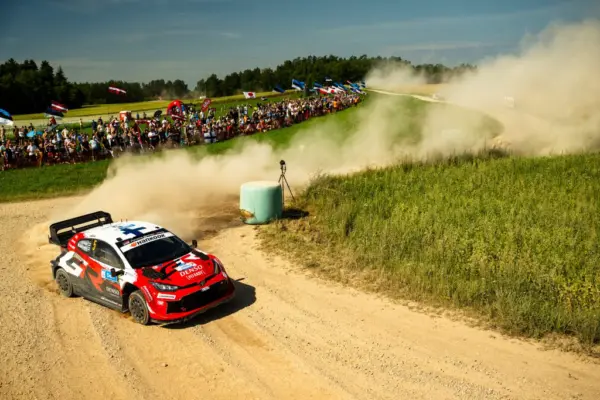
Sami Pajari delivered a rallying masterstroke in Estonia, storming to his first-ever World Rally Championship victory in a performance that left rivals and spectators in awe.
Behind the wheel of his Toyota GR Yaris Rally1, co-driven by Marko Salminen, Pajari dominated from the opening stage through to the finish, completing Rally Estonia’s demanding new 50-hour format with relentless pace and composure. He crossed the line 19.5 seconds clear of Toyota team-mate Oliver Solberg and co-driver Elliott Edmondson, capping a breakout result that signals his arrival among the WRC elite.
Pajari’s supremacy was underlined by his staggering haul of 12 stage wins out of 18, including a devastating streak of nine consecutive stage victories. The Finn led the rally from start to finish, refusing to yield under pressure and showing no signs of nerves despite the unfamiliar territory at the head of the field. Solberg, who claimed his maiden WRC win on these same Estonian roads last year, briefly threatened with a pair of stage wins on Saturday morning, trimming the gap to just 14.1 seconds. However, Pajari immediately countered, extending his lead in the afternoon and quashing any hopes of a late charge from his team-mate.
An emotional Pajari was almost lost for words at the finish, declaring: “It’s something so amazing! Maybe I don’t realise what I have just done. Everybody working at Toyota Gazoo Racing, I’m super, super happy and grateful for you! Thanks for all the support, thanks for trusting in myself. We knew it was coming, there was no doubt, but now we have done it. So, it’s good.”
At just 24, Pajari becomes the second new WRC winner this season, following in the footsteps of Toyota colleague Takamoto Katsuta. The result propels him to third in the championship standings, now 33 points behind leader Elfyn Evans. For Solberg, who has endured a bruising campaign with four retirements in the last five events, second place and a third podium of the season were welcome rewards. The Swede maximized his points haul by claiming victory on Super Sunday and the Power Stage, leaving Estonia with 27 points.
The fight for the final podium spot was a fierce intra-team affair between Hyundai drivers Adrien Fourmaux and Thierry Neuville. Both capitalized on advantageous road positions early on to move into contention, but lacked the outright pace to challenge the Toyotas. Fourmaux survived a dramatic moment over a jump, a brush with an anti-cut device, and a slow puncture, while Neuville recovered from early complaints about his i20 N’s handling to set the fastest time on stage 15 and close to within 1.9 seconds of Fourmaux. Ultimately, Fourmaux responded with authority on the penultimate stage, securing third as Neuville settled for fourth.
Reigning world champion Sebastien Ogier, contesting his first Rally Estonia since 2021, struggled with an unfavorable road position and finished fifth, though he achieved his aim of finishing ahead of title rivals Evans and Katsuta. Evans, forced to open the road on Friday, languished in ninth after the first day but climbed to sixth by the finish and extended his championship advantage to 25 points with a strong Super Sunday.
Elsewhere, Takamoto Katsuta’s challenge ended with a puncture-induced retirement on Friday, while M-Sport’s Martins Sesks rebounded from a 20-second penalty and a crash in shakedown to run as high as sixth before another puncture dropped him to seventh. Esapekka Lappi’s return to Hyundai was an exercise in frustration, the Finn unable to find pace and finishing eighth ahead of Jon Armstrong and Estonian hero Robert Virves, who clinched a hard-fought WRC2 victory by 7.6 seconds over Teemu Suninen and Roope Korhonen.
Pajari’s unforgettable triumph in Estonia marks a seismic shift in the WRC season, establishing the Finn as a serious contender and injecting fresh excitement into the championship hunt.