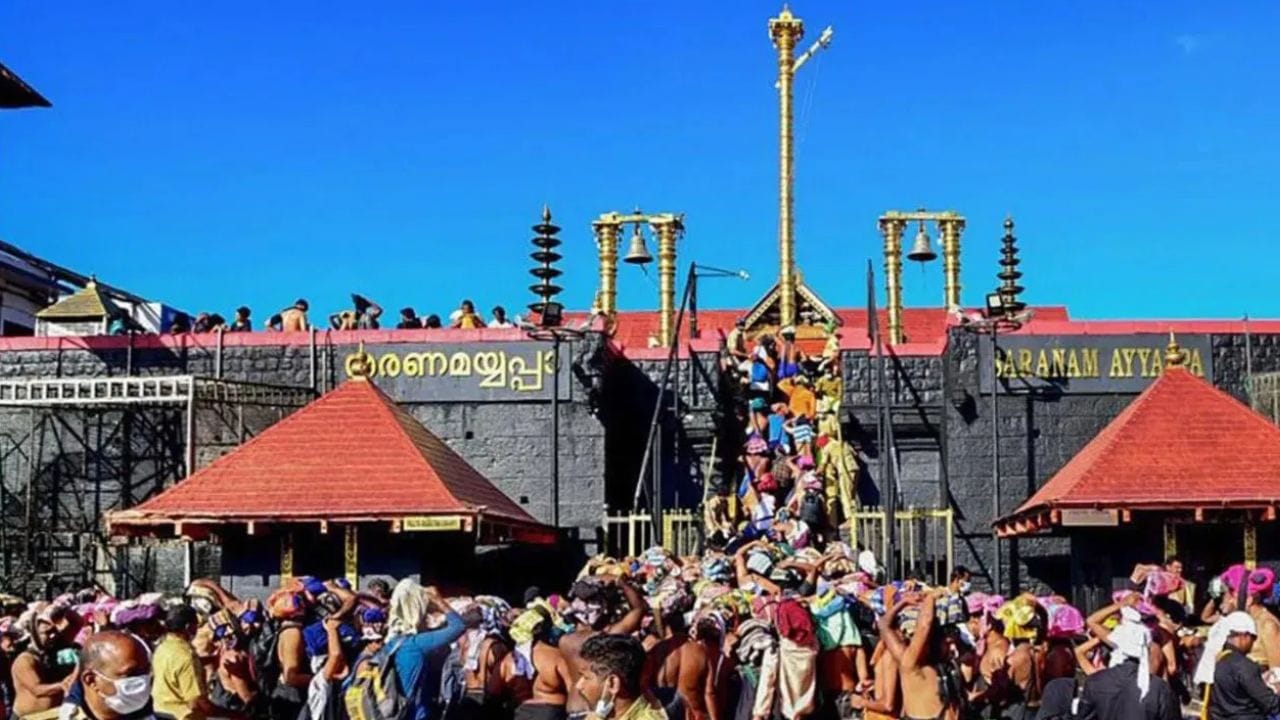
New Delhi: The Supreme Court will begin hearing the high-profile Sabarimala temple women’s entry case from April 7, with a nine-judge Constitution Bench constituted for the matter. The bench will be headed by Chief Justice of India Surya Kant.
Apart from the CJI, the bench comprises of Justices BV Nagarathna, MM Sundresh, Ahsanuddin Amanullah, Aravind Kumar, Augustine George Masih, Prasanna B Varale, R Mahadevan and Joymalya Bagchi.
Bench to examine broader constitutional questions
The case, no longer limited to Sabarimala alone, will examine broader constitutional questions. These include the balance between religious freedom and the right to equality and dignity, the scope of judicial review in matters of essential religious practices, and its impact on similar disputes across religions. The All India Muslim Personal Law Board and some Jain organisations have also filed intervention applications in the case.
In September 2018, a five-judge bench of the Supreme Court, by a 4:1 majority, allowed entry of women of all age groups into the Sabarimala temple. Then CJI Dipak Misra, along with Justices RF Nariman, AM Khanwilkar and DY Chandrachud, formed the majority. Justice Indu Malhotra dissented, saying that judicial intervention in matters of faith should be limited.
‘Devotion cannot be subjected to gender discrimination’
The court had held that devotion cannot be subjected to gender discrimination and rejected the argument that Ayyappa devotees constitute a separate religious denomination. It also struck down Rule 3(b) of the Kerala Hindu Places of Public Worship Rules, 1965, as unconstitutional.
Following the 2018 verdict, several review and writ petitions were filed. The nine-judge Constitution Bench is now expected to rule on larger constitutional questions that could set a precedent for future cases involving religious practices.