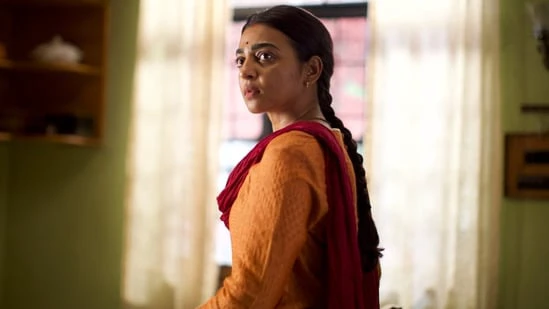
Actor Tisca Chopra’s directorial debut, Saali Mohabbat, evokes a feeling of déjà vu, like the aftertaste of a certain dish whose name we can’t recall.
But it’s a lingering memory of something strong and uncommon. The answer lies within the context itself, as Saali Mohabbat seems to have grown from the same seed that came in the form of a short film, Chutney, a few years ago. Tisca played the lead role of a woman who knows more than she shows in that sinister little film, a trait that is shared by the protagonist of her feature film here, Smita, played by Radhika Apte.
But what made the short film so memorable was the way the details were never spoon-fed to the viewer, and the intrigue unfolded along the way without requiring too much effort. Saali Mohabbat loses some of its momentum from the placement of Smita from the beginning, as she begins to tell a story that takes the viewer into a flashback. Tisca, who co-wrote the script with Sanjay Chopra, establishes that the typical whodunnit is not what interests her in this story. She wants to know more about this woman, where she comes from, and how far she wants to go.
The premise
Her days are long and nights longer in the quiet town of Fursatgarh, as her aimless husband, Pankaj (Anshumaan Pushkar), drinks his way through a huge debt. He wants to sell her ancestral home to settle the amount, but she cannot let that go- it is the only memory of her late mother. The only prospect that brings some joy to her mundane life is to be among trees and plants, as she grows her own fruits and vegetables in her little garden.
The arrival of her sister, Shalini (Sauraseni Maitra gives a fine supporting turn), complicates matters at home and threatens to disrupt whatever was left of Smita’s peace. Shalini also attracts the attention of a local policeman, Ratan Pandit (Divyendu Sharma), and slyly plays along with these two men along the way. She weaponises her beauty, but as it turns out, only to a fatal extent.
The central intrigue unfolds quite well, as Tisca confidently constructs the story within a story with an emotional anchor in place. The filmmaker wants to suggest that it is not the revelations that matter first; it is the story of this woman left to fend for herself that she wants to place ahead. However, the pace falters in the second half. More importantly, the script concentrates a little too much on the narrative shifts to focus on the edge that drives Smita.
Radhika Apte holds it tight
It is Radhika Apte who elevates the film and holds it tight even during its shakiest bits. As Smita, the actor’s body language effectively communicates the mounting discomfort and powerlessness at first, and transforms into something acerbic later. It is a sly and slippery performance from an actor who consistently manages to surprise, regardless of the language or format. Divyendu is quite effective in the supporting turn, and Anurag Kashyap seems to be having the most fun in a small yet crucial role.
Saali Mohabbat surprises and builds a story around a woman who is often overlooked and undervalued. It is a film that lurks around the corners, and from a distance, the frame reveals the unaccounted harshness Smita faces in her daily life. Tisca thankfully does not seep into any moral authority over her, and in doing so, lets the story speak for itself. The crime does not happen in a day; it never grows out of nowhere- there’s always a neglected and broken root somewhere, festering underneath. I know for a fact that Smita and Vanita (from Chutney) would be great buddies, discussing new recipes in their moments of leisure.