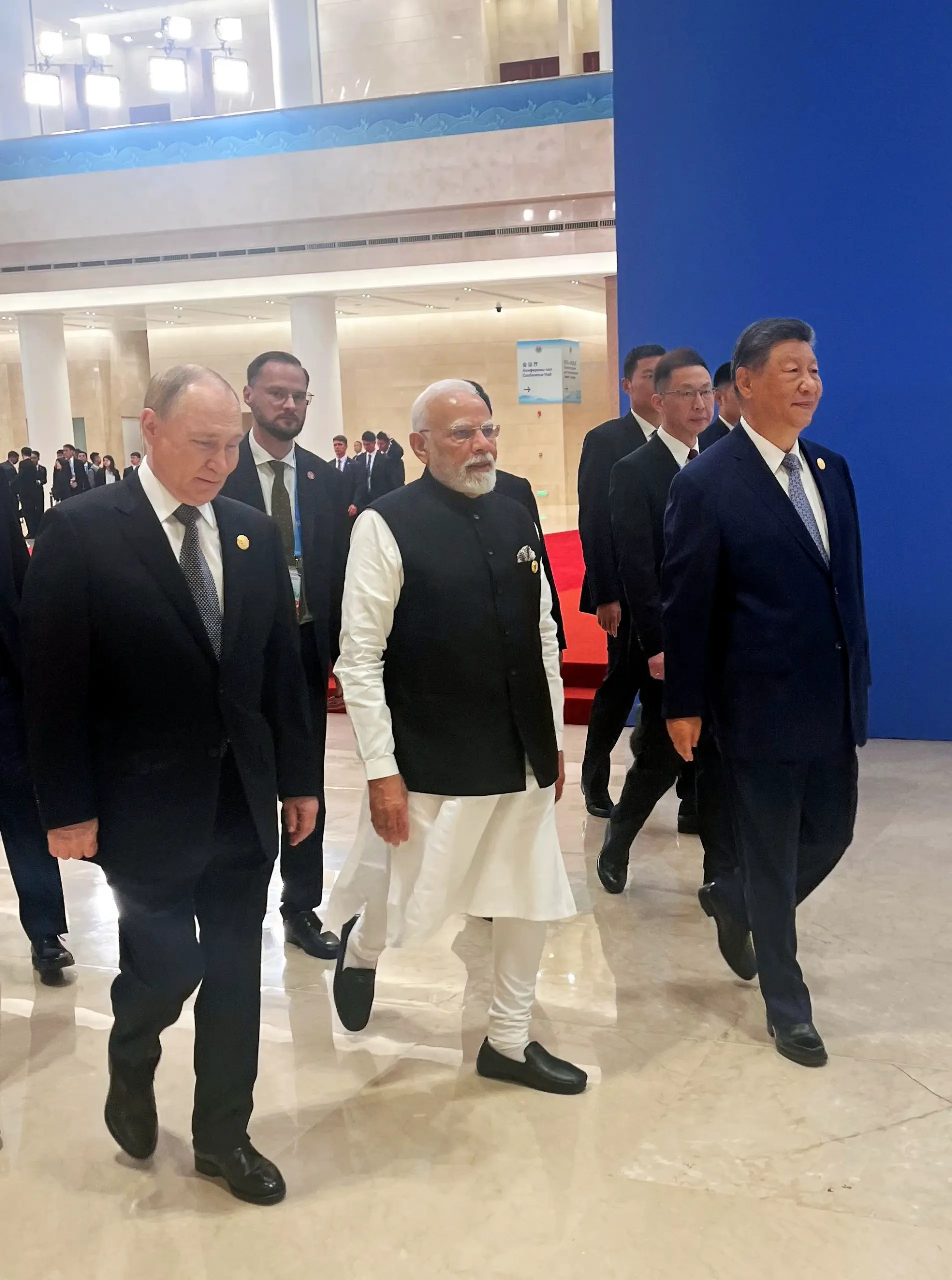
RUSSIAN President Vladimir Putin is in New Delhi on a state visit for the 23rd India-Russia summit. Amid an ongoing war and an unstable world order, what does the special and privileged strategic partnership mean for Russia today?
A look at Russian official documents offers a hint.
The 2021 National Security Strategy of Russia marked a small but significant change in its foreign policy objectives. It noted the development of a strategic partnership with China and India in the same sentence, unlike previous versions when the point about India came after China. The latest foreign policy concept, released in 2023, repeated this trend, mentioning China and India together in the subheading on regional tracks for Russian priorities.
This seemingly minor change pointed to a deeper concern in the Russian administration about the rise of China. While relations with the rising power had never been better, the asymmetries in the partnership were all too visible. Russia’s recognition of this imbalance pointed to how it sought to address it – by strengthening ties with India.
But Russia’s policy choices subverted its intentions, as the war with Ukraine in 2022 made China the most promising partner to replace the loss of European markets (except in oil trade). The situation revealed the skewed nature of Russia’s broader engagement with the Asia-Pacific. Trade with China soared to $244.8 billion last year, making it Russia’s leading trade partner, constituting over a third of its foreign trade turnover, with India a distant second at 8.8%.
With an economy under stress and resources directed to executing its war, Russia now faces the challenge of reducing its over-dependence on China. The cost is not just economic but also geopolitical, where China’s influence across Eurasia has been expanding. While the strategic value Beijing and Moscow have for each remains high, providing a strong basis to their relationship, the fact that China, as a power, is today in a different league is not lost on anyone.
In this situation, it is not surprising that the need to further the partnership with India acquires a renewed logic for Russia, providing an opportunity to balance its pivot to the East, vital for its foreign policy ambitions. The visit offers a chance to use Russia’s strengths to diversify economic ties in areas like agriculture, infrastructure, shipbuilding, space and nuclear energy. Longer-term sustenance of bilateral ties necessitates the continuation of defence-export contracts, maintenance of energy ties and identification of new areas of economic cooperation. Moscow seeks to secure Indian support for its multilateral agenda in non-western institutions, and also to reduce the prospects of one power dominating their functioning.
This bilateral agenda serves another purpose – that of underpinning the Russian worldview about itself, which reflects in its foreign policy. Since 2022, Moscow has positioned itself as aligned with the non-western world, where it occupies a key position in an emerging multipolar order. The Russian narrative of the decline of the West rests on the extent to which the non-western world pursues an independent foreign policy, wherein Russia is a valued partner, reflecting its reach in the Global South.
The other dominant worldviews currently guiding foreign policy – Russia as an anti-colonial power, a conservative civilisational-state espousing traditional values and a Eurasian power – all require recognition from the external world towards whom this narrative is directed. Without a strong backing from India, these Russian attempts to reorder its status in the international system would receive a setback.
Moscow’s self-identification as a great power, which paradoxically can no longer shape the contours of a new world order on its own, entails building partnerships with those who will have a role in shaping the evolving international system. In this pursuit, the role of India as one of the leading candidates cannot be denied.