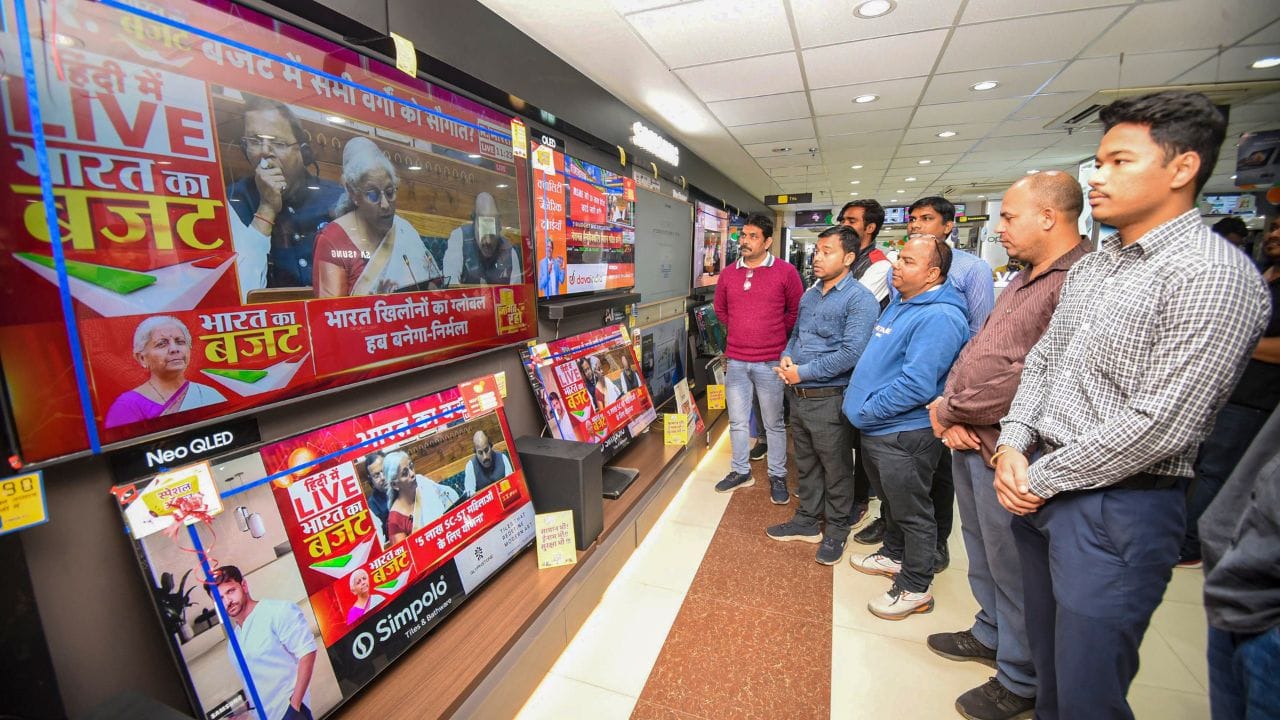
An increase in television prices may be seen in the month of January.Image Credit source: PTI
The impact of the fall of rupee may soon be visible on both the lives and pockets of common people. There may be an increase in the prices of television in the month of January next year. According to the report, due to the rising price of memory chips and record fall in the rupee, television prices may increase by three to four percent from January next year. The value of rupee has recently crossed the figure of 90 per dollar for the first time.
Why should television be expensive?
The falling rupee has put the industry in a vulnerable position as the domestic value addition in an LED TV is only about 30 per cent and key components such as open cells, semiconductor chips and motherboards are imported. Additionally, this problem is also linked to the memory chip crisis, where huge demand for high-bandwidth memory (HBM) for AI servers has led to a severe global shortage, causing prices of all types of memory (DRAM, Flash) to skyrocket. Chip manufacturing companies are focusing on more profitable AI chips, which is reducing the supply for traditional appliances like TVs.
How expensive can TV be?
Haier Appliances India President NS Satish said that due to memory chip shortage and weak rupee, the prices of LED TV sets will increase by three percent. Some TV makers have already informed their dealers about the possible increase in prices. TV makers Super Plastronics Pvt Ltd (SPPL), which holds licenses for many global brands including Thomson, Kodak and Blaupunkt, said that the prices of memory chips have increased by 500 percent in the last three months. According to SPPL CEO Avneet Singh Marwah, television prices may increase by seven to 10 percent from January due to the impact of memory chip crisis and rupee depreciation.
Benefits of GST in danger
These are not exactly favorable times for an industry which recently got a boost in demand after the government reduced GST on 32-inch and larger TV screens from 28 per cent to 18 per cent, which brought down prices by about Rs 4,500. Analysts say that a possible increase in costs may reduce this profit. Videotex Director Arjun Bajaj said that we are currently facing continuous pressure due to huge increase in memory chip prices, and availability is emerging as a serious challenge. At the source level, prices of flash memory and DDR4 have increased by up to 1,000 percent, largely due to supply being diverted towards AI data centres.
How big is India’s TV market?
Signs of slowdown are already visible in the market. According to Counterpoint Research, smart TV sales in India declined by 4 percent in the second quarter of 2025 compared to the previous year, mainly due to increasing demand for smaller screen size TVs, lower demand for new TVs and reduced consumer spending. Despite this, the long-term outlook remains intact. India’s TV market, valued at $10-12 billion in 2024, is expected to grow due to rising disposable income, growing desire for larger screens and the continued attraction of OTT content. However, in the near future, consumers may find that the next upgrade will come at a higher price.