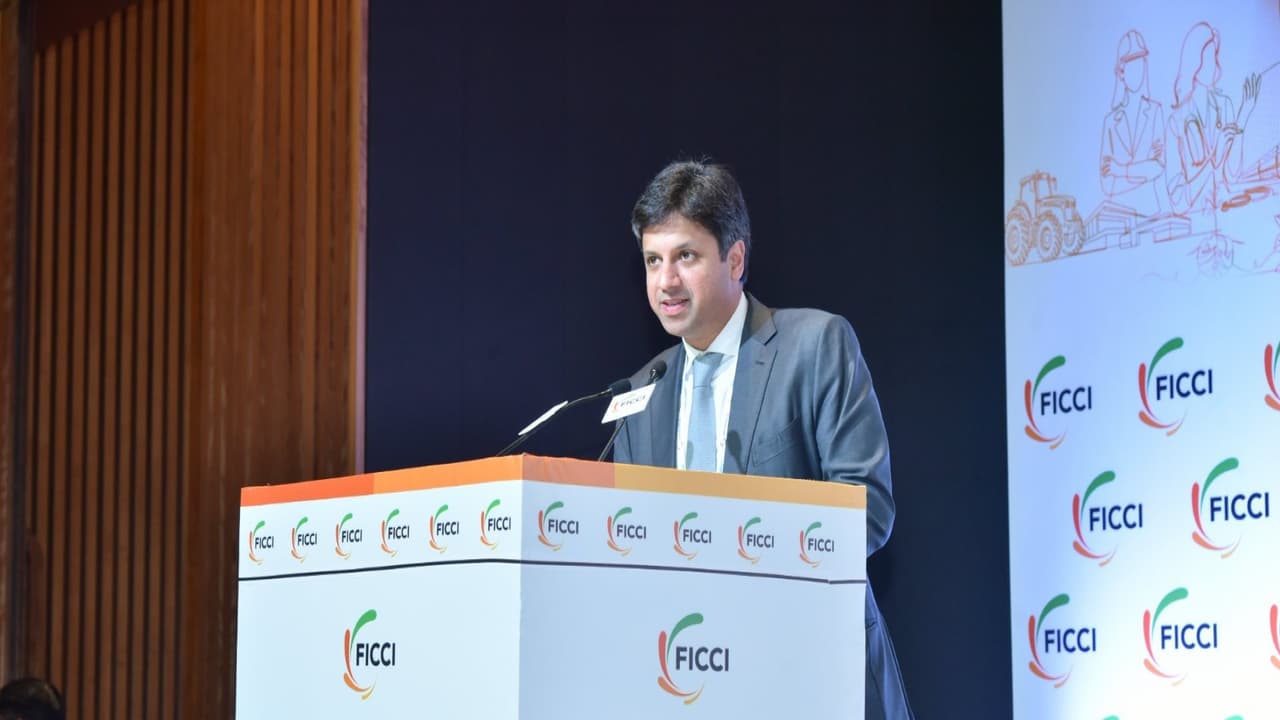
The Indian Rupee’s depreciation is temporary and will reverse after a trade deal with the US, says FICCI President Anant Goenka. The deal, described as nearly complete, is expected to boost trade and provide relief to key industrial sectors.
Rupee Depreciation Temporary, Reversal Hinges on US Deal
The Indian Rupee’s recent depreciation against the dollar is temporary and will reverse once India concludes a trade agreement with the United States (US), according to Anant Goenka, Vice Chairman of RPG Group and President of the Federation of Indian Chambers of Commerce and Industry (FICCI).
In an exclusive interview, Goenka attributed the currency weakness to a widening current account deficit stemming from trade challenges with the US, coupled with foreign portfolio investment outflows. “I believe, hopefully an agreement is on the anvil. Once that happens, I think we can see the rupee strengthening again,” Goenka said. “There is an immediate depreciation of the rupee that has happened, but I would not worry about it, and I think things should bounce back once an agreement is done with the US.”
India-US Trade Deal Nears Completion
Goenka expressed optimism about the ongoing bilateral trade negotiations between India and the United States, describing the deal as nearly complete. He noted that US Commerce Secretary recently addressed FICCI’s 98th Annual General Meeting, suggesting substantial progress has been made.
“The US is India’s largest trading partner. Both of us are strong, large democracies, and to that extent, I think both are inclined towards having a strong, positive, mutually beneficial relationship,” he said. “A large part of the negotiations seem to be concluded. It is now a matter of the final steps and signing that has to be done.”
Boost for Key Sectors
The FICCI chief said the trade deal is expected to provide significant relief to sectors that have faced challenges, including garments, marine products, and gems and jewelry industries. He emphasized that concluding the agreement would eliminate uncertainty and strengthen trade dynamics across Indian industry.
India’s Broader FTA Strategy
Beyond the US deal, Goenka highlighted India’s growing network of free trade agreements, pointing to recent pacts with the United Arab Emirates and Australia as examples of increasing utilization and traction.
Looking ahead, he identified two major agreements expected within the next quarter: the US trade deal and a Free Trade Agreement with the European Union. These are anticipated to have substantial impact on Indian trade.
Comprehensive Agreements Beyond Tariffs
Goenka emphasized that India’s recent FTAs are far more comprehensive than traditional trade agreements, extending beyond tariff reductions to encompass multiple dimensions of economic cooperation.
“It’s not just tariff reduction. It goes on to copyright law monitoring systems for making sure that the FTA is effective, people movement and so on,” he explained. “The comprehensiveness is much deeper in terms of strengthening relationships and trade between the two countries.” (ANI)
(Except for the headline, this story has not been edited by Asianet Newsable English staff and is published from a syndicated feed.)