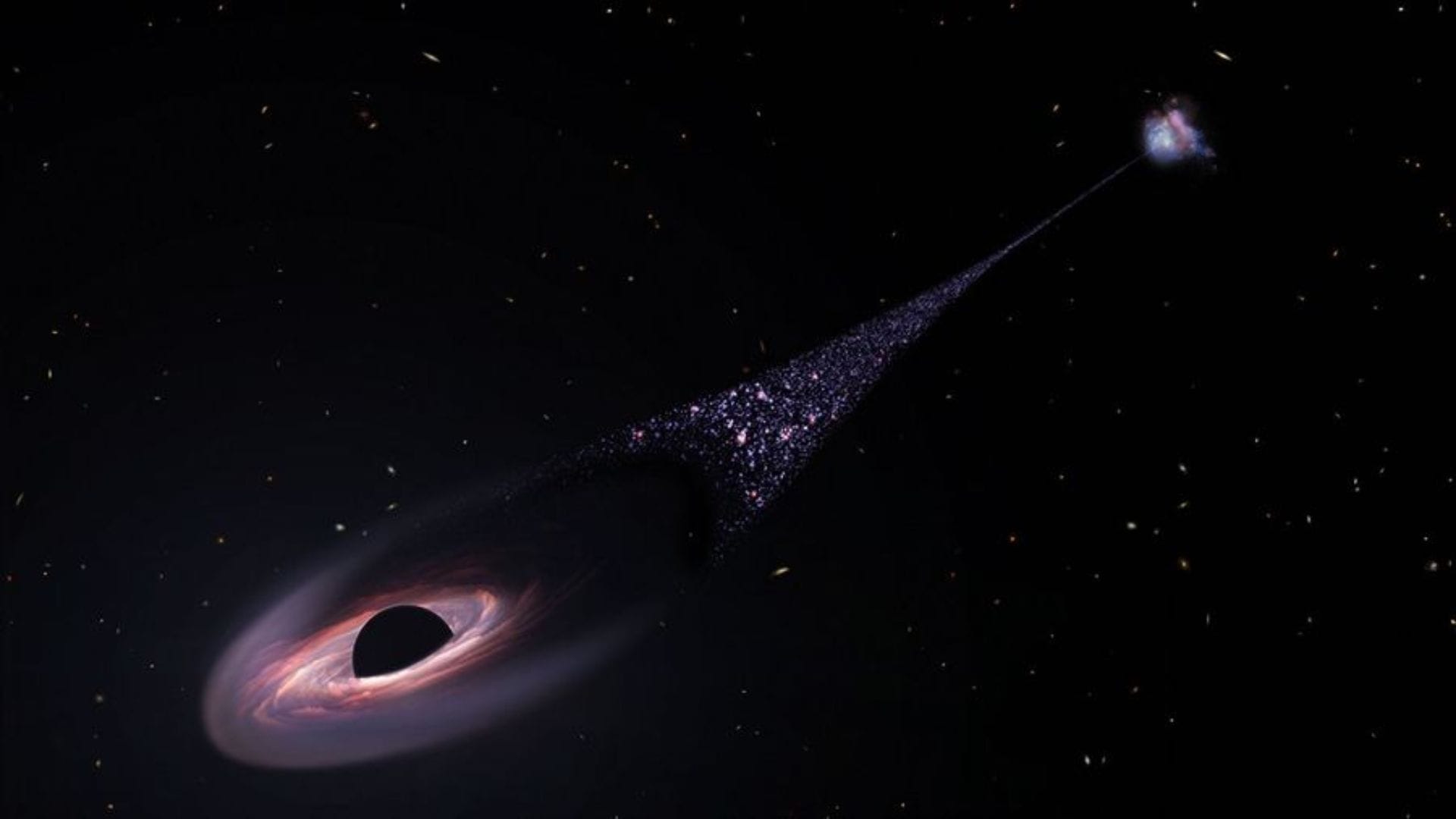
New Delhi: In 2023, the Hubble Space Telescope captured a mysterious streak across the sky, that appeared to be a runaway black hole, leaving behind a trail of newly formed stars. Although some scientists suggested it may just be an edge-on galaxy, recent observations have confirmed that runaway black holes exist, and may be ejected from their host galaxies during interactions between galaxies. The wake of star formation was 200,00 light years long, indicating that the black hole contained 10 million times the mass of the Sun, and was moving at nearly 1,000 kmps. Another runaway black hole discovered is in the galaxy designated as NGC3627, spans 25,000 lightyears, contains about two million solar masses and is traveling at 300 kmps.
These discoveries align with gravitational wave detections that indicated that pairs of black holes could produce powerful directional kicks, as well as scientific theory. Theoretical predictions based on general relativity equations on spinning black holes had previously indicated the existence of such objects. These objects store about 29 per cent of their mass as rotational energy that are released during interactions. When two spinning black holes merge, gravitational waves can be emitted more strongly in one direction, rocketing the newly formed black hole in the opposite direction, at speeds up to 3,000 kmps. Traveling at one per cent the speed of light, these black holes would cut straight through galaxies, rather than following curved stellar orbits.
There may be smaller runaways
Smaller black holes are not detectable in current technologies, but are also probably ejected at similar speeds, and travel between galaxies. Gravitational wave data indicates that the black holes involved in at least some mergers have opposing spins required for such strong directional kicks. While supermassive black holes disrupt entire galaxies, smaller black holes could pass through systems such as ours, altering planetary orbits with their intense gravitational influence. There is no cause for alarm though, the chances are slim. The Conversation has recently posted a scientist’s take on this phenomenon.