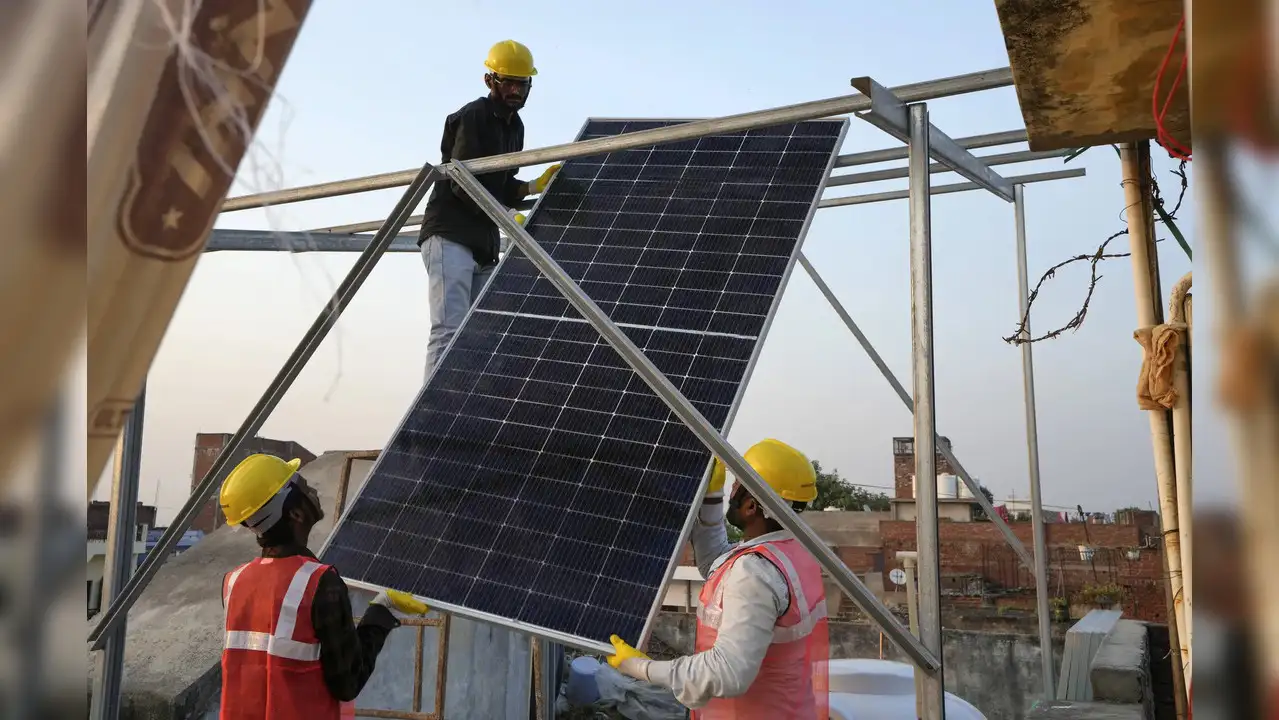
The central government has come up with new policy for solar panels pushing on domestic manufacturing but at the same time, it will end up costing you extra for the panels from June 1.
Under the new arrangement, solar projects connected through net-metering and open-access arrangements can use only domestically manufactured solar cells. The move will strengthen ecosystem and reduce dependence on imports, particularly from China.
For a better understanding, let us go through the whole process. Manufacturing of solar panels starts with polysilicon. This is further converted into ingots and wafers, and these wafers are then used to manufacture solar cells.
Further, multiple cells are assembled into a solar panel that consumers see on rooftops.
under the new rules, the cells inside those panels must come from government-approved Indian manufacturers under the Approved List of Models and Manufacturers (ALMM) List-II framework.
According to estimates, could become around Rs 3,000 per kilowatt expensive. These domestically manufactured cells cost significantly more than imported alternatives.
Hanish Gupta, Founder & Managing Director, Sunkind India Limited told Times Now Digital that the new mandate requiring domestically manufactured solar cells will increase solar panel costs in the near term.
“Solar cell manufacturing is highly capital-intensive, requiring investments of around ₹500 crore per GW and 18–24 months to establish. With technology evolving every few years, manufacturers must recover investments quickly, keeping costs elevated. Today, imported cells are available at around ₹5/Wp, while Indian cells cost ₹12–14/Wp due to limited domestic capacity and supply constraints. However, several new cell manufacturing facilities are under development, and increased competition is expected to gradually reduce costs over the coming years.”
Pawan Kumar Garg, founder and joint MD, Fujiyama Power Systems told Times Now, “While there may be some short term challenges related to cell availability and pricing, the long-term benefits far outweigh the transition concerns. The move is expected to boost demand for domestically produced solar cells and support the government’s vision of building a self-reliant and globally competitive solar industry while ensuring quality and energy security.”
Vinay Rustagi, Chief Business Officer, Premier Energies shared that the changes applies only to corporate projects, and residential projects will remain untouched.
“It is worth noting that this change applies only to corporate projects. Residential and solar pump installations were always required to use domestic cells. For the corporate projects, the net increase in project cost and power tariff is estimated at about 10% or less,” he said.