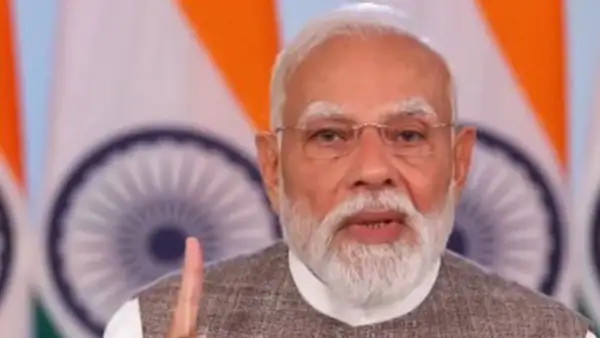
Prime Minister Narendra Modi on Sunday reaffirmed his government’s commitment to implementing women’s reservation, calling the “Nari Shakti Vandan Amendment” the “demand of the hour” and stating that his determination to fulfil the promise of women’s empowerment remained “invincible”.
In a video message posted on X, Modi said efforts to secure women’s representation in the country’s political system had been underway for decades, adding that he, too, had been striving to turn the long-standing demand into reality.
“The fight to give participation to Nari Shakti has been ongoing for decades. For years, I too was among those who were trying to have this in place. The pledge of BJP-NDA for women empowerment remains intact,” PM Modi said.
He further stressed that the national interest must always take precedence, asserting that prioritising political considerations over the broader interests of the country undermines both national interests and women’s empowerment.
“For us, national interest is supreme. But when, for a few people, party interest becomes everything, even greater than national interest, then women’s empowerment and national interest have to suffer,” he said.
Calling the proposed amendment the need of the hour, PM Modi said the government remained determined to fulfil its commitment to women.
“Nari Shakti Vandan Amendment is the demand of the hour. Our resolve is invincible. For the dreams of half the population, and for the future of our nation, we must fulfil this pledge!” he said.
The video message comes ahead of Parliament’s special sitting, scheduled to begin on November 30, during which the Centre is expected to introduce revised legislative proposals on delimitation and women’s reservation.
On Saturday, PM Modi had reaffirmed his government’s commitment to implementing women’s reservation, asserting that opposition from political parties would not derail the initiative. In a post on X, he said the government had made a commitment to women and was determined to honour it.
In the accompanying video, he said, “Women’s reservation is a fight I am fighting for a long time. Many women have raised this issue. I have the blessings of all women in the country. We will defeat every barrier in the way of this. All those parties who are opposing will never be able to stop the women’s reservation Bill.”
Union Home Minister Amit Shah had also said that the Union Cabinet’s approval of the Constitution (132nd Amendment) Bill, 2026, had brought the long-awaited implementation of women’s reservation a step closer.
The proposed legislative package includes the Constitution (132nd Amendment) Bill, 2026, the Delimitation (Second) Bill, 2026, and the Union Territories Laws (Amendment) Second Bill, 2026. The proposals aim to raise the maximum strength of the Lok Sabha to 850 members, with up to 815 representatives from states and 35 from Union Territories.
The Centre’s efforts to secure the two-thirds majority required to pass the constitutional amendment gained momentum after the Dravida Munnetra Kazhagam (DMK), Yuvajana Sramika Rythu Congress Party (YSRCP) and Nationalist Congress Party-Sharadchandra Pawar (NCP-SP) signalled support for the revised proposals, taking the NDA’s projected strength in the Lok Sabha to around 354 MPs.
The DMK, which has 22 Lok Sabha members, backed the proposed 50 per cent increase in parliamentary seats across states, while insisting that Tamil Nadu’s existing share of representation be safeguarded. The YSRCP also reaffirmed its support for the proposals, while the NCP-SP indicated that it would back the revised legislation.
However, Opposition parties have objected to linking women’s reservation with delimitation and called for the exercise to be based on the latest Census data.
Leader of Opposition in the Lok Sabha Rahul Gandhi has advocated implementing women’s reservation within the existing strength of 543 Lok Sabha seats, alongside an OBC sub-quota. He has also opposed the proposed expansion of the Lower House to 850 seats and called for delimitation to be carried out based on the 2027 Census.
Congress president Mallikarjun Kharge has also questioned the proposed delimitation exercise, expressing concerns over its potential implications for Scheduled Castes (SCs) and Scheduled Tribes (STs).