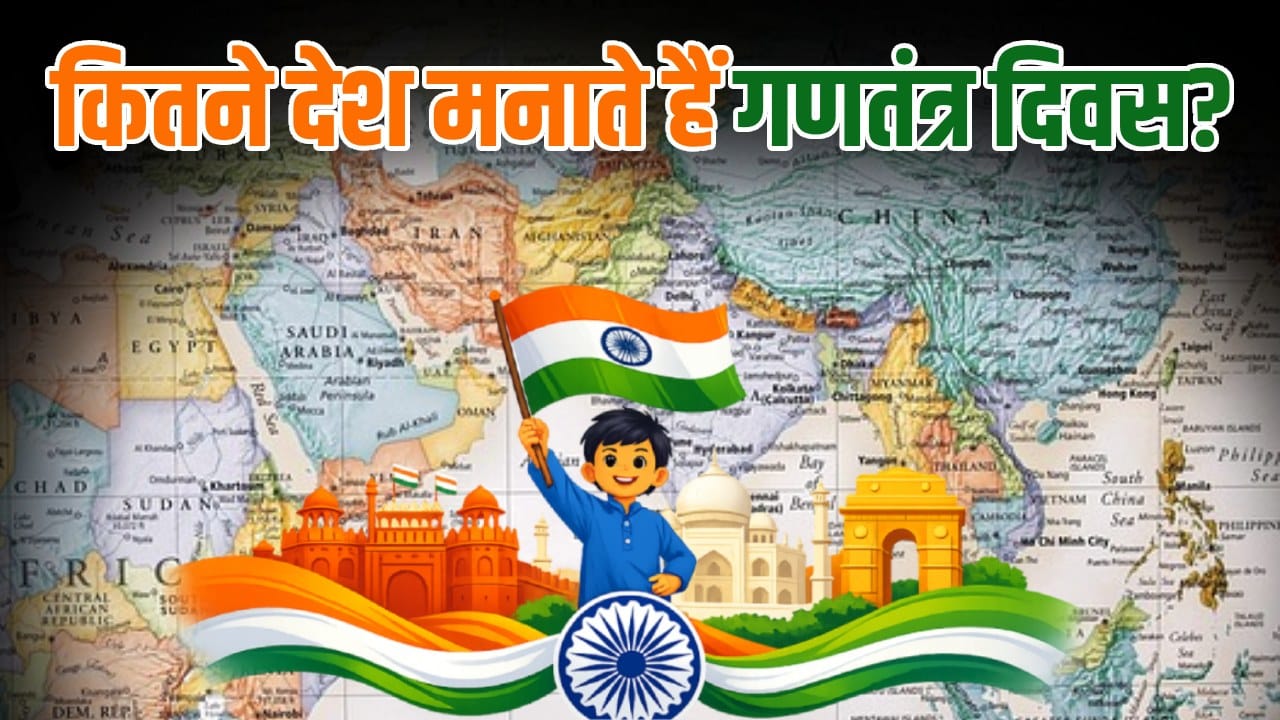
Republic Day is celebrated in many countries of the world, there are different reasons for it.
In India, 26 January is celebrated as Republic Day. It is not just a government holiday, but a celebration of the political idea in which the supreme position of the country is not determined by the authority of any dynasty, king or external power, but by the sovereignty of the people and the Constitution. This is the basic spirit of the republic, where the source of power is the people, and governance is carried out within the ambit of the Constitution and law.
Republic Day is celebrated in many countries of the world, but the reasons behind it are not the same in every country. Sometimes it is a symbol of the end of monarchy, somewhere of a new constitution after colonialism, somewhere of the establishment of a new nation after revolution, somewhere of a major change in the power system, like from monarchy to republic or from empire to republic. In many countries, it is celebrated with names like Constitution Day or Nation Day instead of Republic Day because for them the achievement of the Republic is linked to the making of the Constitution or change of regime.
Why is Republic Day celebrated in these countries?
Italy: from monarchy to republic by referendum
Italy’s Republic Day is celebrated on 2 June. Its basis is a historic referendum, in which Italy chose to abandon the monarchy and the path of the Republic. For Italy, this day shows that the legitimacy of the modern state comes from public consent, not from any dynastic authority. In such countries, Republic Day becomes a celebration of political maturity and civic decision.
Türkiye: from empire to modern republic
Republic Day of Türkiye is celebrated on 29 October, which marks the formation of the modern Republic of Türkiye replacing the Ottoman Empire. Here, Republic Day tells the story of the transition from an imperialist/dynastic structure to a modern nation-state, where administrative, legal and civil institutions were redefined.
Portugal: end of monarchy and political change
Republic Day is celebrated in Portugal on 5 October. This day is associated with the historical change of end of monarchy and establishment of the republic. In such countries, Republic Day marks a move towards political accountability rather than hereditary transfer of power.
Nepal: Declaration of people-based state after monarchy
Nepal’s Republic Day is celebrated on 28 May. This day is associated with the end of monarchy in Nepal and the declaration of a federal democratic republic. In the context of Nepal, Republic Day does not just mean a change in the head of government, but also a change in the nature of the state, where the discussion of power structure, representation and civil rights comes to the centre.
Iran: New identity as Islamic Republic
April 1 is celebrated as Islamic Republic Day in Iran. This day symbolizes the political-religious change after which Iran declared its new governance system as a republic. Here, Republic Day is an indication that the model of the Republic is not the same everywhere—in some countries it is also linked to a religion-based or ideological framework. That is, the basic element of a republic is the absence of hereditary power, but the institutional form may differ from country to country.
Brazil: Declaration of Republic from Monarchy
Republic Proclamation Day is celebrated on 15 November in Brazil. It commemorates the proclamation of the Republic in place of the Monarchy. The history of republic-establishment in many countries of Latin America has been linked to state-building, military-political changes and new constitutional arrangements in the post-colonial era. Therefore, Republic Day there is often also the political story of the birth of the state.
South Africa: historical date of becoming a republic
In South Africa, May 31 was once celebrated as Republic Day. There were changes in the national calendar and symbols in later times, but this example shows that Republic Day often changes with political transitions. Because nations reorganize their memories and priorities over time. Now Freedom Day is celebrated here on 27th April. Because apartheid ended on this day in 1994. And on 31 May 1961, this country got independence from the British Raj.
Main reasons to celebrate Republic Day in the world
1- End of monarchy and establishment of people’s sovereignty: In many countries, Republic Day commemorates the historical moment when the power of kings or emperors ended and citizen-based governance was established.
2- Implementation of the new constitutional system: In some countries, the most concrete sign of becoming a republic is the new constitution—which sets out civil rights, institutions, and the separation of powers. Therefore, Republic Day is actually the day of implementation of the Constitution.
3- Political rebirth after revolution i.e. mass movement: When the power structure changes after a revolution, rebellion or major mass movement, Republic Day strengthens the legitimacy and memory of that change.
4- New sovereign identity by coming out of foreign domination: Many countries became independent, but became republics later—when they left the foreign Emperor/King/Queen or Dominion system as the head of state and chose their own republic. In such countries, Republic Day becomes a sign of complete sovereignty.
5- Public celebration of national unity and civic identity: The parade, flag hoisting, oath, felicitation ceremony—all these make Republic Day a civic festival, where the country reaffirms its faith in its Constitution and civic institutions.
Meaning of Republic Day in India
India became independent on 15 August 1947, but became a republic with the implementation of the Constitution on 26 January 1950. That is, the basis of governance was not the colonial law or the power of any emperor, but the Constitution of India. Therefore, Republic Day in India is a celebration of democracy as well as constitutionalism—where rights, duties, institutions and limits of power are fixed in writing. This day reminds us that nation is not just a geography but a relationship between citizens and law.
Why not Republic Day in many countries, but Constitution Day?
In some countries, the moment of becoming a republic is not remembered by any one name, Republic Day, but by the date of implementation of the Constitution. That’s why they celebrate Constitution Day. Its message is that the real backbone of the republic is the Constitution, which limits power and guarantees civil rights. Many countries in this category celebrate the anniversaries of their constitutional documents as national civic festivals. Even if their National Day is related to some other historical event.
The essence of Republic Day lies in the citizen, not the state.
If we understand the global meaning of Republic Day in one sentence, it is that the master of governance is not any dynasty, dictator or external power, but the citizens and their constitution and law. This message becomes even clearer for India. Freedom is not just a change of power; Being a republic means constitutional rights, accountability of institutions, equality before law and responsibility of governance towards the people. That is why different countries celebrate Republic Day according to their respective history, somewhere it symbolizes the end of monarchy, somewhere revolution, somewhere constitution-making, and somewhere the rebirth of national identity.
Also read: Where do satellites that lose their way in space go, do they fall back to Earth? Question raised from ISRO mission