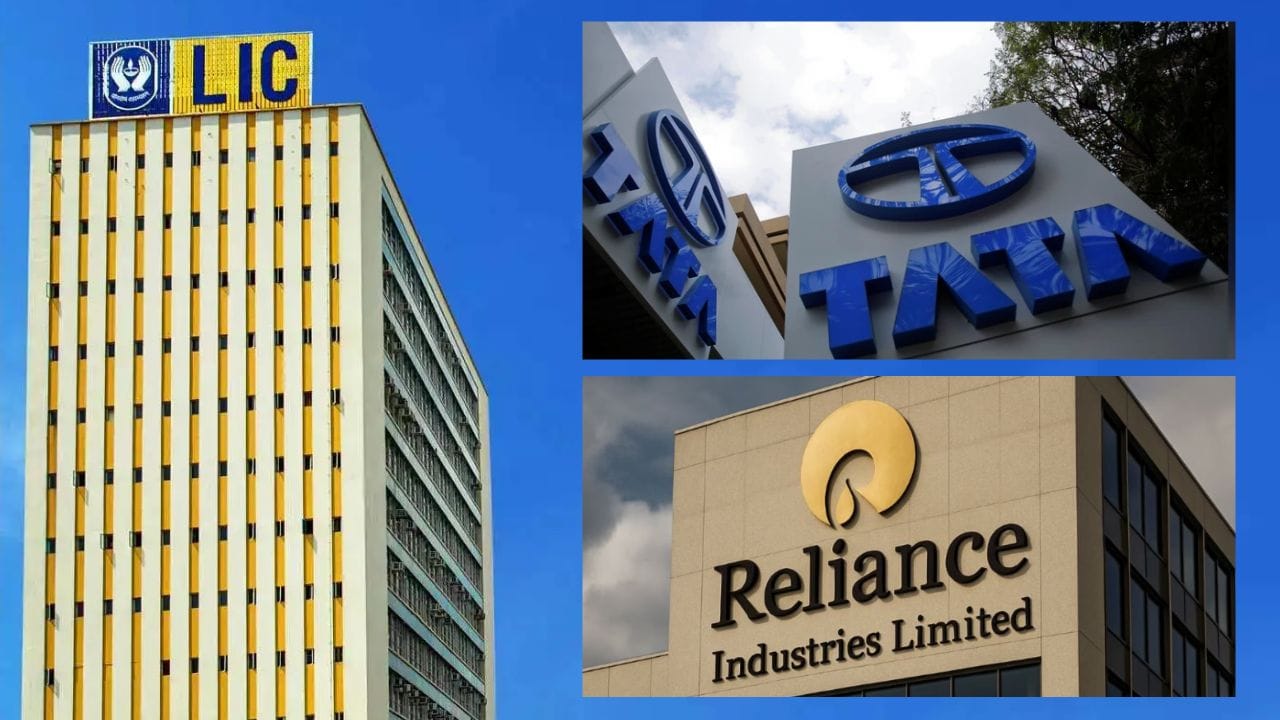
According to the information given to Parliament on Tuesday, Life Insurance Corporation of India (LIC) has made the maximum investment of Rs 88,404 crore in Tata Group, followed by Rs 80,843 crore in HDFC Bank and Rs 60,065.56 crore in Reliance Group. This means that LIC’s investment in Reliance, the country’s largest company, is less than that of Tata. Minister of State for Finance Pankaj Chaudhary said in a written reply in the Rajya Sabha that LIC has invested Rs 47,633.78 crore in Adani Group and Rs 46,621.76 crore in SBI. He said that there are 35 domestic companies or groups in which LIC has invested more than Rs 5,000 crore, with a total investment of Rs 7.87 lakh crore.
LIC invests in 35 companies
The minister shared the list of business groups in which LIC’s combined investment is more than Rs 5,000 crore. This list includes L&T, Unilever, IDBI Bank, M&M and Aditya Birla. LIC has an investment of Rs 3.23 lakh crore in these top five groups, while its investment in total 35 companies is Rs 7.87 lakh crore. He further said that LIC has a board approved investment policy, which provides a comprehensive framework for any investment made by the investment department of the insurance company. He said that the Investment Committee, which is a sub-committee of the board and comprises the CEO & MD, MD and independent directors, takes all investment decisions related to equity and debt investments in the companies.
On what basis does LIC invest?
He said all investment operations follow ‘Standard Operating Procedure’ (SOP), which is approved by the investment committee and communicated to the board. This SOP is reviewed annually by LIC and amended as necessary to comply with regulatory requirements. He said that investment decisions by LIC are taken after strict due diligence, risk valuation and fiduciary compliance.
These decisions are also governed by the provisions of the Insurance Act, 1938 as well as regulations issued from time to time by the Insurance Regulatory and Development Authority of India (IRDAI), Reserve Bank of India (RBI) and Securities and Exchange Board of India (SEBI) (wherever applicable). He also informed that by September 2025, LIC’s investment in seven sectors including cement, FMCG, ports and logistics and news and broadcasting was Rs 2,27,327.84 crore.
Answer on the question of fall in rupee
In response to another question, Chaudhary said that at present no proposal for agricultural loan is under consideration with the government. In a separate reply, Chaudhary said that various domestic and global factors like movement of the dollar index, trend of capital flows, level of interest rates, fluctuations in crude oil prices, current account deficit etc. influence the exchange rate of the Indian Rupee (INR). During the current financial year 2025-26, the prospects are impacted by a widening trade deficit due to rupee depreciation and ongoing developments in India’s trade agreement with the US, while providing relatively weak support from the capital account. He said that the fall in rupee is likely to increase export competitiveness, which will have a positive impact on the economy.
How is the economy affected?
On the other hand, he said that devaluation could increase the prices of imported goods; However, the overall impact of exchange rate devaluation on domestic prices depends on the extent to which international commodity prices impact the domestic market. He further said that imports in the economy depend on many factors, which include demand and supply of goods in the international market, type of tradable goods (i.e. essential or luxury goods), freight cost, availability of substitute goods etc. He further said that thus, the impact of exchange rate fluctuations on import costs, domestic inflation and the overall economy cannot be isolated. In response to another question, he said that the value of rupee is determined by the market, it has no target or specific level or limit.