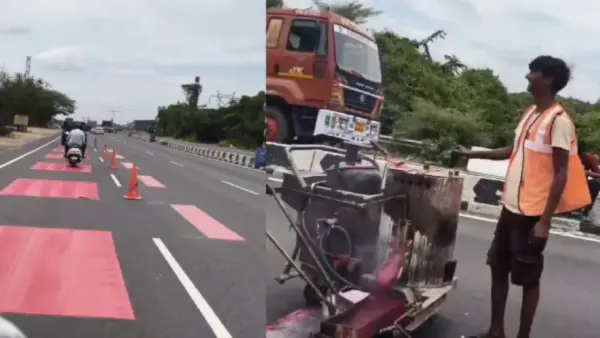
Commuters travelling on the Krishnagiri-Bengaluru National Highway may have come across bright red strips on some of the road’s accident-prone stretches.
These warning strips have been laid across the road to catch drivers’ attention, alert them that they are entering a danger zone and encourage them to reduce speed.
The highway is a busy link between Tamil Nadu and Karnataka, carrying a mix of cars, buses, trucks and other vehicles throughout the day. Traffic from Salem, Krishnagiri and other parts of Tamil Nadu also uses the same route to reach Bengaluru.
The red strips are made of thermoplastic material and work like rumble strips. When a vehicle goes over them, the tyres produce a vibration and a noticeable rumbling sound. That gives drivers a warning that they are approaching a section where they need to be more careful.
The colour is another part of the warning. The red surface stands out against the road and is easier to notice, especially in low-light conditions. So even if a motorist misses a signboard on the side of the road, the strips can serve as a second warning.
There is also another reason for this red mark warning on this route. Highways in the region have witnessed several serious crashes over the years.
Delhi Rains Red Alert: IMD Issues Heavy Rainfall Alert, Air Quality Improved; Mercury Dips
The Union Ministry of Road Transport and Highways has identified 551 black spots on national highways in Karnataka. The Thoppur Ghat section, in particular, has been a long-standing concern for highway authorities.
More than 200 people have reportedly died in crashes on the stretch in the past three years, according to figures cited in official and highway safety discussions. Over a longer period, the section has seen around 1,500 accidents and nearly 260 deaths. The terrain adds to the challenge. The road passes through the Thoppur and Barigam reserve forest areas, where motorists also have to deal with curves, slopes and changing visibility.
An estimated 60,000 to 70,000 vehicles use the route every day. With so many vehicles, including heavy trucks and buses, even a small mistake can have serious consequences.
The red road warnings is therefore intended to make drivers take their foot off the accelerator as they approach these stretches. They may also help in areas where vehicles and wildlife could come into contact.
While rumble strips can help alert drivers, their effectiveness depends on how well they are installed. If they are too high, uneven or poorly placed, they can create problems of their own, especially for two-wheelers.
Madhya Pradesh was the first state to try this road safety measure, with the aim of protecting wildlife along busy road stretches. The idea is to make drivers more cautious and encourage them to slow down in areas where animals often cross.
The National Highways Authority of India (NHAI) introduced the red road markings on the Jabalpur-Bhopal stretch as part of the experiment. The bright markings are designed to catch motorists’ attention and act as a visual warning to slow down, particularly in areas where wildlife movement is common.
The same basic idea is now being used on accident-prone sections of the Krishnagiri-Bengaluru highway – make the warning visible on the road itself rather than relying only on roadside signs.