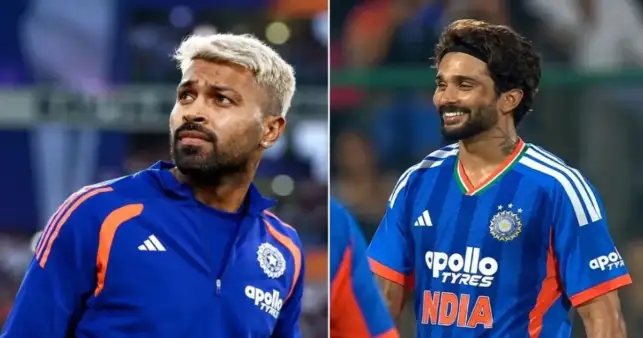
India’s search for a reliable seam-bowling all-rounder has increasingly brought Nitish Kumar Reddy into focus, particularly as the team looks beyond Hardik Pandya for a player capable of contributing with both bat and ball.
Reddy has already shown promise in white-ball cricket, but his long-term development could depend heavily on how seriously he pursues red-ball bowling. Rather than following the path taken by Pandya, Reddy could benefit from building a stronger foundation in first-class cricket and developing the workload required to become a dependable fast-bowling option. There is a long-established process involved in developing into a high-quality fast bowler. The careers of players such as Wasim Akram, Kapil Dev and Shoaib Akhtar underline the importance of sustained workloads, physical conditioning and repeated exposure to longer spells.
Fast bowling is particularly demanding on the body, and learning to maintain pace, movement and accuracy over extended periods cannot be replicated entirely through limited-overs cricket. For a young all-rounder, red-ball cricket can therefore provide an important testing ground for both technique and endurance. Pandya’s career illustrates some of the challenges involved in maintaining the demands of fast bowling while also carrying the responsibilities of a batting all-rounder. The India star has been largely absent from Test cricket for several years and has increasingly focused on white-ball formats, particularly T20 cricket. Injuries and rehabilitation have repeatedly interrupted his international career, making his availability difficult to predict across extended periods.
His absence has also left India looking for alternative players who can provide balance without being overly dependent on a single all-rounder. Reddy offers some of the qualities India have been seeking. He can contribute useful runs in the middle order while also providing seam-bowling options, giving the team greater flexibility when selecting its combination. However, becoming a genuine long-term fast-bowling all-rounder requires more than the ability to bowl a few overs in limited-overs cricket. The physical demands increase substantially when a bowler is expected to deliver sustained spells, return for multiple spells and contribute consistently across several days of a Test match.
That makes red-ball cricket particularly important for Reddy’s development. First-class matches can expose technical weaknesses that may remain hidden in shorter formats while forcing a bowler to manage workload, recovery and changing conditions. They can also help an all-rounder understand how to construct spells, use the crease, create pressure through sustained accuracy and make adjustments as the pitch and ball change. Those experiences are difficult to reproduce in T20 cricket, where the emphasis is on short, high-intensity spells. India therefore have a potentially important decision to make with Reddy. The temptation with a promising young all-rounder is to maximise immediate white-ball value, particularly in an era in which T20 cricket dominates the calendar.
But protecting his long-term development could require giving him sufficient opportunities in domestic and international red-ball cricket. If he is able to build the physical durability and bowling skills required at that level, his value to India could extend well beyond the shortest format. For Reddy, the objective should not necessarily be to become another Hardik Pandya. Pandya’s career has followed its own trajectory, shaped by injuries, workload management and the demands of international cricket. Reddy can instead establish a different route, one built around developing his bowling through sustained red-ball exposure before taking on a heavier workload at the international level. If that process is managed carefully, India could develop an all-rounder capable of offering genuine balance across formats rather than another player whose bowling is restricted by physical limitations.