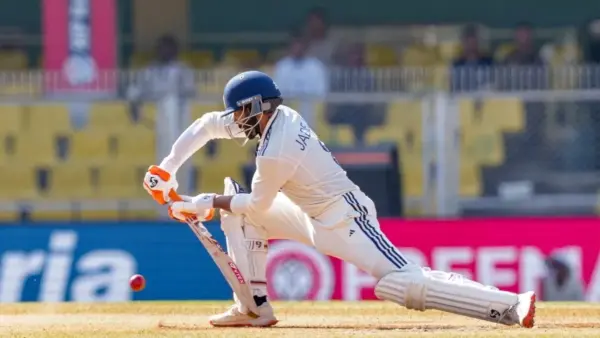
When Cheteshwar Pujara played his final Test for India in the 2023 World Test Championship final against Australia, the biggest question was how the team would compensate for the departure of one of its most dependable middle-order batters.
More than three years into the transition, however, India’s numbers tell a different story. Rather than finding a like-for-like replacement for Pujara, India have gradually divided his responsibilities among several players.
Shubman Gill has emerged as the dominant run-scorer during this period, while Rishabh Pant has supplied explosive counter-attacking ability. But another statistic stands out: among the established middle-order batters in the dataset, Ravindra Jadeja owns the best batting average.
Gill dominates the run charts, but Jadeja tops the averages
Since Pujara’s final Test, India’s batters operating in the No.3 to No.6 range have produced markedly different returns. Gill has been the clear leader in terms of volume, while Jadeja has been remarkably efficient despite receiving considerably fewer opportunities.
| Batter | Matches | Innings | Runs | Average | Best |
|---|---|---|---|---|---|
| Shubman Gill | 25 | 31 | 2,048 | 52.51 | 269 |
| Rishabh Pant | 17 | 31 | 1,286 | 42.86 | 134 |
| Ravindra Jadeja | 16 | 19 | 801 | 53.40 | 112 |
| Virat Kohli | 14 | 25 | 751 | 32.65 | 121 |
| Sai Sudharsan | 7 | 12 | 383 | 31.91 | 87 |
| KL Rahul | 7 | 12 | 363 | 33.00 | 101 |
| Sarfaraz Khan | 6 | 9 | 362 | 45.25 | 150 |
| Dhruv Jurel | 6 | 9 | 221 | 27.62 | 125 |
| Devdutt Padikkal | 2 | 3 | 90 | 30.00 | 65 |
Gill’s 2,048 runs put him comfortably ahead of everyone else. His tally is 762 runs more than Pant’s 1,286, underlining just how consistently he has occupied a central position in India’s batting line-up.
However, the average column produces a fascinating twist. Jadeja’s 53.40 is the highest among the batters listed, narrowly ahead of Gill’s 52.51.
Jadeja’s smaller sample makes his numbers even more interesting
The raw run tally does not fully capture Jadeja’s contribution. He has accumulated his 801 runs in only 19 innings across 16 Tests.
| Batter | Innings | Runs | Runs per Innings | Average |
|---|---|---|---|---|
| Shubman Gill | 31 | 2,048 | 66.06 | 52.51 |
| Rishabh Pant | 31 | 1,286 | 41.48 | 42.86 |
| Ravindra Jadeja | 19 | 801 | 42.16 | 53.40 |
| Virat Kohli | 25 | 751 | 30.04 | 32.65 |
| Sarfaraz Khan | 9 | 362 | 40.22 | 45.25 |
Jadeja’s importance becomes clearer when his opportunities are considered. Unlike Gill and Pant, he has not consistently occupied a specialist top-four batting position. He has often entered the game later, frequently with the responsibility of extending India’s innings while also carrying a major workload as a bowler.
His batting average therefore provides a useful measure of how effectively he has converted those opportunities into runs.
Gill did not simply replace Pujara
It would be tempting to label Gill as Pujara’s successor, but that description misses the broader change in India’s batting philosophy.
Pujara was traditionally associated with patience, prolonged occupation of the crease and attritional Test batting. Gill, by contrast, has brought a more positive scoring approach to the No.3 position.
His 2,048 runs show that he has taken over the responsibility of producing a substantial share of India’s middle-order runs, but without attempting to reproduce Pujara’s exact method.
In effect, India have changed the role rather than simply filling the vacancy.
Pant remains India’s other major pillar
Rishabh Pant’s 1,286 runs at 42.86 place him second behind Gill in total runs during the period. His average is below both Gill and Jadeja, but averages alone do not explain Pant’s value.
Pant’s greatest contribution has often been his ability to alter the direction of a Test match quickly. His aggressive approach allows India to recover momentum even when the batting side is under significant pressure.
That makes him a natural complement to Gill’s run accumulation and Jadeja’s efficiency. The three batters offer distinctly different methods of scoring runs.
| Batter | Primary contribution | Runs | Average |
|---|---|---|---|
| Shubman Gill | Volume and consistency | 2,048 | 52.51 |
| Rishabh Pant | Counter-attacking impact | 1,286 | 42.86 |
| Ravindra Jadeja | Efficiency and all-round value | 801 | 53.40 |
Kohli’s figures represent a transitional phase
Virat Kohli’s 751 runs at 32.65 form part of the same statistical period, but his figures need to be interpreted differently from those of the current generation.
Kohli retired from Test cricket in May 2025, meaning his numbers are now primarily useful as a marker of India’s transition rather than as an indication of a current selection battle.
His departure, following Pujara’s exit, meant India lost two hugely experienced components of their Test middle order within a relatively short period.
Yet the team’s batting structure continued to evolve rather than collapse around the loss of those veterans.
Sarfaraz’s numbers raise another question
Sarfaraz Khan offers one of the more interesting statistical contrasts in the group. His 362 runs may appear modest, but he has averaged 45.25 in nine innings.
That is comfortably higher than the averages recorded by Pant, Kohli, Sai Sudharsan, KL Rahul, Jurel and Padikkal in this dataset.
The issue for Sarfaraz has therefore been less about what he has produced when selected and more about the limited number of opportunities available to him.
India have redistributed Pujara’s responsibilities
The broader picture is more revealing than any individual statistic.
| Role | Player | Key statistic |
|---|---|---|
| Run volume | Shubman Gill | 2,048 runs |
| Counter-attacking impact | Rishabh Pant | 1,286 runs |
| Batting efficiency | Ravindra Jadeja | 53.40 average |
| Productivity in limited opportunities | Sarfaraz Khan | 45.25 average |
| Next-generation depth | Sai Sudharsan, Dhruv Jurel, Devdutt Padikkal | Developing sample |
This is perhaps the clearest indication that India have not attempted to find another Pujara. Instead, the team has gradually built a middle order in which different players perform different functions.
The Jadeja paradox
Jadeja’s 801 runs are easy to overlook beside Gill’s enormous 2,048-run tally and Pant’s 1,286.
But the average tells another story.
At 53.40, Jadeja has been India’s most efficient established middle-order batter in the dataset. His number is even more striking because batting is only one part of his responsibility. He is also expected to operate as a frontline spinner and provide India with additional depth in the lower half of the order.
That combination makes his batting output particularly valuable. India are effectively receiving specialist-level batting returns from a player who also performs a major role with the ball.
Post-Pujara India: A different kind of middle order
The statistical evidence points towards a fundamental change in India’s Test batting structure.
Gill has taken responsibility for the bulk of the runs. Pant supplies a different tempo and the ability to attack when India need momentum. Jadeja has quietly delivered the best average among the established middle-order batters. Sarfaraz has shown encouraging efficiency despite a smaller sample.
Rather than searching for one batter to replicate Pujara’s role, India have spread the workload across multiple players.
| Category | Leader | Figure |
|---|---|---|
| Most runs | Shubman Gill | 2,048 |
| Second-most runs | Rishabh Pant | 1,286 |
| Jadeja’s runs | Ravindra Jadeja | 801 |
| Best average | Ravindra Jadeja | 53.40 |
| Second-best average | Shubman Gill | 52.51 |
| Best average among other specialist batters | Sarfaraz Khan | 45.25 |