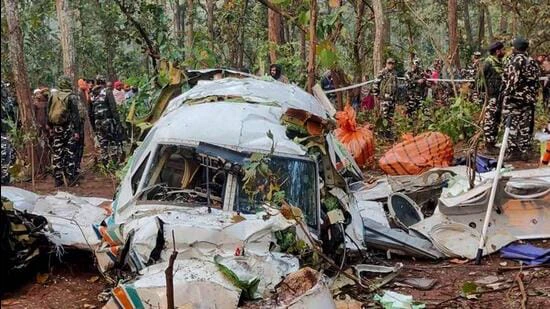
The aircraft that crashed near Jharkhand’s Ranchi killing all seven people on board was a 39-year-old Beechcraft aircraft with over 6,600 flying hours, officials aware of the matter told HT.
The seven seater aircraft crashed in Jharkhand’s Chatra district on February 23 night while operating a medical evacuation flight from Ranchi to Delhi.
Those killed included patient Sanjay Kumar, 41, a doctor, a paramedic, two attendants, pilot in command Vivek Vikash Bhagat, who had around 1,400 hours of flying experience, and first officer Savrajdeep Singh, with over 450 hours.
“Redbird Airways operated the aircraft, a Beechcraft C90A (King Air) twin-turboprop, registered VT-AJV that was manufactured in 1987 and had accumulated around 6,610 hours of airframe time at the time of the accident,” an official said.
“It was powered by P&W PT6A-21 engines and had logged around 2,900 hours on the left engine and 2,800 hours on the right engine,” he added.
“Both propellers had completed around 2500 hours each and its latest Airworthiness Review Certificate (ARC)was issued on January 21, this year and was valid for a year” another official said.
The aircraft departed Birsa Munda Airport in Ranchi at around 7:11pm for Delhi’s Indira Gandhi International Airport (IGIA).
According to a second official, the crew sought a weather deviation shortly after take-off.
“Communication and radar contact were lost approximately 23 minutes after departure. The aircraft later crashed in a forested area near Simaria in Chatra district,” he said.
The crashed aircraft’s maximum take-off weight was 4,583 kg and it did not have a black both ie. it did not have a cockpit voice recorder (CVR) and digital flight data recorder (DFDR).
“In this aircraft, CVR and FDR were not installed as per CAR (civil aviation requirement). The first Certificate of Airworthiness (C of A) for the aircraft was issued in 1987. There was no mandatory regulatory requirement for installation of a CVR or FDR at the time of its original certification,” another official said.
Regulation provision for FDR, as per CAR, (Section-2, Series I, Part V, para 4.1.2) which states about General Aviation planes states, “All multi-engined turbine powered aeroplanes of a maximum certificated take-off mass of 5700kg or less for which the individual certificate of airworthiness is first issued on or after 1st January, 1990, should be equipped with an FDR which should record at least the first 16 parameters listed in Table 1 of Appendix I”.