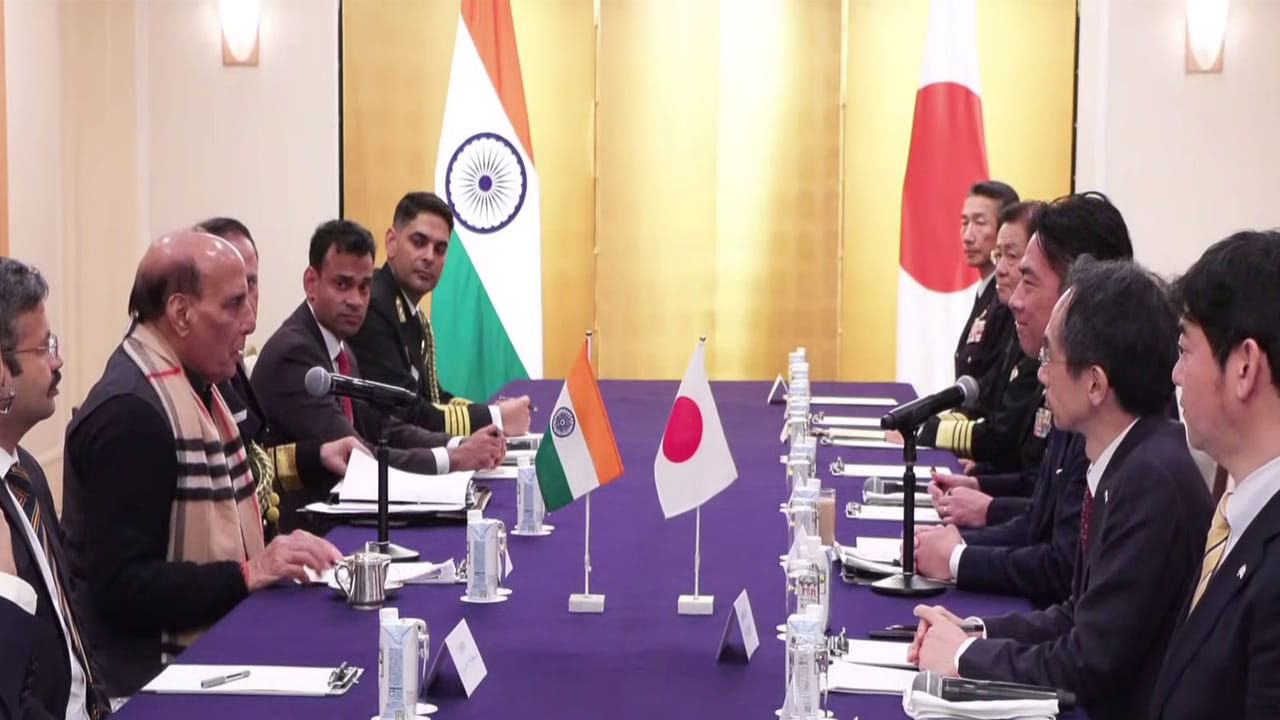
Defence Minister Rajnath Singh visited Tokyo to discuss enhanced military collaboration with Japan, advocating for joint manufacturing, naval technology development, and stronger strategic ties across the Indo-Pacific region for future growth.
Tokyo [Japan], November 19 (ANI): Defence Minister Rajnath Singh on Thursday called for greater joint development, manufacturing and long-term technological partnerships between India and Japan, highlighting their complementary strengths in naval shipbuilding, unmanned systems and advanced defence technologies.
Singh made the remarks during his bilateral talks with Japanese Defence Minister Shinjiro Koizumi in Tokyo, where the two sides discussed expanding defence and security cooperation. Singh said he was pleased with the momentum achieved in India-Japan defence relations and noted that several avenues of cooperation had progressed following Koizumi’s visit to India in August.
“I’m pleased to meet you again in the last two days, we have met several times and I really believe that this is a great coincidence for us. The warmth with which you welcomed me and my delegation yesterday, along with our joint visit to the Yokosuka naval base located in your constituency, reflects the importance you attach to India-Japan relations,” Singh said.
Thanking Koizumi for his hospitality, Singh described defence and security cooperation as an increasingly important pillar of the bilateral relationship. He highlighted recent milestones, including the conduct of the Defence Industry Forum and the meeting of the Joint Working Group on Defence Equipment and Technology Cooperation in Tokyo.
As India and Japan approach the 75th anniversary of the establishment of diplomatic relations in 2027, Singh said the occasion presented an opportunity to add new dimensions to their partnership. “There is considerable potential in naval ship building, unmanned and autonomous systems, advanced defence technologies and the wider defence industrial ecosystem. I believe India and Japan have complementary strengths. We should be looking increasingly at joint development, manufacturing and long-term technological partnerships,” he said.
In a post on X, Singh described the fourth India-Japan 2+2 Ministerial Dialogue as productive and said both countries had reaffirmed their Special Strategic and Global Partnership and shared commitment to a free, open and rules-based Indo-Pacific. “Productive discussions at the 4th India-Japan 2+2 Ministerial Dialogue in Tokyo today alongside Foreign Minister Toshimitsu Motegi, EAM@DrSJaishankarand Japanese Defence Minister@shinjirokoiz. Reaffirmed our Special Strategic and Global Partnership and our shared commitment to a free, open, and rules-based Indo-Pacific,” Singh said.
During the 2+2 dialogue, India and Japan reviewed their growing defence and security partnership in line with the Joint Declaration on Security Cooperation signed in August 2025. Singh highlighted the first-ever participation of Japan Air Self-Defense Force fighter aircraft in the bilateral air exercise Veer Guardian 2026, held in India, and welcomed the third India-Japan Defence Industry Forum in Tokyo on October 13.
On maritime cooperation, the two sides agreed to accelerate implementation of their recently signed Memorandum of Arrangement, covering maritime and air domain awareness, search and rescue operations, and information sharing. They also discussed an early conclusion of an arrangement for reciprocal access to ship repair facilities and agreed to enhance cooperation in mine countermeasure capabilities. Singh further called for the early conclusion of agreements related to UNICORN, the bilateral initiative for co-developing stealth naval mast technology, and emphasised expanding defence industrial cooperation under the framework of “Design with Japan, Make in India”. The two countries also agreed to accelerate cooperation in niche, underwater and missile technologies. The ministers exchanged views on regional and global developments and emphasised the need for peaceful resolution of disputes in accordance with international law. (ANI)