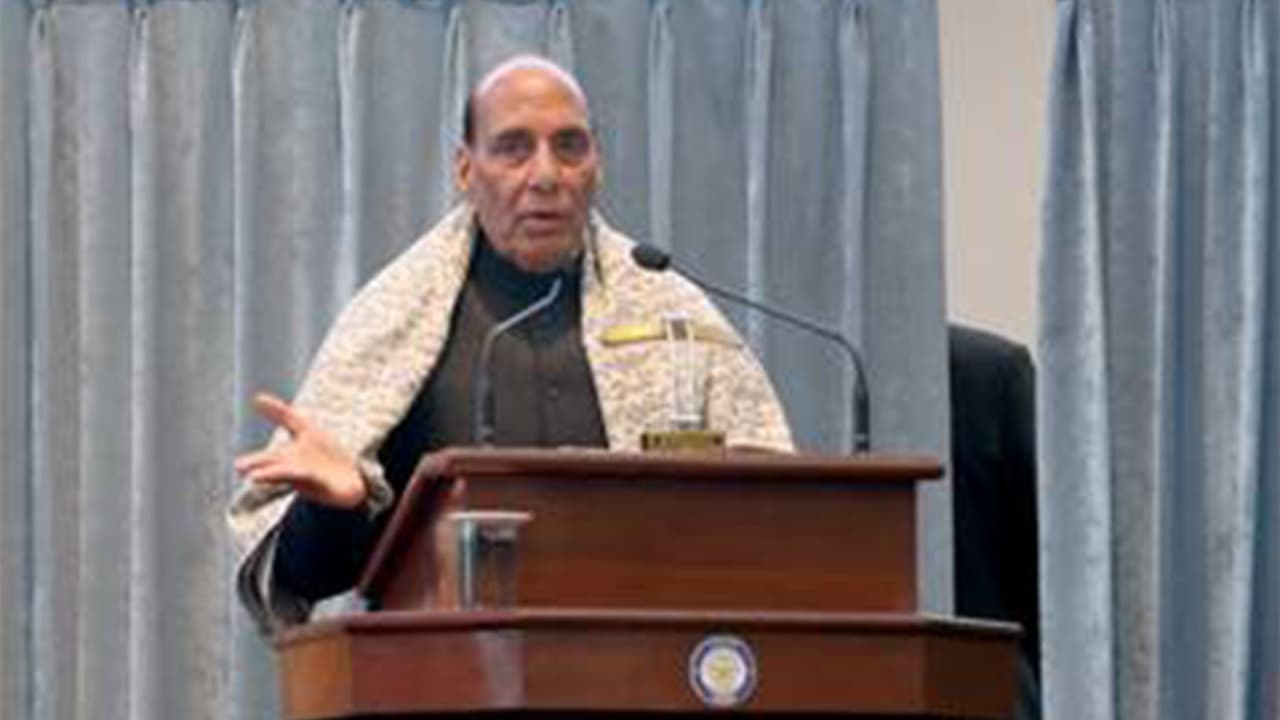
Defence Minister Rajnath Singh hailed DRDO’s role in India’s self-reliance, highlighting Operation Sindoor’s success. He urged scientists to innovate, reduce development time, and collaborate with industry to boost defence exports.
Defence Minister Rajnath Singh on Tuesday emphasised that Operation Sindoor demonstrated that indigenous systems are strengthening India’s operational readiness, as he commended the crucial role of Defence Research and Development Organisation (DRDO) in achieving self-reliance that has become a national mindset under the leadership of Prime Minister Narendra Modi.
Addressing the DRDO Best Performing Scientists and Technical Persons, who witnessed the 77th Republic Day Parade as Special Guests, Rajnath Singh stated that DRDO’s technology was effectively used on the battlefield during Operation Sindoor, and the R&D Organisation is playing a key role in the rapid transformation of the defence sector based on the indigenisation pursuit.
Focus on R&D and Innovation
As per the Ministry of Defence release, to stay ahead of the curve in the present technology-driven world, the Defence Minister stressed the need to focus on R&D, exhorting the DRDO scientists to think innovatively & quickly, while not being afraid of taking risks.
“Technology is changing rapidly. Any tech that is new today may become irrelevant in 4-5 years. Therefore, in today’s times, especially on the battlefield, we must move forward keeping in mind the theory of ‘survival of the fastest’ and not just ‘survival of the fittest’. The country that thinks, decides & deploys technology quickly stays ahead,” he said. Rajnath Singh urged the DRDO to move beyond the sectors where the private sector has already developed its capabilities, suggesting the creation of a separate wing within the organisation that takes risks in sectors where the chances of success may seem low. However, if success is achieved, it will be historic, he added.
Bridging Gaps and Fostering Collaboration
Underscoring the importance of reducing the time between research and prototype, prototype to testing, and testing to deployment, the Defence Minister asserted that “timely induction in the Armed Forces should be the biggest parameter of our performance”. He pointed out that the DRDO usually focuses on design and prototyping, and production is the role of industries, emphasising that it is necessary to bridge this gap.
He stated that, similar to international models, a co-development approach can be adopted, where the industry is involved from the early stages, from design to production. Calling upon the DRDO to collaborate extensively with public sector undertakings and the private sector, Rajnath Singh stated that the time has come to move beyond conventional areas. “For example, Light Combat Aircraft Tejas, which has emerged as a major achievement for us, is a testament to the knowledge sharing between DRDO and Hindustan Aeronautics Limited. Many more such achievements await us, but for that, it is essential that DRDO collaborates with academia and share knowledge with the public and private sectors. Government’s support will only be meaningful when DRDO moves away from a monopolistic R&D model to a collaborative ecosystem, and cooperates with the public sector, private industries, MSMEs, start-ups, and academia. Only then will we be able to make big strides towards an ‘Aatmanirbhar Bharat’,” he said.
Boosting Defence Exports and Future Vision
Defence Minister added that due to the Government’s self-reliance efforts, the defence exports, which were less than Rs 1,000 crore in 2014, have today increased to a record approx. Rs 24,000 crore, and stressed that there is a need to increase it further. “We have set a defence exports target of Rs 50,000 crore by 2029-30. DRDO should consider export markets right from the design stage of its systems, especially focusing on drones, radars, electronic warfare systems, and ammunition. Focusing on exports leads to cost recovery, builds global credibility, and strengthens strategic partnerships,” he said.
He exuded confidence that DRDO will play a significant role in building Viksit Bharat by 2047. Describing the scientists, engineers and technicians as the real strength of DRDO, Rajnath Singh underlined the need to provide them with the opportunities to learn, while also giving them leadership responsibilities and assurances that their ideas will be heard. “There are failures in research; we must learn from them,” he said.
DRDO Awards and Book Launch
The event was organised by the DRDO to honour dedicated scientists, technical experts, and innovators whose commitment, perseverance & excellence form the strong foundation of India’s defence capabilities. On the occasion, the Defence Minister distributed awards to the recipients of the DRDO Award Scheme 2024.
A book titled ‘The Unprecedented Success Story of the First Indigenous Supersonic Multi-Target Surface-to-Air Missile System – AKASH’ co-authored by Dr G Chandramouli, Padma, former Project Director of Akash and Dr Prahlada Ram Rao, Padma and first Project Director of Akash, was also released, which reflects the organisation’s research excellence, developmental strength, and strategic vision. The book chronicles the inspirational journey of the missile system – from conceptualisation to operational success. AKASH stands as a powerful symbol of DRDO’s scientific excellence and the spirit of Aatmanirbhar Bharat. (ANI)
(Except for the headline, this story has not been edited by Asianet Newsable English staff and is published from a syndicated feed.)