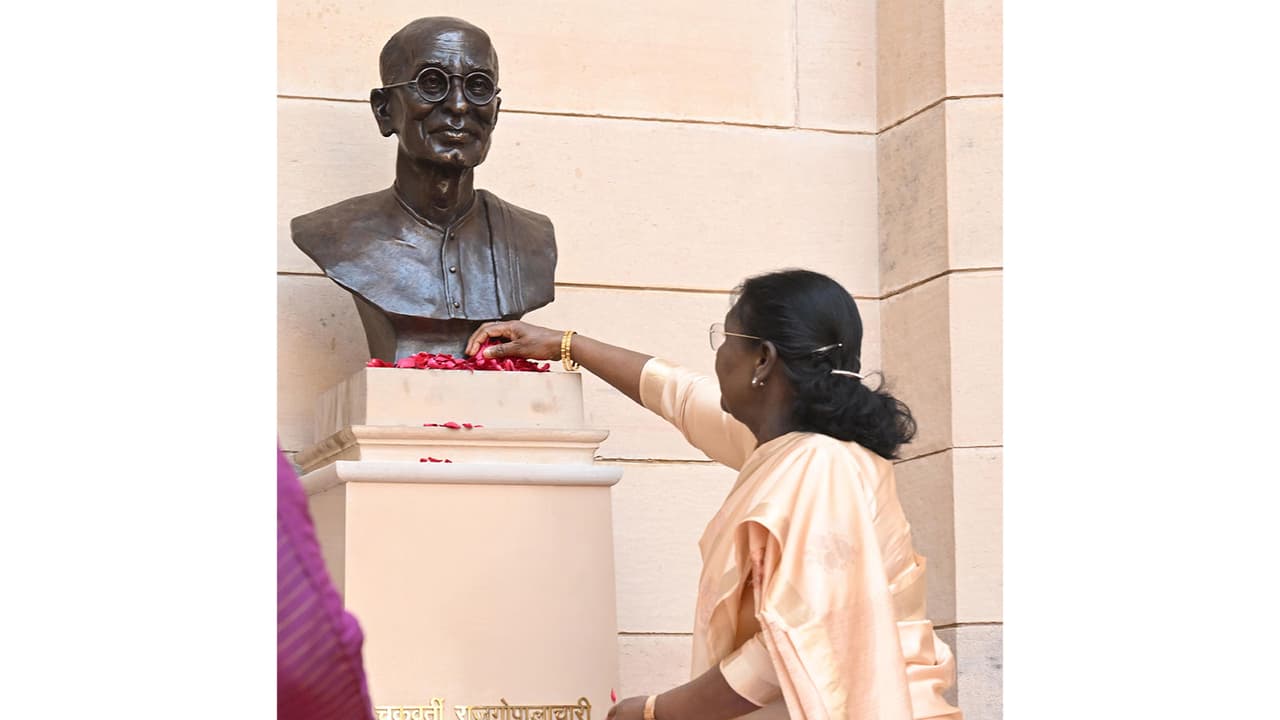
President Droupadi Murmu unveiled a bust of Chakravarti Rajagopalachari at Rashtrapati Bhavan, replacing one of Edwin Lutyens. This move is part of a national campaign to shed the ‘vestiges of the colonial mindset’.
President Droupadi Murmu on Monday unveiled the bust of Chakravarti Rajagopalachari, the first and only Indian Governor General of Independent India, at Rashtrapati Bhavan.
The bust of Rajagopalachari, at the Grand Open Staircase near Ashok Mandap opposite to the statue of Mahatma Gandhi, replaces the bust of Edwin Lutyens. This initiative is part of a series of steps being taken towards shedding “the vestiges of the colonial mindset”.
The President later attended Rajaji Utsav at Rashtrapati Bhavan Cultural Centre, where she took a round of the photo and book exhibition on his life and work. A film on the life of Rajaji was also shown.
The President and other dignitaries also witnessed cultural performances as part of the event.
President Murmu on Rajaji’s Ideals and Decolonization
Speaking on the occasion, the President said that when Rajaji arrived at the Government House (now known as Rashtrapati Bhavan), he placed portraits of Ramakrishna Paramahamsa and Mahatma Gandhi in his room. Rajaji sent a clear message that while India was formally still a Dominion, Swaraj had been fully established in the hearts of Indians. Rajaji set an inspiring example of mental decolonization, she said. His ideals are reflected in the national campaign adopted by the people of India to take pride in India’s heritage and eliminate the vestiges of colonial mindset. Indian consciousness and connection with all Indians, especially the weaker sections, are reflected in Rajaji’s thoughts and actions, the President noted.
She said that portraits of British imperial officials who exploited India were earlier hung in the corridors of Rashtrapati Bhavan. Now, the gallery called ‘Param Vir Dirgha’ is adorned with portraits of Param Vir Chakra awardees. The Granth Kutir has been established at Rashtrapati Bhavan to preserve the great tradition of knowledge accumulated in manuscripts and texts of India’s classical languages. The President said that Rashtrapati Bhavan is “Rashtra ka Bhavan” – it belongs to citizens of the country. Rashtrapati Bhavan and other President’s estates in Shimla, Hyderabad, and Dehradun have been opened to welcome all those who seek to know about the traditions of India’s democracy, and its rich cultural heritage.
The President said that during British rule, the people of India faced the calamity of famine and drought many times. Even in the post-independence era, the citizens faced food shortages. Out of compassion for fellow citizens and to inspire farmers, Rajaji initiated grain cultivation inside the Rashtrapati Bhavan complex. He even ploughed the field himself, setting an inspiring example.
The President said that Rajaji was gifted with multifaceted creativity and several dimensions. His contributions to the legal profession, freedom struggle, social and economic reforms, ancient Indian scriptures, Tamil and English writing, poetry and music, politics and governance greatly enriched these fields.
She underlined that the country’s emphasis on Swadeshi and Aatma-Nirbharata takes forward the idea of Swaraj as described by Rajaji.
The President said that as the country moves ahead towards making ‘Viksit Bharat’ by 2047, icons like Rajaji inspire people with their ideas and ideals. She urged all to resolve to promote the spirit of enterprise to fulfil the dreams of Rajaji. She expressed confidence that the people of India will continue to move forward with the spirit of “nation first,” inspired by Rajaji’s personality and work.
Vice President: A Milestone in Breaking Colonial Legacy
Addressing the gathering, the Vice President CP Radhakrishnan said that today by celebrating Rajaji Utsav, “we have achieved yet another milestone in our journey of breaking away from the colonial legacy”. The Vice President said that Rajaji Utsav is a celebration and rightful recognition of the great son of India. “Rajaji earned a distinguished place in India’s history. He was a man of remarkable brilliance. He consistently advocated economic freedom and believed that India’s economic policy to remain independent and liberal. His life reminds us that true greatness comes from not position or power but from inner refinement, moral strength and steadfast commitment to the values,” he said.
PM Modi: A Moment of Pride for India
Prime Minister Narendra Modi sent a message for the occasion which was read by Culture Minister Gajendra Singh Shekhawat. In his message, the Prime Minister said the unveiling of the bust of Chakravarti Rajagopalachari at the historic central courtyard of Rashtrapati Bhavan by the President is a moment of pride for the people of India. He said the close relationship that Rajaji shared with Mahatma Gandhi, marked by deep mutual trust and friendship, is well known. Therefore, it is fitting that Rajaji’s bust is being installed right opposite the statue of Mahatma Gandhi.
Further, the fact that Rajaji’s bust will be positioned where Edwin Lutyens’ bust used to stand is a crucial detail, making it an important act of mental decolonization, he said.
The Prime Minister said Rashtrapati Bhavan stands not as a seat of power, but as a visible embodiment of democratic self-confidence rooted in Indian civilisation. Initiatives such as the ‘Rajaji Utsav’ and the unveiling of a bust of Shri C. Rajagopalachari reinforce this direction, he said, adding that they honour leaders who shaped the nation “and remind us that freedom is sustained by celebrating their memory.”
The Prime Minister in his ‘Mann Ki Baat’ address on Sunday, said that the unveiling of bust of Rajaji is one of the steps towards removing vestiges of the colonial mindset. The exhibition on the life and work of Rajaji will be organised as part of Rajaji Utsav from February 24 to March 1, 2026, at Amrit Udyan. (ANI)
(Except for the headline, this story has not been edited by Asianet Newsable English staff and is published from a syndicated feed.)