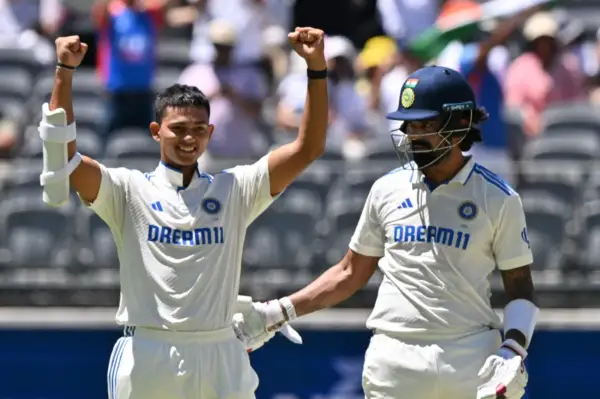
KL Rahul and Yashasvi Jaiswal have provided India with a dependable opening combination after the team experimented with 10 different partnerships over the past few years.
Their 130-run stand in the first Test against New Zealand at Wellington ended a 32-year wait for an Indian opening pair to register a century partnership in a Test match in the country. The partnership came at an important stage after New Zealand posted 368 in their first innings, putting India under pressure to respond. Rahul and Jaiswal negotiated the new ball before gradually taking control of the innings, combining patience with attacking strokeplay. Their contrasting approaches helped India finish the second day at 159 for one, trailing the hosts by 209 runs. The stand also offered encouragement to India’s team management as it continues to look for stability at the top of the batting order.
India’s opening combinations have undergone considerable changes since 2021, with the team trying different players depending on availability, form and the demands of individual series. Rohit Sharma, Rahul, Jaiswal, Shubman Gill, Mayank Agarwal and Cheteshwar Pujara have all featured in different opening arrangements during this period. The repeated changes reflected India’s search for a partnership capable of providing consistent starts in different conditions. While some combinations produced substantial runs, they were not always retained for extended periods. Rohit and Jaiswal, for instance, developed an effective partnership, while Rahul also had successful spells alongside other opening partners. However, retirements and changes in the team’s batting structure created opportunities for new combinations. With Rohit and Pujara having retired from Test cricket, Rahul and Jaiswal have emerged as an important option for India’s current batting line-up.
The 130-run partnership in Wellington was built through complementary batting styles. Rahul concentrated on defending the good deliveries, leaving balls outside off stump and preventing New Zealand’s fast bowlers from creating early breakthroughs. Jaiswal, meanwhile, used his range of strokes to put pressure on the bowlers without taking unnecessary risks. The left-hander scored 85 off 89 deliveries, including 16 boundaries, while Rahul remained unbeaten on 52 at the close of play. Jaiswal’s approach was particularly important after the opening overs, when Matt Henry and Kyle Jamieson found movement with the new ball. The openers initially struggled to score freely but gradually settled into their innings. Their understanding allowed Jaiswal to take the attacking role while Rahul maintained stability at the other end. Matt Henry eventually dismissed Jaiswal after New Zealand successfully reviewed a caught-behind appeal.
The partnership also reflected the importance of preparation ahead of the New Zealand series. Rahul and Jaiswal had spent time playing unofficial red-ball matches against New Zealand A before the Test assignment. The arrangement gave India’s specialist Test players an opportunity to become familiar with local conditions, including the movement and bounce available to fast bowlers. Their time in the middle helped them adjust to the challenges expected at the Basin Reserve. The preparation appeared particularly useful during the opening session of India’s innings, when the new ball created difficulties for both batters. Rather than attempting aggressive shots immediately, they focused on assessing the conditions and understanding the bowlers’ lengths. Jaiswal gradually increased the scoring rate, while Rahul continued to build his innings through controlled batting.
Rahul’s experience at the top of the order has also contributed to the partnership’s development. The senior batter has opened for India during different phases of his Test career and has previously produced important performances in overseas conditions. His ability to adjust his approach according to the match situation provides a contrast to Jaiswal’s naturally attacking style. The pair had already demonstrated their potential during the 2024-25 Border-Gavaskar Trophy in Australia, when they shared a 201-run opening partnership in Perth. That stand helped India recover after being dismissed for 150 in the first innings and contributed to their eventual victory. Their successful partnership in Wellington further strengthened the case for retaining the combination, particularly as India looks for reliable starts against quality fast-bowling attacks.
India’s 130-run opening stand was its first century partnership for the first wicket in a Test in New Zealand since Navjot Singh Sidhu and Nayan Mongia added 102 runs at Hamilton in March 1994. The highest opening partnership by an Indian pair in New Zealand remains the unbeaten 149 shared by Manoj Prabhakar and WV Raman in Auckland in February 1990. Rahul and Jaiswal’s effort in Wellington was therefore India’s second-highest opening stand in Test cricket in the country. While the partnership did not immediately erase the deficit against New Zealand, it gave the visitors a platform to build their innings. Its significance extended beyond the runs scored, offering India a combination of experience and attacking ability after several changes at the top of the order.