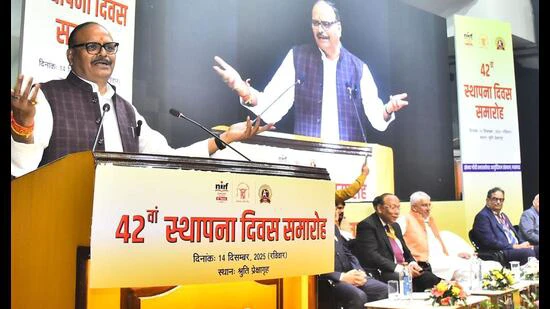
Asserting that the future of healthcare lies beyond conventional tertiary care, deputy chief minister Brajesh Pathak on Sunday announced that a state-of-the-art quaternary care centre would be established at the Sanjay Gandhi Postgraduate Institute of Medical Sciences (SGPGI) for the management of multi-organ failure.
The proposed centre will integrate advanced diagnostics, precision medicine, high-end critical care and specialised multidisciplinary expertise. A detailed proposal has been prepared and budgetary arrangements are underway, said Pathak, who also holds the health portfolio, while addressing the 42nd Foundation Day of SGPGI.
“Quaternary care represents the highest level of medical intervention, requiring cutting-edge technology, specialised manpower and advanced research integration. SGPGI’s recent academic, clinical and infrastructural progress reflects a long-term transformation into a national hub for advanced healthcare,” Pathak said, noting that many critically ill patients are referred to the institute after exhausting treatment options elsewhere.
To extend specialised expertise across Uttar Pradesh, Pathak said SGPGI would be connected to all government medical colleges through a hub-and-spoke model, enabling real-time specialist consultation and advanced decision-making closer to patients. Six medical colleges have already been integrated into the network, he added.
Critical care capacity is being significantly scaled up, with beds in the critical care medicine department increasing from 20 to 100. Emergency department capacity is also being doubled to support advanced life-saving interventions, Pathak said.
State minister Mayankeshwar Sharan Singh stressed the importance of transparent communication with patients regarding their conditions and treatment options. He also highlighted the need for improved remuneration for doctors to curb workforce migration, adding that the government is actively working on the issue.
National Medical Commission chairman Dr Abhijat Chandrakant Sheth said medical education is being redesigned to support advanced healthcare delivery, with greater emphasis on clinical exposure, hands-on training and innovation. The new framework, he said, would directly strengthen patient care in high-end medical settings.
SGPGI director prof Radha Krishna Dhiman said the institute is developing future-ready infrastructure to support quaternary care services. He announced that an advanced paediatric centre would become operational by October 2026, bringing 24 departments under one roof with a total capacity of 575 beds. The first phase will include 14 departments with 310 beds.
The institute currently has 43 functional departments, with new outpatient facilities under development. Dhiman said a centre for public health and epidemiology is also being set up to support evidence-based policymaking and community-focused research, while a clinical pharmacology centre is planned to strengthen drug evaluation, interdisciplinary research, and monitoring of drug safety and effectiveness.
He added that SGPGI is expanding the emergency medicine and renal transplant centre (EMRTC), a 558-bed facility comprising 200 emergency medicine beds, a 10-bed stroke unit and 348 beds dedicated to renal sciences. The institute has also operationalised an advanced diabetes centre offering comprehensive multidisciplinary care for complex cases, along with a newly launched fatty liver and obesity clinic. The institute also plans to establish a centre for artificial intelligence in healthcare to make healthcare delivery safer, faster, more accurate and scalable.