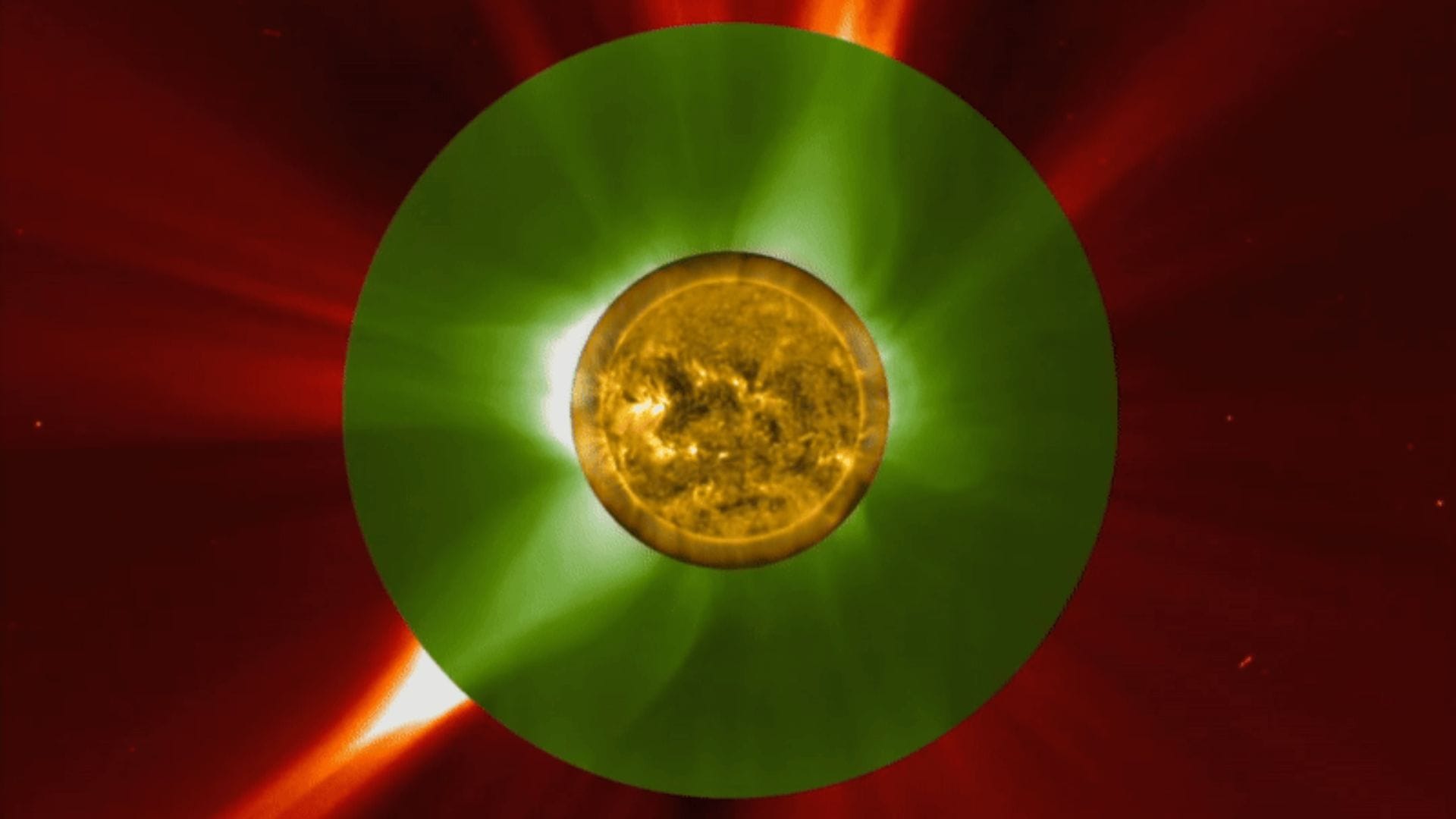
New Delhi: Proba-3 is an innovative heliophysics observatory that uses a pair of spacecraft flying in precise formation, an Occulter that blocks the visible disk of the Sun and the Coronagraph that observes the Solar Corona or outer atmosphere. The instrument cannot continuously observe the Sun like the heliophysics observatories deployed at the first Lagrange Point in the Sun-Earth System, with the formation flying limited to six hours in every orbit. Since its launch, the pair of satellites have created over 50 artificial solar eclipses, with hundreds of hours of observations filling in an observational gap in Sun telescopes.
Principle investigator of the ASPIICS coronagraph on board Proba-3, Andrei Zhukov from the Royal Observatory of Belgium says “You can see the CME forming at the edge of the solar disc, captured by Proba-2. It extends into the inner coronal region, which is now visible to us thanks to Proba-3, before reaching the high corona observed by SOHO. The continuity with which we can now observe the CME structure extend outwards from the Sun is incredible.” The Royal Observatory of Belgium hosts the Solar Influences Data Analysis Centre (SIDC), which is the ‘official’ space weather service provider for the world.
Better space weather forecasts
Proba-3 covers a critical gap between one and three solar radii, allowing heliophysicists to get a complete picture of coronal mass ejections erupting from the Sun. The capability allows for better measurements of the speed of the charged plasma clouds violently ejected from the Sun, improving the forecasts and potential impacts to the Earth and the orbital infrastructure surrounding it. Incidentally, the Aditya-L1 mission also covers the same gap. The inside-out Sun telescope was launched by ISRO’s PSLV-C59 mission in December last year.