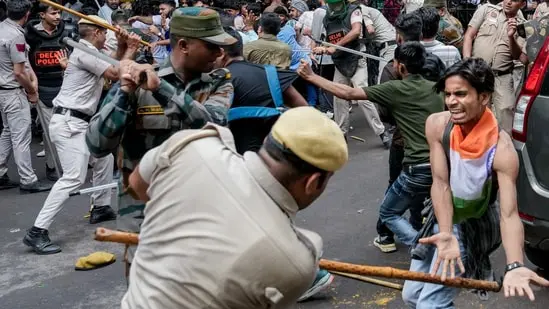
The Delhi High Court on Wednesday directed authorities to preserve CCTV footage, videography and all other relevant records related to the alleged police brutality during the Cockroach Janata Party’s protest in the national capital.
A bench comprising Chief Justice DK Upadhyaya and Justice Tejas Karia ordered that the material be preserved in accordance with the Standard Operating Procedure (SOP) issued by the Delhi Police or the Union government.
The court also sought responses from the Centre and the Delhi Police on the pleas, which seek an SIT investigation into the alleged excessive use of force, registration of FIRs against police personnel, production of deployment and operational records, and disciplinary action against officers involved.
The matter has been listed for hearing on September 11.
“Issue notice. In the meantime, we direct that the relevant record in relation to the incident as mentioned in the writ, including the CCTV footage, videography, if any, shall be preserved in accordance with the SOP issued by the Delhi Police or by the Union of India. List on 11.9,” the court said in its order.
Appearing for the petitioners, Senior Advocate N Hariharan argued that the protest began peacefully at Jantar Mantar but later witnessed “brutality of the largest measure possible”. He contended that no warning or whistle was given before force was used and alleged that the police action was disproportionate and retributive.
Hariharan further alleged that unarmed protesters were “beaten black and blue”, women protesters were molested and more than 90 people sustained injuries. He urged the court to direct registration of FIRs against identifiable officers and order an inquiry into the entire incident.
Senior Advocate Vikas Singh submitted that although the gathering had grown in size by July 20, it remained peaceful throughout and that the authorities themselves had not alleged that the assembly turned violent.
He alleged that police personnel, accompanied by several persons in civil clothes, attacked demonstrators without provocation and maintained that there was no allegation that protesters had resorted to violence.
Senior Advocate Gopal Sankaranarayanan argued that several individuals involved in the police action were not in uniform. He accused Additional DCP Sandeep Lamba of physically assaulting a woman standing on the sidelines and urged the court to summon the officer and hold him accountable. Referring to videos purportedly depicting the incident, he alleged indiscriminate use of tear gas, lathi-charge and physical assault, including against women, mothers and family members present at the protest.
He told the court that he had reviewed over 100 videos documenting alleged instances of excessive force and said judicial intervention was necessary to prevent such conduct from becoming normalised.
Police deny brutality claims
Opposing the petitions, the Delhi Police argued that the protest did not remain peaceful and that videos showed policemen being injured. Solicitor General Tushar Mehta appeared for the Centre, while Additional Solicitor General Chetan Sharma and Senior Advocate SV Raju opposed the pleas on behalf of the authorities.
Raju contended that the crowd had become unruly, resorted to violence and pelted stones at police personnel. He argued that persons alleging cognisable offences should approach the Magistrate under the available legal remedies, including Section 156(3), and claimed that the petitions were based on selective social media videos while suppressing material facts.
Describing the pleas as “publicity-seeking petitions”, Raju submitted that the injured persons themselves had not approached the court and argued that the petitions did not warrant issuance of notice.
The bench, however, observed that the matter was “not an isolated individual incident”. It remarked that if it had been an isolated occurrence, the police’s contention that the aggrieved persons could pursue private complaints before the Magistrate may have been justified.