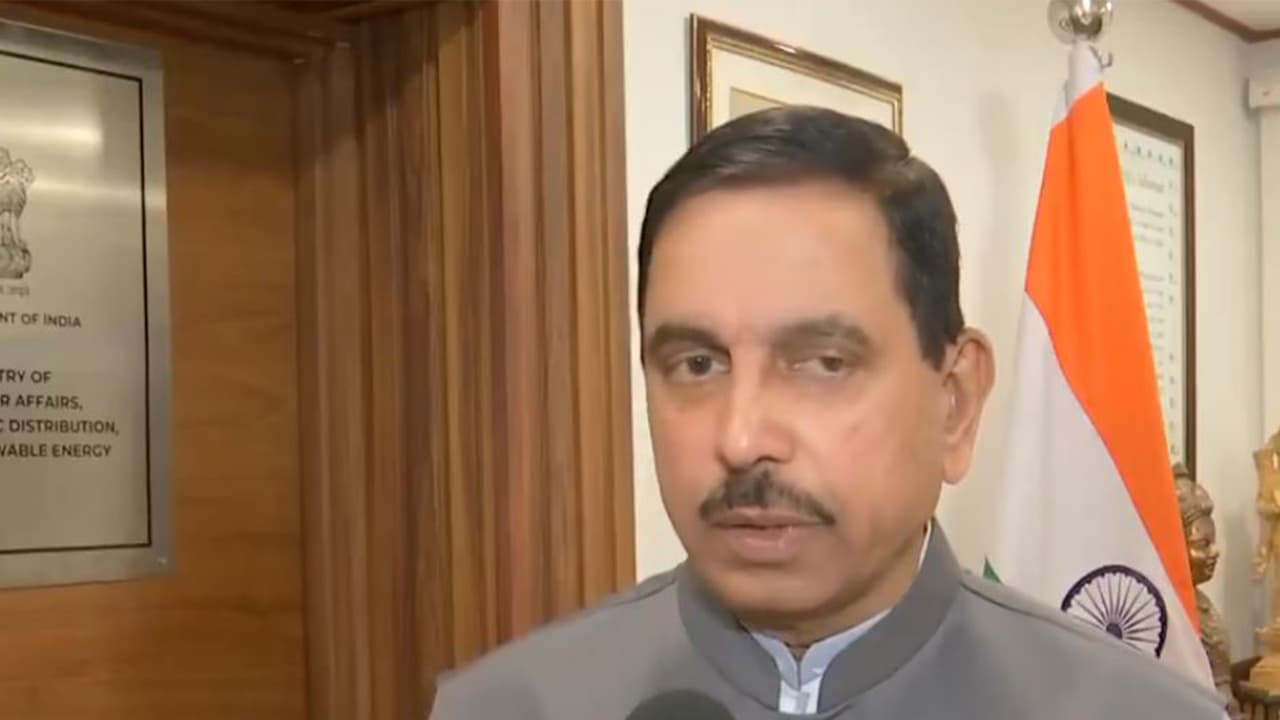
Union Minister Pralhad Joshi rejected Karnataka’s claims of excessive ethanol blending in petrol as sensationalist, affirming that OMC tests confirm compliance with standards and highlighting the program’s massive economic benefits for farmers.
Union Minister Counters Ethanol Allegations
Union Minister Pralhad Joshi has strongly countered Karnataka Minister Arshad over allegations of excessive ethanol blending in petrol, terming the claims a “classic case of choosing sensationalism over responsible governance.” Refuting assertions that petrol in the state contained 26 to 31 per cent ethanol, Joshi asserted that extensive official testing conducted by Oil Marketing Companies (OMCs) found all fuel samples fully compliant with the prescribed 19 to 21 per cent E20 standards.
“Instead of creating alarm through unverified claims of 26–31% ethanol in petrol, the Minister should have first examined the official test results. All 893 samples tested across 27 States and UTs complied with the prescribed 19–21% range. More importantly, all 56 samples tested in Karnataka by the OMCs were compliant, recording 19–20%, with an average of 19.30%,” Joshi posted on social media platform X.
Technical Discrepancies and Methodology
Questioning the methodology behind the tests cited by the Karnataka government, the Union Minister highlighted severe technical discrepancies and lack of standardisation. “The Karnataka certificates state only ‘Ethanol % by Gas Chromatography’. They do not mention the test method, calibration, dilution or reference sample,” Joshi pointed out.
Detailing the physical properties of the fuel tested, Joshi noted: “The samples showing 26–31% ethanol content in Karnataka recorded densities of just 0.742–0.749 g/cc. In contrast, the samples tested by Oil Marketing Companies, which confirmed compliant E20 petrol, recorded higher densities of 0.752–0.760 g/cc. With more than 20% ethanol content, the density should have been much higher than that of E20 Petrol. However, it was not.”
The Union Minister further revealed that the testing was not carried out by accredited facilities: “Moreover, none of the labs that tested these samples were part of the approved Schedule 3 labs that are notified in the gazette. The deficiencies in its sampling procedure, retention samples and laboratory certification raise serious questions about the credibility of the measurement.”
Political Controversy and Economic Impact
Accusing the Congress party of political hypocrisy, Joshi pointed out that the ethanol blending initiative was originally launched during the UPA regime. “Is the Congress Government in Karnataka now opposed to the very ethanol programme that was started by them? In fact in 2005, the then Petroleum Minister Mani Shankar Aiyar had said that they want to increase ethanol blending, if ethanol availability improves. Now the same Congress is opposing it,” he said.
Highlighting the economic benefits delivered to sugarcane farmers, Joshi noted that since 2014–15, the Ethanol Blended Petrol (EBP) programme has facilitated over ₹1.66 lakh crore in direct payments to cultivators, improving mill liquidity and clearing 97 per cent of sugarcane dues for the 2025–26 season as of August 20, 2026.
Exposing what he termed a “fundamental contradiction” in the state government’s stance, Joshi pointed to Karnataka’s major role as a beneficiary of the programme. “In 2025–26, Karnataka distilleries were allocated 165.89 crore litres of ethanol, including 97.54 crore litres from sugarcane-based feedstocks. Of the 30 lakh metric tonnes of sugar diverted for ethanol across India, Karnataka alone accounted for 11.92 lakh metric tonnes as of August 31, 2026 — nearly 40% of the national diversion,” he noted. “If the Karnataka Government believes ethanol blending is detrimental to farmers, why does it seek greater ethanol allocation for its sugar industry?” Joshi asked.
Underlining the macroeconomic and environmental impact of the initiative, the Union Minister added that the programme has helped the country save over ₹1.97 lakh crore in foreign exchange, substitute nearly 316 lakh metric tonnes of crude oil imports, and cut carbon dioxide emissions by approximately 952 lakh metric tonnes. “The question is simple: Is the Karnataka Congress Government standing with its farmers, or is it putting political sensationalism ahead of their economic interests?” Joshi concluded.
Karnataka Government Response
Karnataka state minister Rizwan Arshad on Monday claimed that the oil marketing companies (OMCs) have avoided answering the fundamental question of how much ethanol they blended in petrol in their joint statement. Speaking to reporters, Arshad said the OMCs’ response to the state’s findings focused entirely on technical matters, asserting that the state government firmly stood by its test results showing blending of up to 31.2 per cent.
“They (OMCs) have avoided answering the core, fundamental question that we asked: how much did you blend? Did you blend E20 or higher than that?…The Karnataka government firmly stands by the tests we conducted and the results we brought before the public. We strongly maintain that our test results show that you blended ethanol up to E31.2,” he said.
He said the state used the same scientific testing methodology specified by the OMCs, adding that when the government approached the companies with 63 samples and sought the ethanol percentage, the results were not provided properly. “It was only then, out of compulsion, that we took the assistance of a third-party laboratory, one that is NABL-accredited and ISO-certified. The NABL accreditation agency itself is run by the Government of India,” he said. Arshad demanded that the Centre put in place a third-party testing system, citing a conflict of interest in the government testing its own fuel.
(Except for the headline, this story has not been edited by Asianetnews Editorial staff and is published from a syndicated feed.)