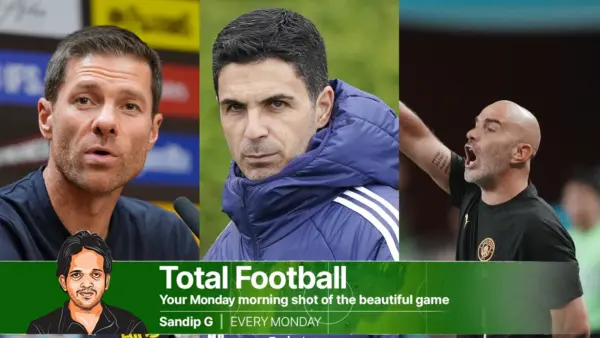
No player is bigger than the club; no manager is bigger than the league either. The Premier League has endured the departures of Sir Alex Ferguson and Arsene Wenger; Jurgen Klopp and the many iterations of Jose Mourinho.
So it will eventually reconcile with the departure of Pep Guardiola, even if Manchester City might or might not waddle through the post-Ferguson kind of apocalypse United suffers.
Little doubt that with Guardiola, the league would lose a slice of its identity, glitter, and even aura. The Premier League considerably owes its supremacy and pride to the Spaniard who remoulded the league with his ideals. It could be the most symbolic moment in the league since the arrival of Roman Abramovich and his bottomless coffers of petrodollars; it could be a season of flex and flux, renewal and regeneration, of an impressionable cast of managers, most of them worshippers of Guardiola, dreaming to be the next manager-idol, the next Guardiola. It would be a battle of wannabe superpower managers.
Even Mikel Arteta is in the race. He might be the most successful among the pile, yet he is without a halo that only sustained success and radical thinking could bestow.
Nine clubs have installed a new manager, the most sweeping churn since 1946-47, when the league resumed after WWII. Apart from the nine, there are two other managers who have been less than eight months into their tenures. United’s Michael Carrick was a caretaker last season, and Tottenham Hotspur’s Roberto de Zerbi was appointed in the dying months in a survival battle.
Therefore, it could be the most exciting season, for the confluence of distinct coaching philosophies and personalities, the proverbial waft of fresh air, the new hierarchy that would assume shape in the coming months, and their motives and motifs. It could be the most volatile one too, for the unpredictability of their methods and tenure, snap-judged on the successes and failures in the early months.
There are ample tales of caution, not least that ex-Liverpool manager, Arne Slot, fired the season after he landed the club the league title. The manager didn’t empathise with the stack of injuries, key players’ loss of form, or defections. Guardiola’s successor and former deputy Enzo Maresca’s hands had been burned at Chelsea, where his tenure lasted 18 months despite collecting Club World Cup, Conference League, and qualification for the Champions League in his first year. He would hope City’s management are more patient and benevolent.
Guardiola DNA
Among the pack, the shadows of Guardiola would spread most expansively on Maresca. He conforms to all the narratives that reassures fans. He understands the Guardiola-wired DNA of the club, he had guided the junior sides to League Two glory, and he was Guardiola’s accomplice during the treble-winning season. None of these would automatically guarantee City’s domination, but it would soothe fans, at least before the season starts and results stack up. He adheres to Guardiola’s possession-heavy style and positional play.
His Chelsea, like Guardiola’s City, saw one of the full-backs (both inverted) tuck inside to form a functional double pivot when attacking, so as to avoid transition and defend better when they lose the ball. But their pressing patterns are different, and Maresca is more unpredictable with his build-up shapes (as was Guardiola in the last two seasons). He is, sometimes condescendingly, called Diet Pep. He and City fans would be more than content if he lives up to his moniker. He has inherited a dynamic squad, annexed the highly-rated Elliot Anderson, but if Rodri departs, he would be pushed into rebuilding.
The most hyped arrival would be Xabi Alonso, not a romantic reunion with his former club Liverpool, but to the manager’s inferno that is Stamford Bridge. The Spaniard is the eleventh the London club has hired this half-a-decade alone. The squad, bolstered further by the Morgan Rogers’ acquisition, brims with talent. But the manager’s foremost task would be to build a coherent core from the oversized squad, to find a method amidst the madness that has swirled around the club, to strike the perfect note to make Chelsea competitors again. The midfield riches are shimmering, but in pursuit of rhyme or reason. He could make Chelsea champions again; he could be fired two months into his reign as well.
The most fascinating could be De Zerbi’s Spurs. A dynamic manager that transformed Brighton from the banal to beautiful, he saved Spurs from relegation. But his brief this time would be graver. Nothing less than a Champions League berth could gratify the management that had invested heavily in rebuilding the core squad with midfielders Sandro Tonali and Matheus Fernandes for a combined 185 million pounds. Add centre-back Jan Paul van Hecke (52 million), Andy Robertson and Marcos Senesi (on free transfers), Spurs have the quality to challenge for a Champions League spot. The aesthetics that come with de Zerbi’s style would just be an embellishment.
In a frantic reset has been Liverpool’s Andoni Iraola as well. Through much of the preseason, he had to do the integration without 14 members of his first-choice squad (either through injuries or post World Cup vacation). “It’s difficult to build a proper team with a lot of question marks,” he quipped during the pre-season in the US. His Bournemouth sides were rapid with their vertical raids and asphyxiated opponents with press. The full-backs went full pelt against opposition wingers and centre backs often occupied a daringly high line.
In short, five of the traditional top six stride into the new season with a new man at the helm. The superpower manager throne is vacant. Arteta stands the nearest for coronation. But there are others orchestrating his slip in the post-Guardiola era.